Climate Change Mitigation (AQA A-Level Geography): Revision Notes
📚Revision Notes
Climate change mitigation
Introduction to climate change mitigation
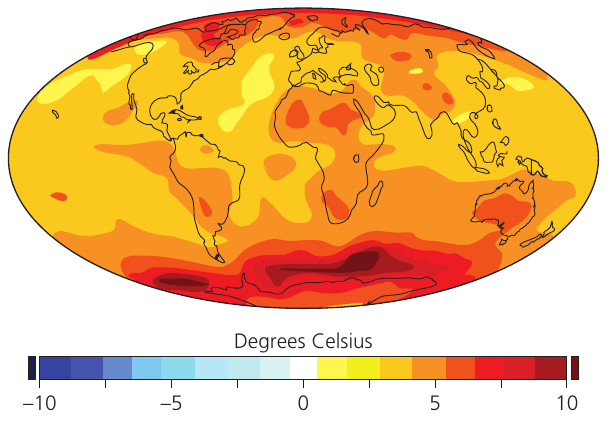
The Earth's climate is changing due to human activities that release greenhouse gases into the atmosphere. When we talk about climate change, we need to understand a key concept called radiative forcing.
Radiative forcing is the imbalance between incoming solar energy and outgoing infrared energy from Earth's surface. It is measured in watts per square metre ().
When this energy balance is disrupted, the planet either warms up or cools down. Before 1750, radiative forcing was negligible. However, since the Industrial Revolution, it has increased significantly due to greenhouse gas emissions and changes in land use that affect the Earth's reflectivity (albedo).
Important
The Intergovernmental Panel on Climate Change (IPCC) reports that current radiative forcing levels stand at 2.8 W/m² (with uncertainty ranging from 2.5 to 3.1 W/m²). If carbon dioxide levels continue rising at current rates, scientists predict the Earth will become substantially hotter, potentially melting much of the ice cover.
Water and carbon cycles and the atmosphere
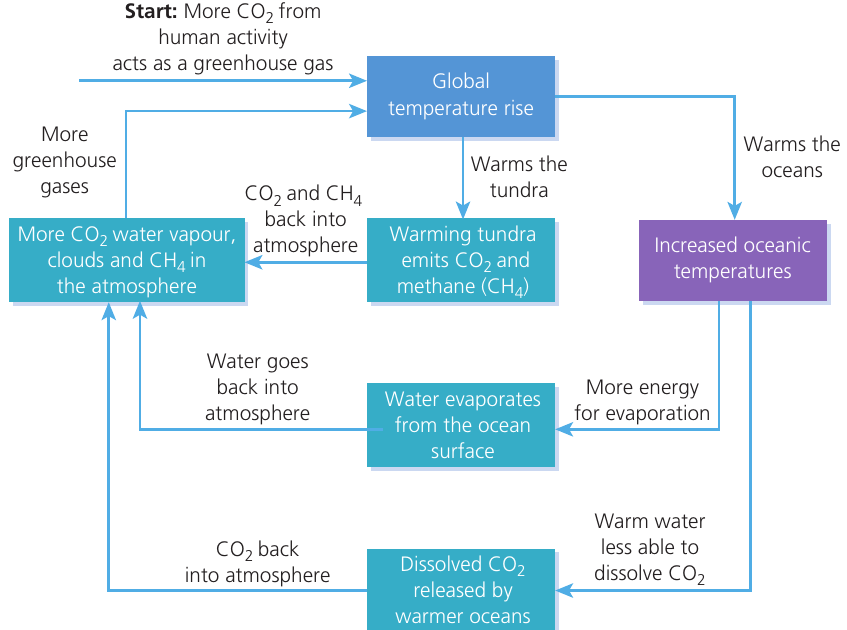
The relationship between water and carbon cycles creates a complex system that amplifies global warming through positive feedback mechanisms.
Carbon dioxide plays a crucial role in Earth's climate system. Whilst CO₂ contributes approximately 20% to the overall greenhouse effect, and water vapour accounts for about 50%, it is actually CO₂ that controls the temperature. This is because carbon dioxide levels determine how much water vapour can remain in the atmosphere, which in turn determines the magnitude of the enhanced greenhouse effect.
The positive feedback loop
When carbon dioxide concentrations increase in the atmosphere, several interconnected processes occur:
- Air temperatures rise due to enhanced greenhouse heating
- Oceans warm up as a result
- Warmer ocean water evaporates more readily, releasing additional water vapour into the atmosphere
- Water vapour itself is a powerful greenhouse gas, so this amplifies the warming effect
- Higher temperatures also warm the tundra regions
- Warming tundra releases both methane (CH₄) and additional CO₂ that were previously locked in frozen soils
- These extra greenhouse gases further increase atmospheric temperatures
- Warmer oceans become less able to dissolve CO₂, releasing previously dissolved carbon dioxide back into the atmosphere
Important
This creates a self-reinforcing cycle where initial warming triggers further warming. It's important to note that there is a time lag between the increase in CO₂ and the resulting temperature rise because oceans absorb heat slowly. Scientists estimate that Earth's temperature will increase by at least another 0.6°C due to carbon dioxide already present in the atmosphere.
Climate change mitigation strategies
Climate change mitigation refers to efforts aimed at reducing or preventing greenhouse gas emissions. There are numerous approaches to achieving this goal, which can be organised into several main categories.
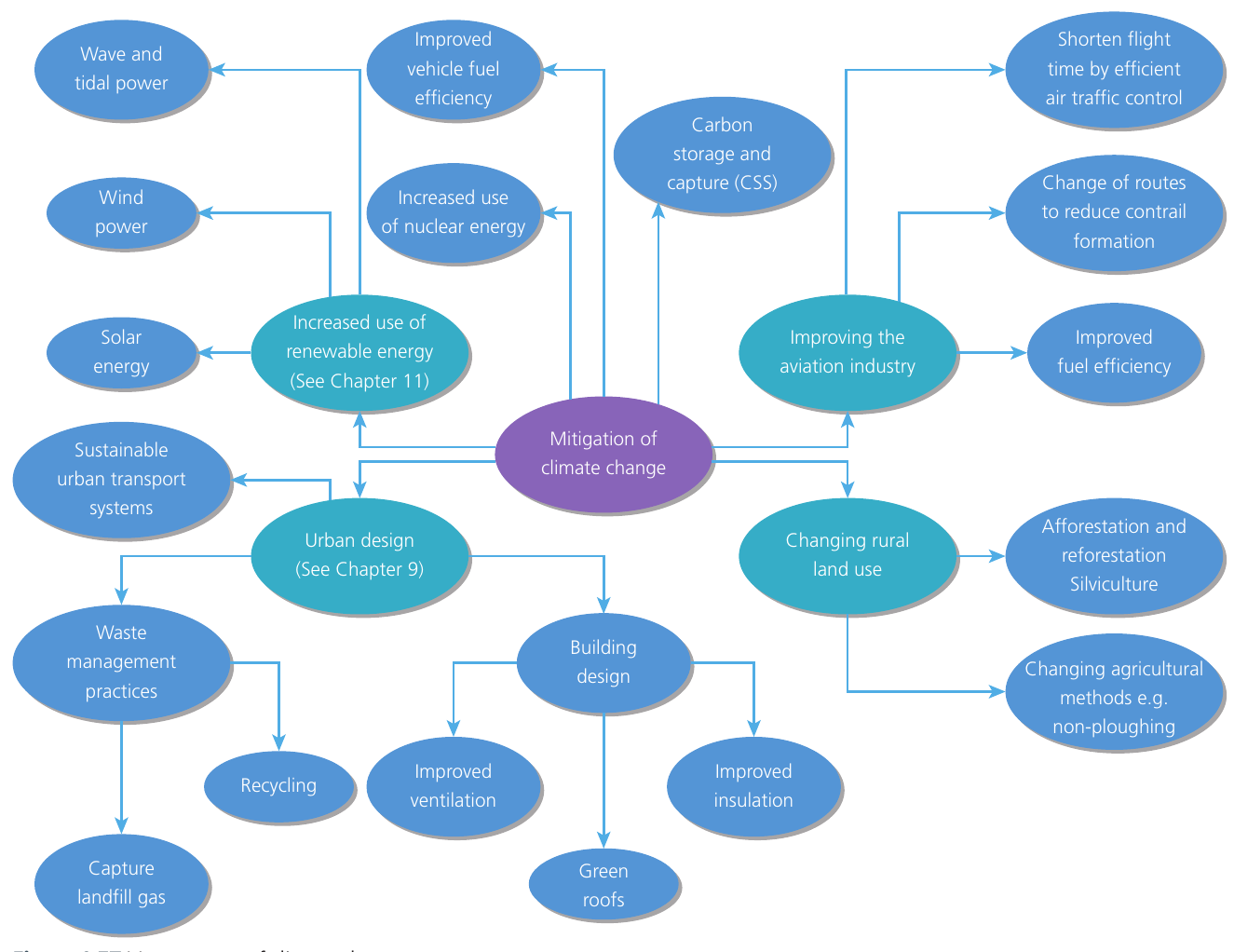
The mitigation strategies include:
Energy production
- Transitioning to renewable energy sources (wave and tidal power, wind power, solar energy)
- Increasing the use of nuclear energy
- Implementing carbon storage and capture (CCS) technologies
Transport and aviation
- Improving vehicle fuel efficiency
- Developing sustainable urban transport systems
- Shortening flight times through efficient air traffic control
- Changing routes to reduce contrail formation
- Enhancing fuel efficiency in the aviation sector
Note
Urban design and rural land use changes are equally important mitigation strategies, working alongside energy and transport innovations to create comprehensive solutions to climate change.
Urban design
- Implementing better building design with improved insulation and ventilation
- Installing green roofs
- Improving waste management practices, including recycling and capturing landfill gas
Rural land use
- Changing agricultural methods (such as adopting non-ploughing techniques)
- Implementing afforestation and reforestation programmes (silviculture)
Each of these strategies contributes to reducing overall greenhouse gas emissions, though they operate through different mechanisms and at different scales.
Carbon capture and sequestration (CCS) technologies
Carbon capture and storage represents a technological approach to preventing CO₂ from entering the atmosphere. This method can capture up to 90% of carbon dioxide emissions produced from fossil fuel use in electricity generation and industrial processes.
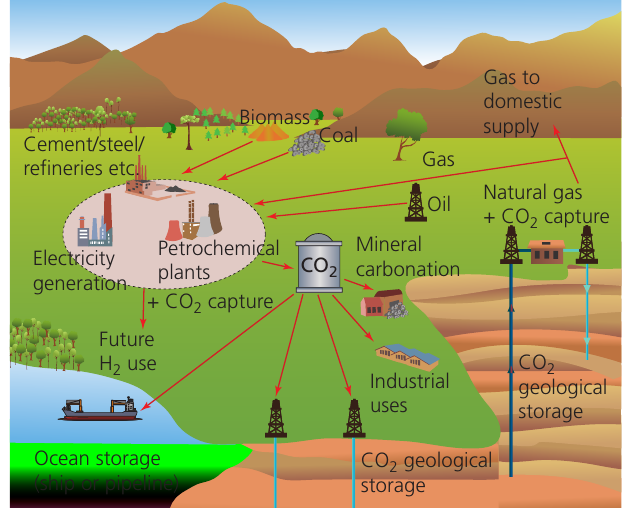
How CCS works
The CCS process consists of three main stages:
1. Capturing the CO₂
Technologies allow the separation of carbon dioxide from gases produced during electricity generation and industrial processes. There are three main methods:
- Pre-combustion capture
- Post-combustion capture
- Oxy-fuel combustion
2. Transporting the CO₂
Once captured, millions of tonnes of carbon dioxide are transported to storage locations. This is typically done through:
- Pipelines
- Ship transport
- Road tankers
Note
The CO₂ is already being moved annually for various commercial purposes using these methods, meaning the infrastructure and expertise for safe transport already exists.
3. Storing the carbon dioxide
The captured CO₂ must be stored securely to prevent it from entering the atmosphere. Storage options include:
- Depleted oil and gas reservoirs
- Deep saline aquifer formations (several kilometres below the surface)
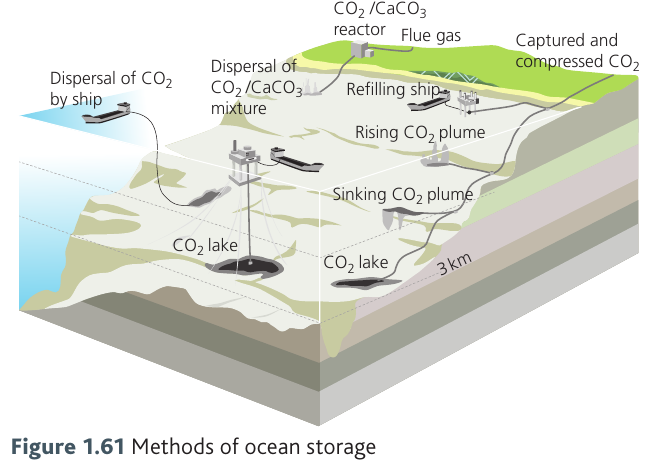
- Deep ocean storage
Geo-sequestration
When carbon dioxide is stored in deep geological formations, the process is called geo-sequestration. The CO₂ is converted into a high-pressure, liquid-like form known as 'supercritical CO₂', which behaves like a runny liquid. This supercritical CO₂ is injected directly into sedimentary rocks.
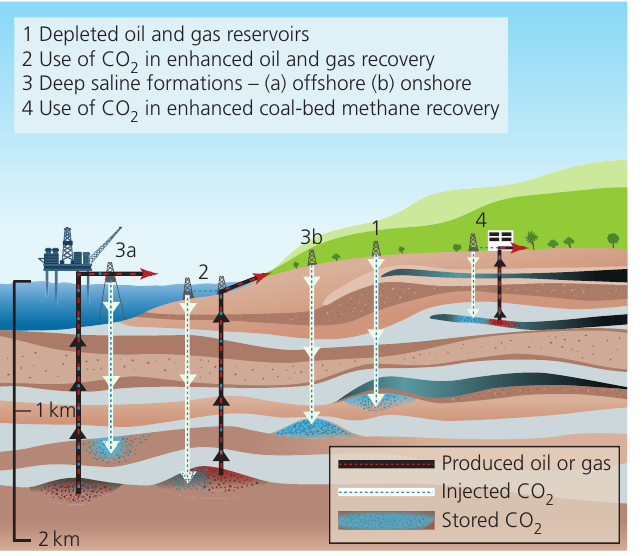
Suitable geological storage sites include:
- Old oil fields
- Gas fields
- Saline formations (underground salty water layers)
- Thin coal seams
Note
Physical and geochemical mechanisms trap the CO₂ underground, preventing it from escaping to the surface. The rocks act as natural seals, keeping the carbon dioxide contained for thousands of years.
Enhanced oil recovery
CCS systems can extract a greater percentage of oil and gas from existing reservoirs. The CO₂ is injected under pressure, which helps force the remaining oil or gas out. Whilst this helps pay for the CCS technology through increased oil production, it does create a problem by producing more fossil fuel for eventual burning.
Ocean storage
Carbon dioxide could also be stored in the ocean through various methods, though this approach has significant disadvantages due to ocean acidification and associated environmental problems.
Case study: Boundary Dam CCS plant
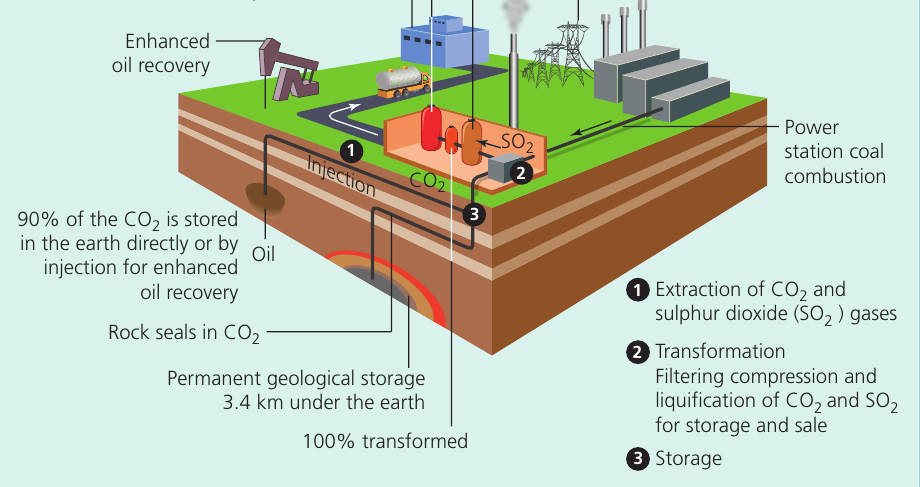
The Boundary Dam facility in Saskatchewan, Canada, provides a real-world example of CCS technology in operation. Built by the provincial utility SaskPower, this coal-fired power station has been retrofitted to capture carbon emissions.


Example
Case Study Details: Boundary Dam CCS Facility
The plant demonstrates CCS technology at commercial scale:
Capture and Storage:
- The plant is a 110-megawatt coal power and CCS facility
- It captures 90% of its CO₂ output (approximately 1 million tonnes per year)
- Only 10% of the CO₂ produced reaches the atmosphere
- The captured CO₂ is piped 66 km to the Weyburn Oil Unit
Underground Storage:
- At Weyburn, CO₂ is injected into an oil-bearing rock formation at a depth of 1,500 metres
- The injection adds pressure to the oil-bearing rock, helping push more oil out (enhanced oil recovery)
- The CO₂ is stored at a permanent geological storage site 3.4 km underground
- Rock layers seal in the CO₂, preventing escape
Timeline:
- CO₂ injection at Weyburn started in October 2014
- Full operations began in April 2015
Costs and benefits
Important
The Boundary Dam CCS unit cost $800 million to construct, and the plant consumes 21% of its coal power output to operate the carbon scrubbing equipment and compress the CO₂ into liquid form for burial. However, the additional costs are partially offset by the extra oil recovered from the Weyburn oil field through enhanced oil recovery.
This case study demonstrates that whilst CCS technology works, it imposes significant energy penalties and financial costs.
Changing rural land use
Carbon storage can be improved in rural areas by ensuring that carbon inputs to the soil exceed carbon losses. Various strategies can be employed depending on land use, soil properties, climate conditions, and the size of the land area.
Grasslands
Grasslands offer substantial potential for greenhouse gas mitigation, with an estimated 810 million tonnes of CO₂ potentially being sequestered globally per year (in the period to 2030), with almost all of this carbon being stored in the soil.
Improving carbon storage in grasslands
- Avoiding overstocking: Too many grazing animals can damage grasslands and reduce their carbon storage capacity
- Adding manures and fertilisers: These materials have a direct impact on soil organic carbon (SOC) levels by increasing the added organic material. They also provide indirect benefits by boosting plant productivity and stimulating soil biodiversity (for example, earthworms help degrade and mix organic material into the soil)
- Revegetation: Using improved pasture species and legumes can increase productivity, resulting in more plant litter and underground biomass, which adds to the SOC stock
- Irrigation and water management: Better water availability improves plant productivity and increases the production of soil organic matter
Croplands
Agricultural lands also offer opportunities to increase soil organic carbon through various techniques:
- Mulching: This practice adds organic matter to the soil. When crop residues are used as mulch, it also prevents carbon losses from the system
- Reduced or no tillage: Ploughing and harrowing accelerate the decomposition of organic matter and release soil carbon that might otherwise remain stored. Reduced tillage also prevents the break-up of soil aggregates that protect carbon
- Some use of animal manure or chemical fertilisers: These can increase plant productivity and therefore SOC levels
- Rotations of cash crops: Using pasture or cover crops alongside cash crops, and applying green manures, can increase the biomass returned to the soil
- Using improved crop varieties: These produce higher productivity both above and below ground, enhancing crop residues and increasing SOC
- Trees in croplands (silviculture) and orchards: These can store carbon both above and below ground. CO₂ emissions can be further reduced if the trees are cultivated as a renewable source of fuel
Important
It is crucial to recognise that many of these mitigation approaches have different and sometimes unwanted side effects that must be carefully considered. Agricultural practices must balance carbon sequestration with food production, biodiversity, and economic viability.
Forests and tree crops
Forests play a vital role in reducing atmospheric CO₂ by storing large quantities of carbon both above and below ground.
- Protection of existing forests: Preserving current forests maintains their soil carbon stocks
- Reforesting degraded lands: Increasing tree density in degraded forests raises biomass density and therefore carbon density, both above and below ground
Improved aviation practices
The aviation industry is a significant and growing source of CO₂ emissions. According to the Air Transport Action Group, in 2019 the global aviation industry carried 4.5 billion passengers, producing 915 million tonnes of CO₂.
Whilst the industry has made considerable progress in reducing its CO₂ production (for example, modern aircraft like the Airbus A380 and Boeing 787 use less than three litres of fuel per 100 passenger kilometres), the EU Directorate General for Climate Action warns that global CO₂ emissions from aviation will be 70% higher in 2020 than in 2005 and could increase by a further 300% by 2050.
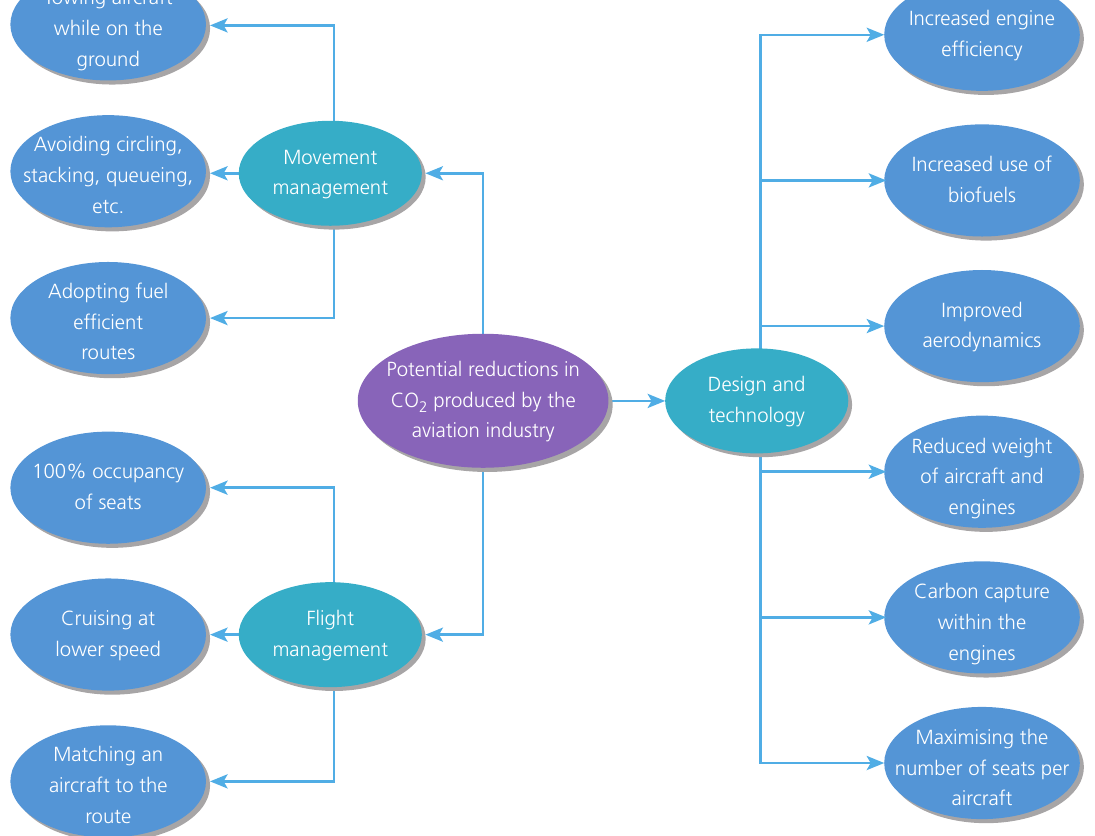
The diagram above shows various ways the aviation industry could reduce emissions. These must be approached cautiously as many remain at the aspirational or theoretical stage.
Movement management strategies
Note
Operational Efficiency Improvements
These strategies focus on reducing fuel consumption through better operational practices:
- Towing aircraft whilst on the ground (reducing fuel consumption during taxiing)
- Avoiding circling, stacking, and queuing (reducing unnecessary fuel burn)
- Adopting fuel-efficient routes
- Achieving 100% seat occupancy
- Cruising at lower speeds
- Matching aircraft size to the route requirements
Design and technology innovations
- Increased engine efficiency
- Increased use of biofuels (sustainable aviation fuels)
- Improved aerodynamics
- Reduced weight of aircraft and engines
- Carbon capture within the engines themselves
- Maximising the number of seats per aircraft
Note
Implementing these strategies could significantly reduce aviation's contribution to global CO₂ emissions, though many technological solutions require substantial development before they become viable. The challenge lies in balancing environmental concerns with the industry's rapid growth and the global demand for air travel.
Remember!
Summary
Key Points to Remember:
- Climate change mitigation involves efforts to reduce or prevent greenhouse gas emissions through various strategies across multiple sectors
- Carbon capture and storage (CCS) can capture up to 90% of CO₂ emissions from power plants and industrial facilities, but it is expensive and energy-intensive, requiring significant investment and operational costs
- Positive feedback loops between water and carbon cycles amplify global warming - rising CO₂ increases temperatures, which releases more water vapour and methane, causing further warming in a self-reinforcing cycle
- Rural land use changes such as reduced tillage, mulching, revegetation, and afforestation can significantly increase carbon storage in soils and biomass, with grasslands alone potentially sequestering 810 million tonnes of CO₂ per year
- Multiple approaches are needed across energy production, transport, urban design, and land management to effectively mitigate climate change - no single solution is sufficient on its own