Effects of the Changing Carbon Budget (AQA A-Level Geography): Revision Notes
📚Revision Notes
Effects of the Changing Carbon Budget
Introduction
Carbon dioxide concentrations in the atmosphere have fluctuated significantly throughout Earth's history. Evidence suggests that 100 million years ago, atmospheric CO₂ levels were several times higher than current values, whilst 500 million years ago they were approximately 20 times greater than today's concentrations. These levels subsequently declined before experiencing a dramatic rise 200 million years ago, reaching four to five times present values, followed by a gradual decrease until recent pre-industrial times.
Understanding the consequences of changing carbon levels requires sophisticated computer modelling. Scientists have developed models containing between 50 and 100 interacting equations that describe the various processes within the carbon cycle. These models can only indicate potential outcomes rather than certainties, as the carbon system is highly complex.
Impact on land
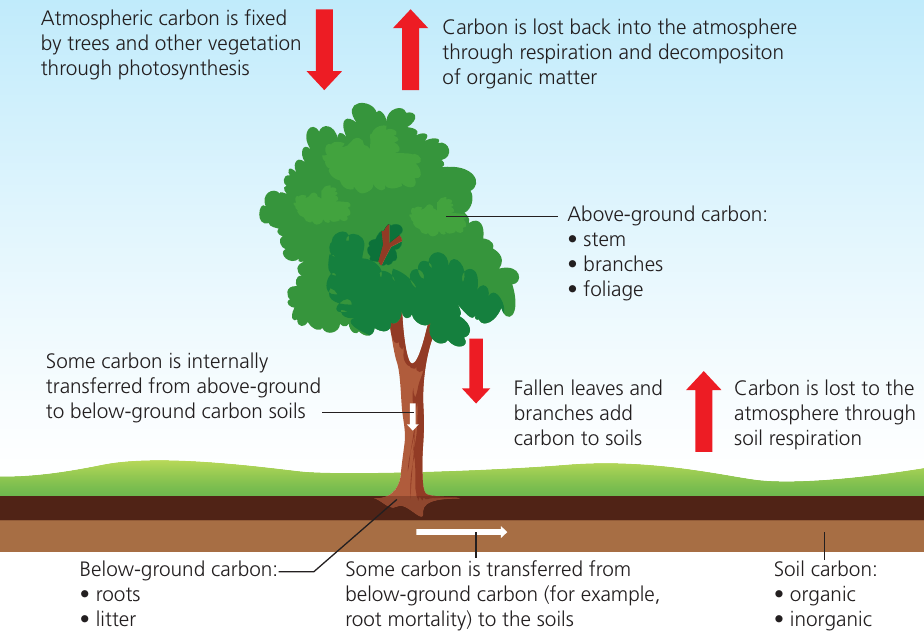
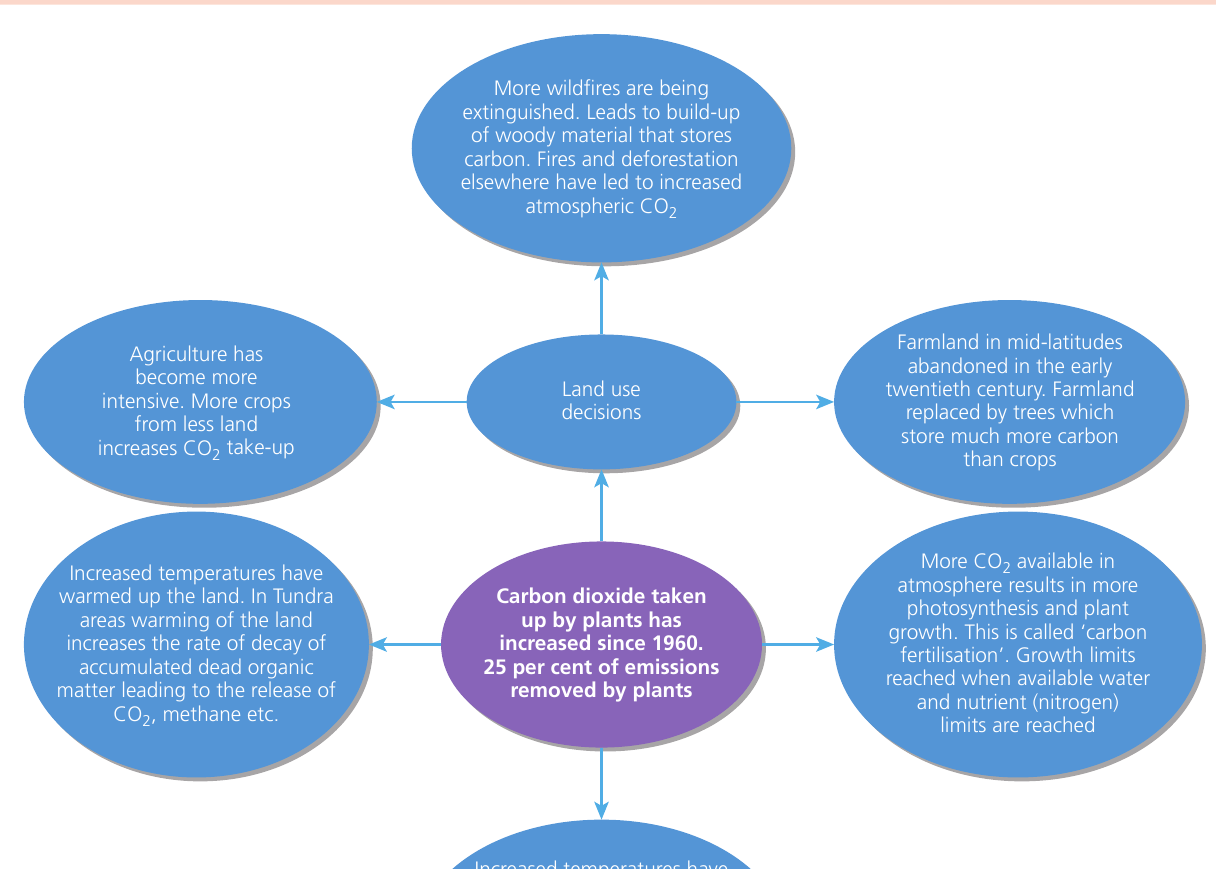
Research shows that vegetation has increasingly absorbed atmospheric carbon since 1960. Plants have removed approximately 25 per cent of human emissions during this period. However, the effects on terrestrial ecosystems are varied and complex.
Carbon fertilisation
Higher atmospheric CO₂ concentrations have stimulated increased photosynthesis and plant growth in many areas. This enhanced growth is known as carbon fertilisation. When more carbon dioxide becomes available, plants can photosynthesise more effectively, taking up additional carbon from the atmosphere.
Note
Carbon fertilisation has natural limits. Plant growth eventually becomes restricted by other factors such as water availability and nutrient supply, particularly nitrogen. This means that plants cannot continue absorbing increasing amounts of CO₂ indefinitely.
Rising temperatures have also extended growing seasons in many regions. Longer summers mean more time for plant growth and higher rates of evapotranspiration, though this increased water demand can limit growth if water supplies are insufficient.
Land use changes and their effects
Human decisions about land management have created significant impacts on the carbon cycle:
- Wildfire suppression: More effective fire control has led to accumulation of woody material that stores carbon. However, fires and deforestation elsewhere have released substantial amounts of CO₂ into the atmosphere
- Mid-latitude reforestation: Farmland abandoned during the early twentieth century in mid-latitude regions has been colonised by trees, which store considerably more carbon than agricultural crops
- Intensive agriculture: Modern farming practices have increased land productivity and therefore CO₂ uptake from the atmosphere
Temperature effects in cold regions
Warming has had particularly significant effects in tundra areas. Higher temperatures in these regions have accelerated the decomposition of accumulated dead organic matter in the soil. This decay process releases CO₂, methane and other greenhouse gases back into the atmosphere, creating a positive feedback loop that amplifies warming.
Important
Positive feedback mechanism - A process where the initial change triggers responses that amplify the original change. In this case, warming causes organic matter decay, which releases more greenhouse gases, causing further warming. This self-reinforcing cycle makes climate change more difficult to control.
Impact on oceans
Approximately 30 per cent of the carbon dioxide released into the atmosphere has dissolved into the world's oceans through direct chemical exchange. This absorption has led to several concerning changes in marine environments.
Ocean acidification
When carbon dioxide dissolves in seawater, it creates carbonic acid, which makes the ocean slightly less alkaline. The pH of the ocean's surface has already dropped by 0.1 units, representing a 30 per cent change in acidity.
This acidification particularly affects marine organisms in two ways:
Direct impact on shell formation: Carbonic acid reacts with carbonate ions in seawater to form bicarbonate. However, carbonate ions are essential building blocks that animals such as coral and many planktonic species need to construct their calcium carbonate shells and skeletons. With fewer carbonate ions available, these organisms must expend more energy to build their protective structures, resulting in thinner, more fragile shells.
Reduced biodiversity: As shell-building becomes more difficult, populations of affected species decline, threatening marine biodiversity throughout the food web.
Example
Case Study: Oyster Larvae Mortality
In 2007, oyster larvae off the coasts of Oregon and Washington in the USA began dying in vast numbers. Scientists directly linked these losses to ocean acidification.
Impact timeline:
- Between 2005 and 2009, lost production cost millions of dollars
- Rising acidity levels caused the oyster population to crash
- Economic damage severely affected coastal communities
Key finding: Research showed that acidic seawater was rising from the ocean depths, and the water coming up today contains CO₂ that was absorbed approximately 30 to 50 years ago. This demonstrates the time lag between emissions and their full impact on marine ecosystems.
One optimistic perspective suggests that more acidic seawater may actually dissolve more calcium carbonate rocks (such as chalk and limestone) over time. This reaction could eventually enable the ocean to absorb even more CO₂, though this is a very slow process.
Important
Coral reef impacts: Coral reefs provide food and livelihood security for approximately 500 million people worldwide. Significant reef degradation due to carbonate ion loss threatens the survival of coastal communities. The reduced biodiversity also diminishes food availability and weakens the natural coastal protection that reefs provide against storm surges and sea level rise.
Ocean warming
Warmer oceans resulting from climate change could reduce phytoplankton abundance. These microscopic organisms thrive in cool, nutrient-rich waters. Declining phytoplankton populations would weaken the oceans' ability to remove carbon from the atmosphere through the biological carbon pump, making the ocean a less effective carbon sink.
Note
Conversely, higher CO₂ levels are essential for both plant and phytoplankton growth. Increased atmospheric CO₂ could potentially stimulate growth in certain low-productivity species of phytoplankton and ocean plants like sea grasses that absorb carbon dioxide directly from seawater.
Ocean warming also destroys the symbiotic algae that coral requires for growth, resulting in coral bleaching and eventual reef death.
Ocean salinity
Changes in salinity have been observed in the deep North Atlantic. This shift is probably caused by increased precipitation levels and higher temperatures - both consequences of elevated atmospheric carbon. Greater precipitation leads to increased river run-off that eventually reaches the sea.
These salinity changes have been linked to a potential slowdown of large-scale oceanic circulation in the North-East Atlantic. This disruption could significantly affect the climate of North West Europe, as ocean currents play a crucial role in heat distribution.
Melting sea ice
Satellite monitoring over the last 35 years has recorded Arctic sea ice retreating at a rate of 12.8 per cent per decade. Sea ice loss serves not only as an indicator of warming but also as part of a dangerous feedback mechanism.
Ice-albedo feedback
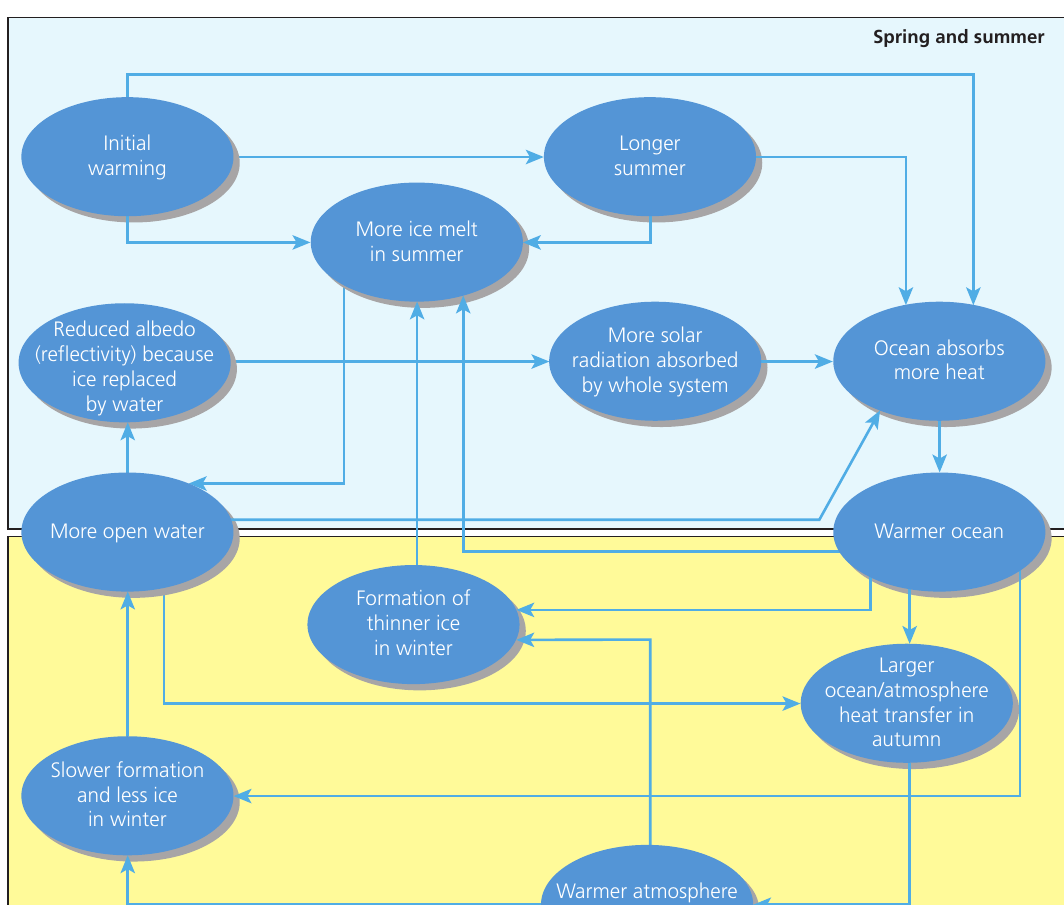
When sea ice melts, highly reflective ice is replaced by darker, more heat-absorbent water. This change means the ocean can absorb more sunlight, which amplifies the warming that initially caused the ice to melt. This self-reinforcing cycle is called the ice-albedo feedback.
Important
The Ice-Albedo Feedback Cycle
During spring and summer, initial warming leads to longer summers and increased ice melt. The reduced albedo (reflectivity) causes the whole system to absorb more solar radiation, warming the ocean further.
In autumn and winter, the warmer ocean transfers more heat to the atmosphere and forms thinner ice. This thinner ice is more vulnerable to melting the following summer, perpetuating the cycle.
This is another example of a positive feedback mechanism - the melting ice creates conditions that accelerate further melting, making it increasingly difficult to reverse the process.
Ecosystem and wildlife impacts
Sea ice provides a unique habitat for algae that appear in highly concentrated forms within the ice structure, with elevated fat content. The loss of ice-bound algae affects marine life throughout the food chain, from krill to fish, seals, walruses and polar bears.
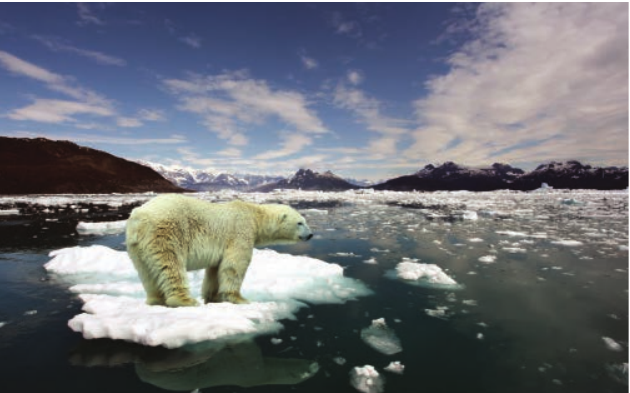
Animals like polar bears that depend on sea ice to reach their primary food source of seals can no longer travel across frozen waters. This habitat loss threatens their survival.
Sea level rise
Global sea levels have remained relatively stable over the last 5,000 years, but they are subject to change. Coastal landform studies indicate that sea levels were significantly lower in the past than they are today. The last glacial retreat triggered a worldwide sea level rise approximately 10,000 years ago, caused by melting of vast land-locked freshwater ice sheets.
Current research shows that sea levels worldwide have been rising at a rate of 3.1 mm per year since the early 1990s. Higher atmospheric CO₂ concentrations and resulting temperature increases have caused:
Accelerated terrestrial ice melt: Both summer melting and winter snowfall reductions have created a net gain of water entering the oceans from rivers rather than being lost through evaporation. Additionally, the massive ice sheets covering Antarctica and Greenland are moving more rapidly towards the oceans due to increased meltwater lubricating their bases.
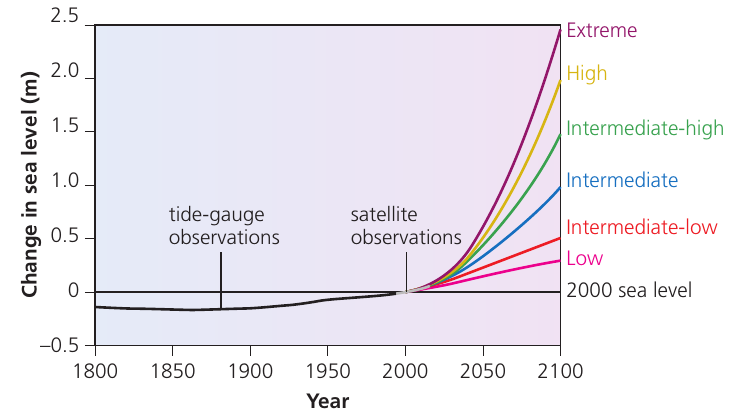
Thermal expansion: When water heats up, it expands. Approximately half of the past century's sea level rise can be attributed to warmer oceans having a greater volume and therefore occupying more space. Accurate measurements of this phenomenon have only recently become possible.
Note
If Earth continues warming at current rates, oceans are projected to rise between 0.6 and 2.5 metres by 2100. This represents a range of predictions based on different greenhouse gas emission scenarios, from low to extreme pathways. The variation demonstrates the uncertainty in climate science, though the overall trend towards significant rise remains clear.
Impact on the atmosphere
Although the land and oceans will absorb most excess CO₂, up to 50 per cent may persist in the atmosphere for many thousands of years. This has major significance because CO₂ is the most important gas controlling Earth's temperature.
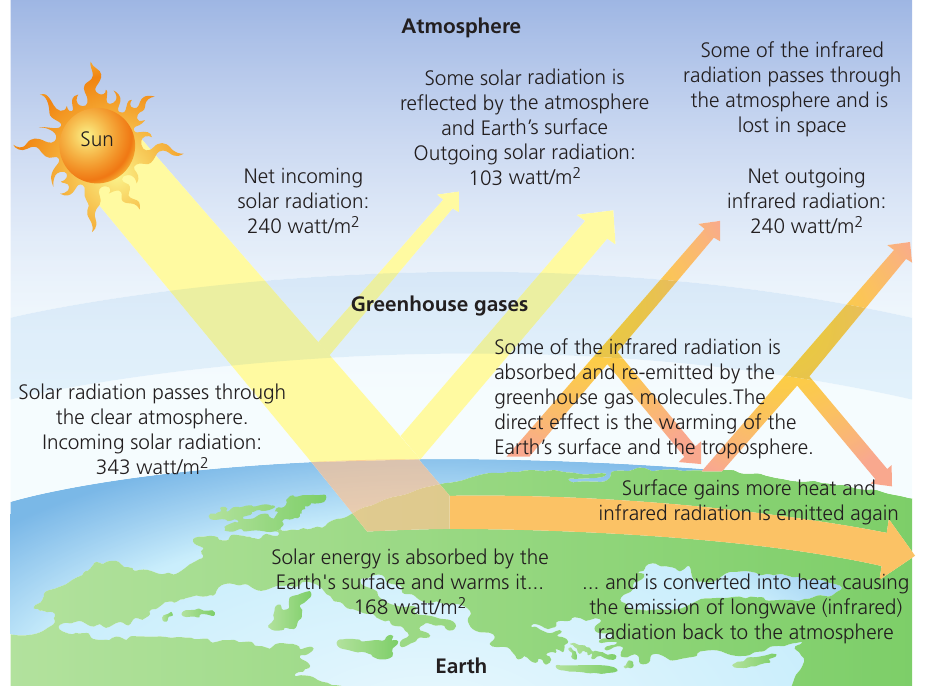
The fact that Earth has a greenhouse effect is positive - without any greenhouse gases, our planet would be frozen at approximately . The problem is not the greenhouse effect itself, but rather the enhanced greenhouse effect. This occurs when extra CO₂ and other greenhouse gases in the atmosphere create what scientists call radiative forcing.
Key terms
Important
Enhanced greenhouse effect - The impact on the climate from the additional heat retained due to the increased amounts of carbon dioxide and other greenhouse gases that humans have released into the Earth's atmosphere since the industrial revolution.
Important
Radiative forcing - The difference between the incoming solar energy absorbed by the Earth and energy radiated back to space.
Note
Soil organic carbon (SOC) - The organic constituents in the soil: tissues from dead plants and animals, products produced as these decompose and the soil microbial biomass.
Understanding radiative forcing
Energy constantly flows into the atmosphere as sunlight, with about half shining on Earth's surface. Some of this incoming radiation (approximately 30 per cent) is reflected back to space, whilst the rest is absorbed by the planet. Earth then radiates some of this absorbed energy back into the much colder surrounding space as infrared radiation (heat).
Carbon dioxide, methane and halocarbons are greenhouse gases that absorb a wide range of energy wavelengths, including infrared energy emitted by Earth, and then re-emit it. Some of this re-emitted radiation travels out in all directions, but some returns to Earth where it heats the surface.
Note
Without greenhouse gases, Earth would be frozen. However, excessive greenhouse gases cause Earth to become too warm, like Venus where greenhouse gases maintain surface temperatures around .
When the balance between incoming and outgoing energy differs from zero, warming (if positive) or cooling (if negative) occurs. The magnitude of Earth's energy imbalance is called radiative forcing, measured in watts per square metre () of Earth's surface.
Current measurements and projections
Prior to 1750, radiative forcing was negligible. Since then it has increased substantially, not only due to elevated greenhouse gas emissions but also because of changing albedos resulting from land use changes. Calculating the precise amount of radiative forcing is challenging due to many complicating factors, including natural variations in solar radiation and the effects of aerosols such as carbon particles from diesel exhausts, which contribute to warming.
Important
The current level of radiative forcing, according to the IPCC AR5 report, stands at 2.8 watts/m² (with a range of uncertainty from 2.5 to 3.1). If CO₂ levels continue rising at projected rates, experts predict Earth will become considerably hotter, potentially warm enough to melt much existing ice cover.
The role of water vapour
Carbon dioxide causes approximately 20 per cent of Earth's greenhouse effect, water vapour accounts for about 50 per cent, and clouds contribute around 25 per cent. The remainder comes from small particles (aerosols) and minor greenhouse gases like methane.
When carbon dioxide concentrations increase, air temperatures rise. Warmer oceans then release more water vapour, which evaporates into the atmosphere and amplifies greenhouse heating. Although CO₂ contributes less to the overall greenhouse effect than water vapour, scientists have found that it is CO₂ that sets the temperature. This temperature then controls the amount of water vapour in the atmosphere and therefore determines the magnitude of the enhanced greenhouse effect.
Temperature lag
Note
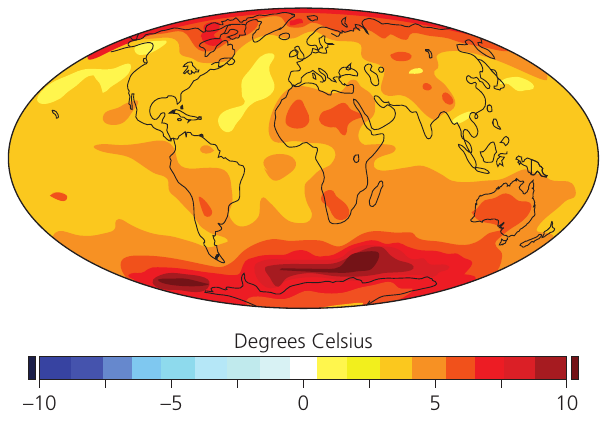
There is a time delay between rising CO₂ concentrations and increased warming because the ocean absorbs heat slowly. This means Earth's temperature will increase by at least another due to carbon dioxide already present in the atmosphere, even if emissions were immediately stopped.
Remember!
Summary
Key Points to Remember:
-
Plants have absorbed 25% of emissions since 1960, but this uptake is limited by water and nutrient availability, and warming tundra releases stored carbon back to the atmosphere
-
Ocean acidification (pH drop of 0.1) threatens marine ecosystems, particularly carbonate-shell forming organisms like coral and shellfish, affecting 500 million people who depend on coral reefs
-
Arctic sea ice is retreating at 12.8% per decade, creating a positive feedback loop through the ice-albedo effect where less reflective ice leads to more heat absorption and further melting
-
Sea levels are rising at 3.1 mm/year and could increase by 0.6-2.5 metres by 2100 due to thermal expansion and accelerating ice sheet melt
-
Radiative forcing of 2.8 watts/m² drives enhanced greenhouse effect, with CO₂ controlling temperature and therefore water vapour levels, creating a time lag between emissions and full warming response