Systems Frameworks and Application (AQA A-Level Geography): Revision Notes
📚Revision Notes
Systems frameworks and application
Understanding systems in geography
Geography deals with incredibly complex natural processes. To make sense of how water moves through the environment, or how carbon cycles through the atmosphere and oceans, we need tools that help us see the bigger picture. This is where systems thinking becomes invaluable.
A system is essentially a way of looking at connected parts that work together as a whole. Rather than studying individual elements in isolation, systems thinking helps us understand how different components interact and influence each other. For instance, when studying water or carbon cycles, we can identify where these substances are stored, how they move between locations, and what drives these movements.
Geographers use systems models because the real world is too complex to study in its entirety. By simplifying reality into manageable models—such as the water cycle or demographic transition model—we can identify fundamental relationships and patterns that might otherwise remain hidden beneath layers of detail.
Important
What is a system?
A system is a set of interrelated components working together towards some kind of process. Systems are made up of stores or components that have flows or connections between them.
Core components of a system
Every system, whether it's describing river drainage or global carbon movement, contains several key elements that work together to create the overall system behaviour.
Stores and components
These are the locations where energy or matter accumulates within the system. Think of them as reservoirs or containers. For example, in the carbon cycle, the atmosphere is a store where carbon dioxide accumulates. In the water cycle, glaciers represent a store of frozen water.
Note
The size of stores can vary dramatically. Some stores, like the ocean in the water cycle, are massive and change slowly. Others, like atmospheric moisture, are relatively small and can change rapidly. Understanding the relative sizes of stores helps predict how systems will respond to changes.
Important
Key system terminology
Energy – The ability to do work. In physical geography, much of this energy ultimately comes from the Sun.
Store/component – A part of the system where energy or mass is stored or transformed.
Input – The addition of matter and/or energy into a system.
Output – The results of the processes within a system.
Flow/transfer – A form of linkage between one store/component and another that involves movement of energy or mass.
Flows and transfers
These are the pathways along which energy or matter moves between different stores. Flows represent the dynamic aspect of systems—the movement that makes things happen. For instance, evaporation is a flow that transfers water from ocean stores to the atmospheric store.
System properties
Beyond just stores and flows, systems have three important properties that help us understand how they function:
- Elements: The actual things that make up the system of interest (e.g., water molecules, carbon atoms, soil particles)
- Attributes: The perceived characteristics of these elements (e.g., temperature, salinity, acidity)
- Relationships: Descriptions of how the various elements and their attributes work together to carry out processes
Boundaries
Most systems have a structure that lies within a boundary. This boundary defines what is inside the system and what is outside it. Boundaries help us focus our analysis on the relevant components without getting distracted by everything else in the universe.
It's important to remember that systems are generalisations. They deliberately remove incidental detail that might obscure fundamental relationships. This simplification is their strength—it allows us to see patterns and connections clearly.
Types of systems
Systems can be classified into three main categories based on how they exchange matter and energy with their surroundings. Understanding these distinctions is crucial for analyzing real-world geographical processes.
Isolated systems
Isolated systems are completely sealed off from their surroundings. They have no interactions with anything outside the system boundary, meaning there is no input or output of energy or matter.
Note
In reality, truly isolated systems are extremely rare in nature. They're primarily found in carefully controlled laboratory experiments. However, understanding them helps us appreciate the other types of systems and provides a theoretical baseline for comparison.
Closed systems
Closed systems allow transfers of energy both into and beyond the system boundary, but do not permit the transfer of matter.
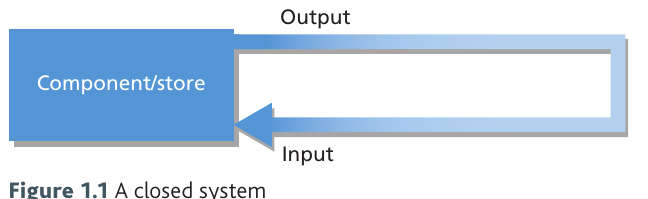
A closed system can receive energy from outside (input) and release energy to its surroundings (output), but the actual material within the system stays contained. The Earth itself can be considered a closed system when viewed at a planetary scale. Energy from the Sun enters the Earth system, and the Earth radiates energy back into space, but the amount of matter (water, carbon, nitrogen, etc.) remains essentially constant.
Example
Worked Example: Earth as a Closed System
Consider the Earth's water cycle at a planetary scale:
- Energy inputs: Solar radiation heats water, causing evaporation
- Energy outputs: Earth radiates heat energy back into space
- Matter: The total amount of water on Earth remains constant—it simply changes form and location through processes like evaporation, precipitation, and condensation
This demonstrates why Earth is a closed system: energy flows in and out, but the water molecules themselves stay within the system boundary.
Open systems
Open systems are the most common type in physical geography. These systems allow both matter and energy to be transferred across the system boundary into the surrounding environment.

Most ecosystems are excellent examples of open systems. A forest ecosystem receives energy from sunlight, water from precipitation, and nutrients from outside sources. It also releases energy (heat), water (through evapotranspiration), and organic matter (through leaf litter and dead organisms) to its surroundings.
Dynamic equilibrium
When we observe a system over time, we might notice that inputs and outputs don't always match perfectly. When there is a balance between the inputs and outputs, the system is said to be in a state of dynamic equilibrium. This means that the stores remain stable—they neither grow nor shrink significantly.
However, equilibrium doesn't mean nothing is happening. The term "dynamic" indicates that there's still movement and activity within the system; it's just that inputs and outputs are balanced overall.
Note
Think of dynamic equilibrium like a bathtub with the tap running and the drain open. If water flows in at the same rate it drains out, the water level stays constant—but water is continuously moving through the system. The level is in equilibrium, but the system is dynamic.
If one element of the system changes—for example, if one of the inputs increases without a corresponding increase in outputs—then the stores will change, and the equilibrium is upset. This is where the concept of feedback becomes crucial.
Feedback mechanisms
Feedback occurs when a change in one part of a system triggers a chain reaction that eventually influences the original change. There are two fundamental types of feedback that control how systems respond to disturbances:
Positive feedback
In positive feedback, the effects of an action are amplified or multiplied by subsequent knock-on effects. This creates a self-reinforcing cycle that can accelerate change.
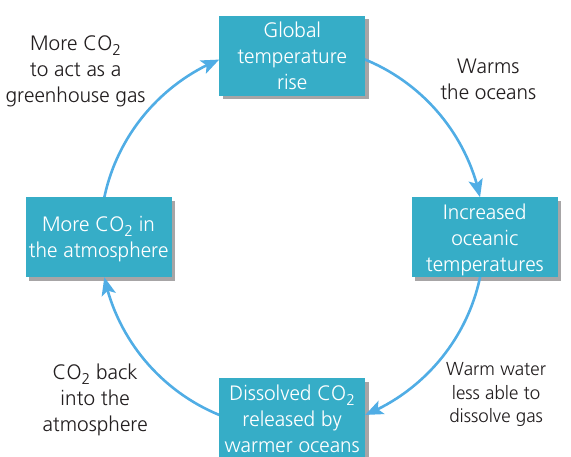
Example
Worked Example: Ocean Warming and CO₂
Let's trace through the positive feedback loop:
Step 1: Global temperatures rise due to greenhouse gas emissions
Step 2: The oceans warm up as they absorb heat from the atmosphere
Step 3: Warmer water is less able to dissolve CO₂ gas, so dissolved CO₂ is released back into the atmosphere
Step 4: This additional CO₂ acts as a greenhouse gas, which further increases global temperatures
Step 5: Warmer temperatures heat the oceans even more, continuing the cycle
Result: Each loop amplifies the original change, creating an accelerating warming effect
Positive feedback can lead to rapid and sometimes dramatic changes in systems. It tends to move systems away from equilibrium.
Important
Common Misconception: "Positive" feedback doesn't mean "good" feedback—it simply means the feedback amplifies change. Positive feedback can lead to beneficial or harmful outcomes depending on the context.
Negative feedback
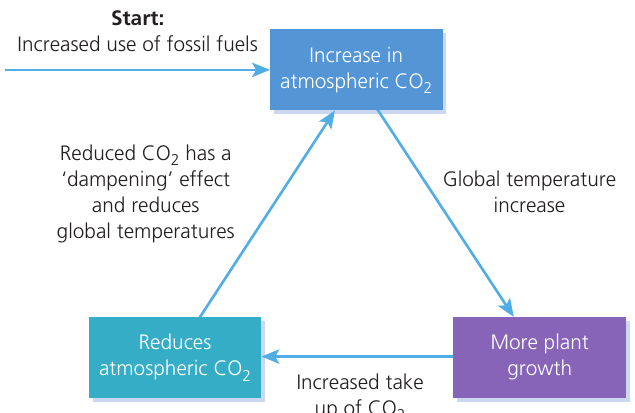
Negative feedback occurs when the effects of an action are nullified or dampened by its subsequent knock-on effects. This creates a self-regulating cycle that tends to stabilize the system.
Example
Worked Example: Plant Growth and Atmospheric CO₂
Let's examine how negative feedback stabilizes the system:
Step 1: Increased use of fossil fuels leads to more CO₂ in the atmosphere
Step 2: This causes global temperatures to increase
Step 3: Higher temperatures and more atmospheric CO₂ promote increased plant growth (since plants use CO₂ for photosynthesis and grow better in warmth)
Step 4: More plants mean increased uptake of CO₂ from the atmosphere through photosynthesis
Step 5: This reduces atmospheric CO₂ levels, dampening the original increase
Result: The system self-regulates and counteracts the initial change
Negative feedback helps maintain equilibrium within systems. It provides stability and prevents runaway changes.
Cascading systems and Earth's subsystems
At the global level, the Earth can be understood as comprising four major subsystems that work together as an interconnected whole:
- Atmosphere: The layer of gases surrounding Earth
- Lithosphere: The solid, rocky outer layer of Earth
- Hydrosphere: All water on Earth's surface
- Biosphere: All living organisms on Earth
Each of these can be considered an open system that forms part of a larger chain—a cascading system. In cascading systems, the output from one subsystem becomes the input for another, creating an interconnected network.
Note
The beauty of cascading systems is that they help explain how changes in one part of Earth can have far-reaching effects elsewhere. For example, volcanic eruptions (lithosphere) can release gases into the atmosphere, which affects temperature and precipitation (hydrosphere), which in turn impacts plant and animal life (biosphere).
The interlocking relationships among the atmosphere, lithosphere, hydrosphere, and biosphere have a profound effect on Earth's climate and climate change. Changes in one subsystem inevitably influence the others through these connections.
This interconnectedness is why water and carbon cycles are so important to understand. Water and carbon move through all four subsystems, linking them together and playing crucial roles in regulating Earth's temperature and sustaining life.
The concept of "Spaceship Earth" emerges from this systems perspective. It's a term expressing concern over the use of limited resources available on Earth and encouraging everyone to act as a harmonious crew working towards the greater good of the planet.
Summary
Key Points to Remember:
-
Systems thinking simplifies complexity: Systems models help geographers understand relationships between components by removing unnecessary detail and focusing on fundamental connections.
-
Three types of systems matter: Isolated systems (no exchanges), closed systems (energy only), and open systems (both matter and energy). Most natural systems are open systems.
-
Dynamic equilibrium means balanced change: When inputs equal outputs, stores remain stable, even though processes continue operating within the system.
-
Feedback loops control system behaviour: Positive feedback amplifies changes and destabilises systems, while negative feedback dampens changes and promotes stability.
-
Earth is an interconnected cascading system: The atmosphere, lithosphere, hydrosphere, and biosphere work as linked subsystems where outputs from one become inputs for another, profoundly affecting climate and life.