Variable Acceleration - 1D (AQA A-Level Mathematics): Revision Notes
📚Revision Notes
2.2.1 Using Calculus in 1D
Variable Acceleration
The motion of an object can be modelled by using formulas given in terms of time.
e.g., can be used to model the position x of a particle at time t seconds.
Sketching this curve
- Roots: t = 4, 2 (from calculator)
- Intercept: 8
- Minimum point: t = 3, x = -1
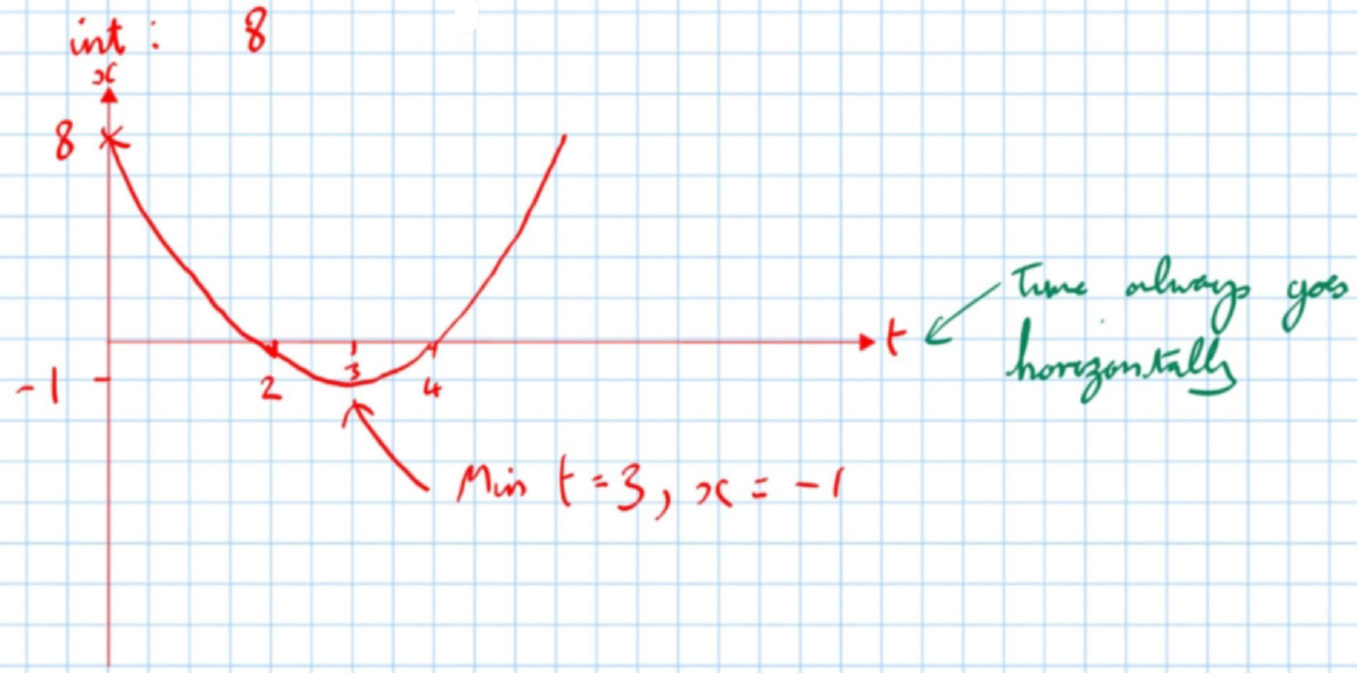
In this situation, the turning point of the particle is the point at which the particle has no speed, i.e., the particle is stationary.
Terminology
- Displacement: How far a particle is from the origin where negative and positive directions matter.
- Distance: How far something has travelled relative to an origin.
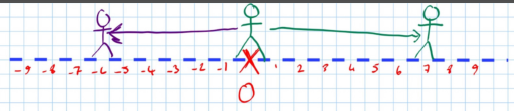
In this situation, the person walks a distance of 7 m, displacing himself 7 m from the origin.
In this example, he walks a distance of 6m, displacing himself 6m from the origin.
Definitions:
Note
- Velocity: Rate of change of displacement (direction matters).
- Speed: Rate of change of distance (direction doesn't matter).
Differentiation and Integration:
Note
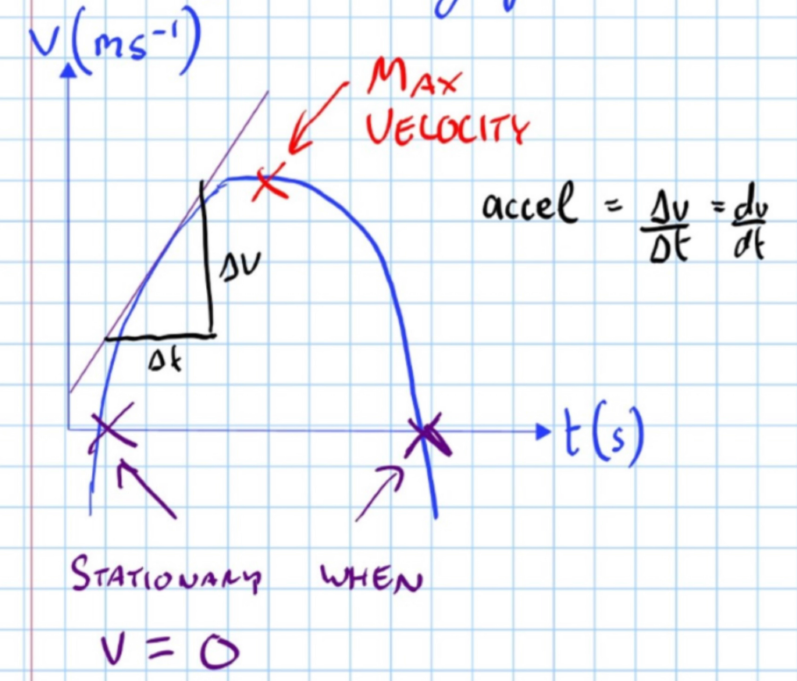
Velocity-Time Graph :
- Max Velocity
- Acceleration:
- Stationary when v = 0
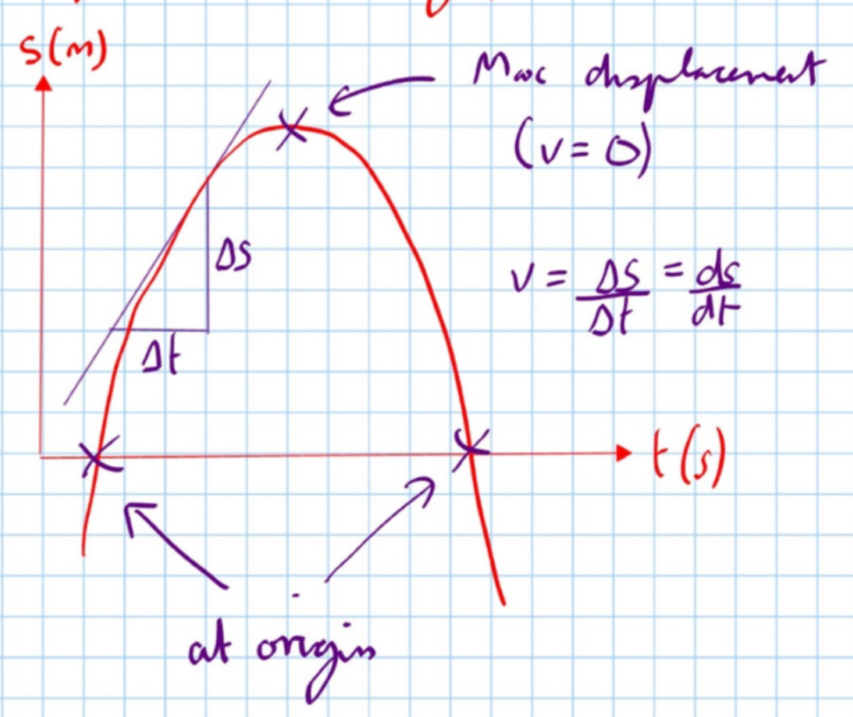
Displacement-Time Graph ():
- Max displacement (when v = 0)
- At origin
Note
Example: A particle is travelling with the trajectory .
- Find its velocity in terms of t and therefore its minimum displacement.
- Comment on the acceleration of the particle. a) The velocity is given by:
At minimum displacement, ds/dt = 0:
(Negative time indicates the time before the reference point.)
b) The acceleration a is given by:
Acceleration is positive and constant, which means the particle will get faster and faster.
Note
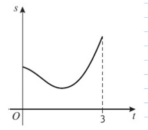
A particle moves in a straight line such that its distance, s metres, from a fixed point at time is given by:
The diagram shows the displacement-time graph of the motion of .
a) Determine the time at which is moving with minimum velocity.
b) Find the displacement of from at this time.
c) Find the velocity of at this time.
Solution:
a)
Velocity is at maximum or minimum when dv/dt = 0:
b) Let :
c) Let :
Integration in Variable Acceleration Problems
Note
Example: Given that and that initially a particle is at the origin, find the total displacement in the first 8 seconds of motion of the particle.
Method 1: Differential Equations
Using the initial condition:
For :
Method 2: Integration with Limits
Using the calculator:
Note
Q4 (Jan 2011, Q6) The velocity of a particle at time t is given by . The particle travels in a straight line and passes through a fixed point when
- (i) Find the displacement of the particle from O when
- (ii) Calculate the distance the particle travels from its position at until it changes its direction of motion.
- (iii) Calculate the distance of the particle from O when the acceleration of the particle is
Solution:
- (i)
Let :
When , .
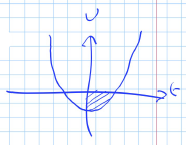
- (ii) Note: When a particle changes direction, v = 0.
For , .
Distance from start:
- (iii)
When :
Note
Q5 (Jun 2014, Q3) A particle travels in a straight line. The velocity of at time seconds after it passes through a fixed point is given by . Find
- (i) the velocity of P when it passes through A.
- (ii) the displacement of P from A when t = 1.5.
- (iii) the velocity of P when it has acceleration .
Solution:
- (i)
- (ii)
At :
- (iii)
Note
Q8. (OCR 4761, Jan 2008, Q5)
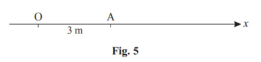
A toy car is moving along the straight line Ox, where O is the origin. The time t is in seconds. At time the car is at A, 3 m from O as shown in Fig. 5. The velocity of the car, , is given by
Calculate the distance of the car from O when its acceleration is zero.
Solution:
- Integrate velocity to find displacement:
- At :
So,
- Find acceleration by differentiating velocity:
- Set acceleration to zero and solve for :
- Substitute into the displacement equation: