The SUVAT equations can be extended to two dimensions. However, strictly speaking, there is no such thing as "squared" vectors, so any equations with squared vector quantities are invalid.
Kinematics Equations:
Motion in a straight line (1D):
v=u+at
s=ut+21at2
s=21(u+v)t
v2=u2+2as
s=vt−21at2
Motion in two dimensions (2D):
v=u+at
s=ut+21at2
s=21(u+v)t
s=vt−21at2
Problem Statement:
Note
A particle starts from the point with position vector (3i+7j) m and moves with constant velocity(2i−j)ms−1.
a) Find the position vector of the particle 4 seconds later.
b) Find the time at which the particle is due east of the origin.
Solution:
Given:
Initial position vector s0=(3,7)
Velocity vector u=v=(2,−1) (since velocity is constant)
Acceleration vector a=(0,0)
Time t=4
Part (a):
To find the position vector s:
s=ut+21at2⇒s=(2,−1)(4)+21(0,0)(4)2=(8,−4)
Remember, we didn't start at (0,0):
Position=(3,7)+(8,−4)=(11,3)
Part (b):
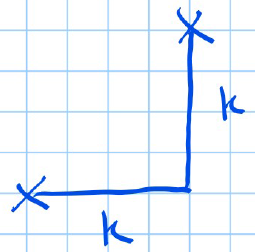
Context:Due east means y=0 and x has a value, say k.
In part (a), we worked out a position from a known time. We must adapt this method for an unknown time, t.
Equation:
r=Initial Position+Displacementr=(37)+(2−1)t+21(00)t2=(3+2t7−t) m
Since y=0, we set:
7−t=0⇒t=:highlight[7 seconds]
Additional Problem:
Note
A particle P has velocity (−3i+j)ms−1) at time t=0. The particle moves with constant accelerationa=(2i+3j)ms−2. Find the speed of the particle and the bearing on which it is travelling at time t=3 seconds.
Given:
s=?
u=(−3,1)
v=?
a=(2,3)
t=3Velocity:
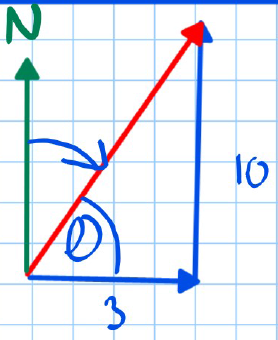
v=u+atr=(−31)+(23)(3)=(−3+61+9)=(310)
Magnitude of velocity:
∣v∣=32+102=:highlight[109 m s−1]
Bearing:
tanθ=310⇒θ=73.301∘
Final Bearing:
∴Bearing=:highlight[16.7∘]
Problem: Ice Skater on an Ice Rink
Note
An ice skater is skating on a large flat ice rink. At time t=0, the skater is at a fixed point O and is travelling with velocity (2.4i−0.6j)ms−1).
At time t=20 s, the skater is travelling with velocity (−5.6i+3.4j)ms−1.
Relative to O, the skater has position vector s at time t seconds.
Modelling the ice skater as a particle with constant acceleration, find:
a) The acceleration of the ice skater.
b) An expression for s in terms of t.
c) The time at which the skater is directly north-east of O.
A second skater travels so that she has position vector r=(1.1t−6j) m relative to O at time t.