Equation of a Trajectory (AQA A-Level Mathematics): Revision Notes
📚Revision Notes
2.6.3 Equation of a Trajectory
Note
The equation of trajectory describes the path of an object under projectile motion, typically in a parabolic form. It combines both horizontal and vertical components of motion, assuming constant acceleration due to gravity and no air resistance.
Note
For an object launched with initial velocity at an angle from the horizontal:
- Horizontal displacement ( ):
- Vertical displacement ( ): By eliminating time , the trajectory equation is:
This equation represents a parabola and shows the relationship between horizontal and vertical displacements of the projectile.
Projectile: Cartesian Equation of Motion
Note
Example:
A particle is projected at an angle of above the horizontal with an initial speed of . Find the Cartesian equation for the path (trajectory) of the particle.
Steps:
1. Note all initial conditions as vectors in SUVAT.
Given:
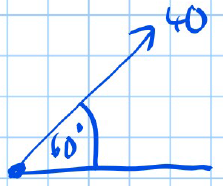
2. Use to get the parametric equations of motion in terms of
3. Write the equation in and in terms of t, then eliminate t.
Given:
Substituting into the equation for :
Projectiles: Horizontal Projectiles
When an object is projected horizontally, after projection, the only force acting on the object is its weight. The initial velocity is always of the form , where u is the initial horizontal speed.
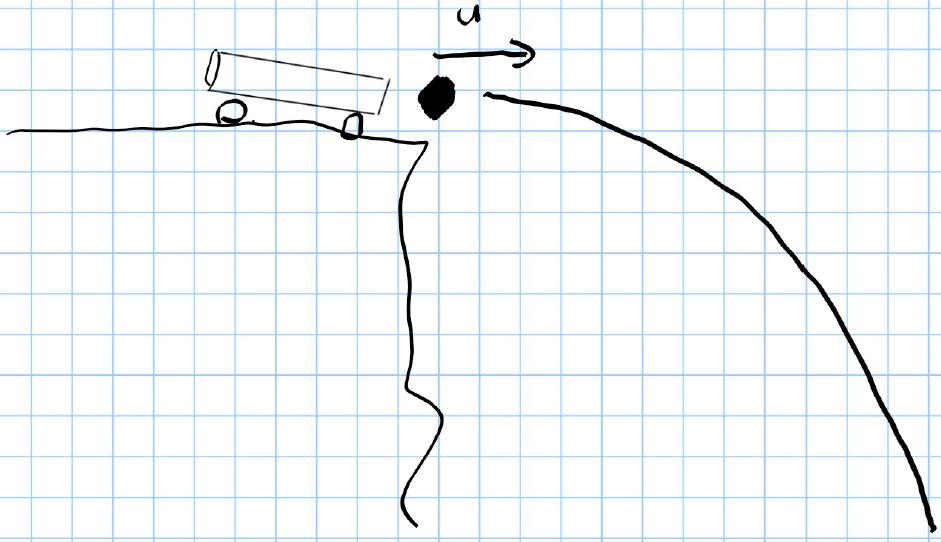
Note
Example:
A particle is projected horizontally at an initial speed of . 10 seconds later, it hits the ground. Find the distance above the ground from which it was projected.
Solution:
Given:
- Initial velocity
- Acceleration
- Time
- Displacement
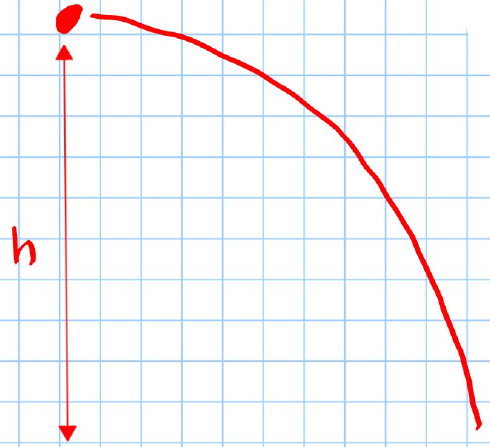
Steps:
- Set positive directions:
- Positive -direction is rightward (horizontal)
- Positive -direction is upward (vertical)
- Use the SUVAT equation:
- Calculate the horizontal displacement x:
- Calculate the vertical displacement h:
Therefore, the height .
Note:
To calculate the total distance from the origin O, use: