Cathode rays (AQA A-Level Physics): Revision Notes
📚Revision Notes
12.1.1 Cathode rays
Introduction to Cathode Rays
A cathode ray is a stream of particles observed when a potential difference is applied across a discharge tube containing a low-pressure gas. As the potential difference increases, the tube begins to glow, with the glow being most intense at the cathode. This glow, known as the cathode ray, puzzled early scientists until J.J. Thomson conducted experiments that led to the discovery of the electron.
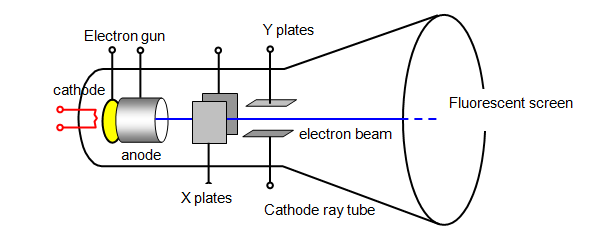
Key Properties of Cathode Rays (as Discovered by Thomson):
- Mass – Thomson measured the mass of cathode ray particles.
- Negative Charge – Cathode rays carry a negative charge.
- Uniform Properties – Regardless of the gas used in the discharge tube, the properties of cathode rays remain consistent.
- High Charge-to-Mass Ratio – Cathode rays exhibit a large ratio of charge to mass, much higher than atoms, indicating that they are subatomic particles. Following these observations, it was concluded that cathode rays were particles found in all atoms and were later named electrons.
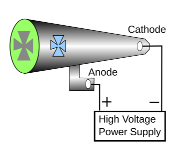
Process Leading to the Glow in the Discharge Tube:
The glow observed in the discharge tube is the result of several steps involving gas ionisation and electron acceleration. Here's a step-by-step breakdown:
- Ionisation of Gas – The high potential difference applied across the tube causes electrons to be stripped away from gas atoms. This forms pairs of positive ions and free electrons.
- Acceleration of Positive Ions – The positively charged ions are pulled towards the cathode. As these ions strike the cathode, they release additional electrons.
- Electron Acceleration and Excitation – The electrons, now in a low-pressure environment, are rapidly accelerated along the length of the tube. These high-speed electrons collide with other gas atoms, exciting them (i.e., raising their energy levels). When these excited atoms return to their original energy states, they emit photons (light particles), producing a visible glow.
- Intense Glow at the Cathode – The glow is brightest at the cathode because this is where gas ions and electrons combine, releasing a large number of photons in the process.
Understanding Why the Glow is Brightest at the Cathode:
The high brightness near the cathode results from the recombination of gas ions with electrons, which leads to the emission of light. This recombination occurs due to the concentration of positive ions around the cathode, where they can capture free electrons.