Specific charge of the electron (AQA A-Level Physics): Revision Notes
📚Revision Notes
12.1.3 Specific charge of the electron
Specific Charge Determination Methods
The specific charge of an electron (denoted as , where is charge and is mass) represents the charge-to-mass ratio. To measure this, physicists use methods involving magnetic and electric fields to determine the ratio. Here are two commonly studied methods:
1. Fine Beam Tube Method
In this experiment, electrons are accelerated using an electron gun and enter a fine beam tube filled with low-pressure gas and a uniform magnetic field:
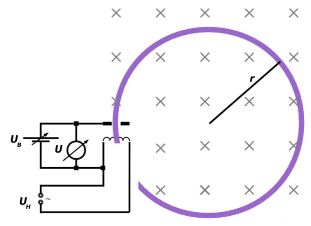
- The electrons are injected perpendicular to the direction of the magnetic field.
- The magnetic field exerts a force perpendicular to the electrons' motion, causing them to travel in a circular path. This happens because the magnetic force acts as a centripetal force.
- As they move in circles, the electrons excite gas atoms along their path. When these atoms de-excite, they release photons of light, making the circular path of the electrons visible and allowing the radius of the path to be measured.
Calculations:
- Using , where is the magnetic field strength, is the velocity, and is the radius of the path, we can rearrange to:
This formula allows the specific charge to be calculated by measuring , , and .
2. Thomson's Crossed Fields Method
This method uses crossed electric and magnetic fields:
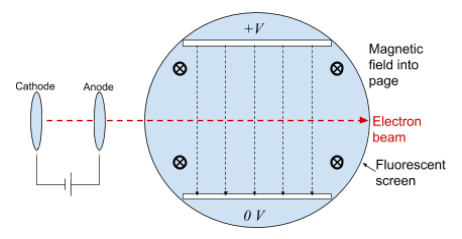
- Electrons are accelerated into an apparatus containing perpendicular magnetic and electric fields.
- The electric and magnetic forces act in opposite directions. By adjusting the fields until the electron beam is undeflected, we ensure that the forces are equal and opposite.
- Using Fleming's left-hand rule and balancing the forces where , we can rearrange to:
Here, is the accelerating voltage.
Significance of the Experiment
Thomson's measurements of the specific charge showed that electrons have a constant specific charge regardless of the gas used. This confirmed that all atoms contain electrons, leading to Thomson's plum pudding model. This model was later disproved by Rutherford's scattering experiment.
The specific charge of an electron is around 1.76 × 10¹¹ Ckg⁻¹, which is approximately 1800 times larger than the specific charge of a proton (the hydrogen ion) at 9.58 × 10⁷ Ckg⁻¹.