Newton’s corpuscular theory of light (AQA A-Level Physics): Revision Notes
📚Revision Notes
12.2.1 Newton's corpuscular theory of light
Newton's Theory of Light: Corpuscular Model
Isaac Newton proposed that light is composed of tiny particles, which he termed corpuscles. His corpuscular theory of light aimed to explain certain behaviours of light, including reflexion and refraction.
- Reflection:
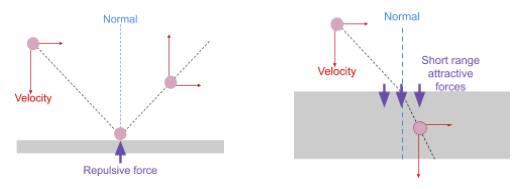
- According to Newton, corpuscles collide with surfaces, and a repulsive force at the surface pushes them away.
- This causes the perpendicular component of their velocity (relative to the surface) to reverse direction, while the parallel component of velocity remains unchanged.
- This behaviour explains why light reflects off surfaces at the same angle at which it arrives.
- Refraction:
- Newton theorised that when corpuscles approach a denser medium, they experience a short-range attractive force.
- This force increases the velocity perpendicular to the surface as corpuscles enter the denser medium, while the parallel component of velocity stays constant.
- As a result, light bends towards the normal when it enters a denser medium. Newton's model suggests that light travels faster in denser media, which is contrary to what we now understand but was accepted at the time. Newton's corpuscular theory successfully accounted for reflexion and refraction, but it struggled to explain other phenomena, such as diffraction. To address these limitations, alternative theories emerged.
Huygens' Wave Theory of Light
Christian Huygens proposed that light behaves as a wave rather than as a stream of particles. His model suggested that:
- Each point on a wavefront acts as a source of secondary wavelets, which spread out to form the next wavefront. This concept is known as Huygens' Principle.
- In this view, reflexion and refraction can be explained without invoking particles:
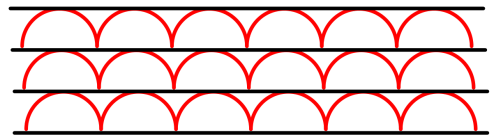
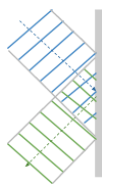
- Reflection:
- As wavelets move away from a surface, they rejoin to form the reflected wavefront.
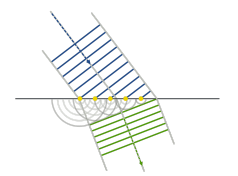
- Refraction:
- When entering a denser medium, wavelets slow down, causing the light wave to bend towards the normal as it enters the medium.
Huygens' principle laid the groundwork for understanding light as a wave, but Newton's theory was more widely accepted initially due to Newton's influence and because diffraction hadn't yet been observed. Additionally, the speed of light in various media had not been measured accurately, allowing Newton's model to remain popular despite its limitations.
Key Differences Between the Theories
- Newton's Corpuscular Theory:
- Light is composed of particles (corpuscles).
- Explains reflexion and refraction but suggests light travels faster in denser media (which is incorrect).
- More widely accepted initially due to Newton's reputation.
- Huygens' Wave Theory:
- Light behaves as a wave, with each point on a wavefront acting as a source of secondary wavelets.
- Better suited to explaining phenomena such as diffraction.
- Suggests light travels slower in denser media, aligning with modern understanding.