Significance of Young’s double slit experiment (AQA A-Level Physics): Revision Notes
📚Revision Notes
12.2.2 Significance of Young's double slit experiment
Young's Double-Slit Experiment: Key Findings
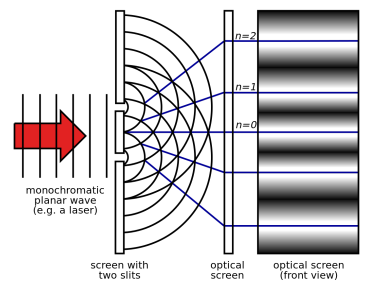
In Young's double-slit experiment, coherent light (light waves with a constant phase difference) is shone through two closely spaced slits. This setup causes the light to diffract (spread out) as it passes through each slit, with each slit acting as a coherent point source. The diffracted light waves then interfere with each other, creating a pattern of light and dark fringes on a screen behind the slits. This phenomenon is a result of interference, which is a property of waves.
- Constructive Interference:
- Bright fringes are produced where the light waves from each slit meet in phase (i.e., the peaks and troughs of the waves align).
- This constructive interference occurs where the path difference (difference in distance travelled from each slit to a point on the screen) between the waves is a whole number of wavelengths (i.e., , where is an integer).
- Destructive Interference:
- Dark fringes appear where the light waves meet completely out of phase (i.e., the peak of one wave aligns with the trough of another), cancelling each other out.
- This destructive interference happens when the path difference is equal to a half-integer multiple of wavelengths i.e., .
Significance of Young's Experiment
The results of Young's double-slit experiment provided strong evidence for the wave nature of light. According to Newton's corpuscular theory of light, if light were made up of particles (corpuscles), passing light through two slits would result in only two bright spots on the screen, corresponding to the slits. Instead, the interference pattern observed—bright and dark fringes—demonstrates diffraction and interference, behaviours characteristic of waves, not particles.
Impact on Scientific Understanding of Light
- Refutation of Newton's Theory: Young's experiment was a turning point because it contradicted Newton's corpuscular theory, which suggested that light should only produce two bright fringes rather than an interference pattern.
- Support for Huygens' Wave Theory: This experiment validated Huygens' principle, which proposed that each point on a wavefront can be considered a source of secondary wavelets that spread out in all directions. This concept explains how light waves can interfere to produce alternating light and dark fringes.
Why Huygens' Theory Was Initially Disregarded
At the time, Newton had a highly respected reputation, which influenced the scientific community's preference for his corpuscular theory over Huygens' wave theory. Additionally, phenomena like diffraction had not yet been extensively observed, and the speed of light in different media had not been accurately measured. It wasn't until the speed of light was measured in water, showing that light travels slower in water than in air, that scientists found evidence against Newton's theory (which predicted that light would travel faster in denser media).
Note
Walkthrough Example: Observing Interference Patterns
Imagine shining a laser beam through two narrow slits cut into an opaque card. On a screen placed a short distance away, you observe a series of alternating bright and dark lines (fringes).
- Bright Fringes (Constructive Interference): These appear where the light waves from each slit reinforce each other. Here, the path difference between the waves from each slit is an integer multiple of the wavelength.
- Dark Fringes (Destructive Interference): These appear between the bright fringes, where the waves from each slit cancel each other out. The path difference here is a half-integer multiple of the wavelength.