Special relativity (AQA A-Level Physics): Revision Notes
📚Revision Notes
12.3.5 Mass and energy
Einstein's theory of special relativity introduced the concept that mass and energy are interchangeable. This relationship is captured by the famous equation:
Where:
- is the energy,
- is the mass,
- is the speed of light in a vacuum.
This equation shows that a small amount of mass can be converted into a significant amount of energy due to the large value of .
1. Relativistic Mass
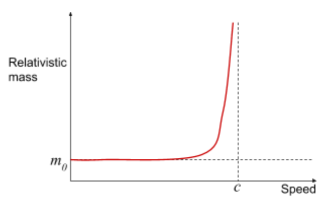
As an object's speed increases, so does its relativistic mass. This means that transferring energy to an object in motion causes its mass to increase. The faster an object moves, the more massive it becomes.
The relativistic mass of an object moving at speed can be calculated as:
Where:
- is the rest mass (the mass of the object when it's at rest),
- is the velocity of the object,
- is the speed of light.
This equation illustrates that as approaches , the relativistic mass increases significantly, approaching infinity. This is why no object with mass can reach the speed of light — it would require infinite energy to do so.
2. Kinetic Energy at Relativistic Speeds
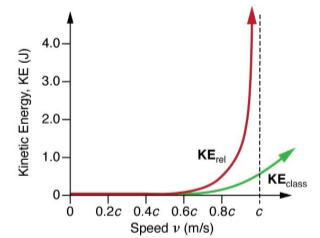
At relativistic speeds (over 1/10th of the speed of light, ), the classical kinetic energy equation is no longer accurate. Instead, relativistic kinetic energy must be used.
The total energy of a moving object at relativistic speeds is given by:
Where:
- is the total energy,
- is the rest mass.
The kinetic energy of an object moving at relativistic speeds can then be calculated as:
where is the rest energy of the object.
3. Bertozzi's Experiment – Experimental Evidence for Relativistic Mass Increase
Bertozzi's experiment demonstrated how the mass of an object increases with speed, providing support for Einstein's theory of special relativity.
In the experiment:
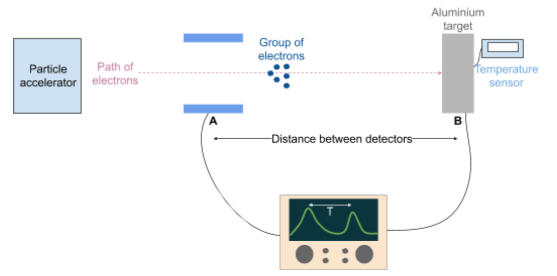
- Electrons were accelerated in pulses by a particle accelerator between two points, A and B. Their time of travel between these points was measured.
- The speed of the electrons was calculated from the measured distance and time.
- The electrons then collided with an aluminium target, where their kinetic energy was transferred into heat. This energy was measured by noting the temperature increase of the aluminium target using a temperature sensor.
The kinetic energy of one electron was calculated using:
Where:
- is the mass of the target,
- is the specific heat capacity of the target,
- is the temperature change,
- is the number of electrons in the pulse.
Results of Bertozzi's Experiment
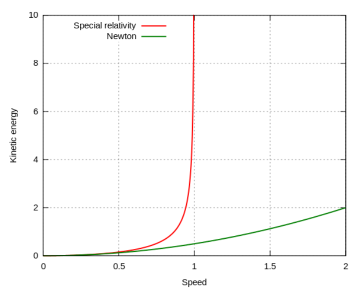
When the results of kinetic energy vs speed were plotted, they matched closely with predictions from special relativity. This was significant because:
- The graph showed that kinetic energy increases sharply as speed approaches , unlike in classical mechanics.
- It demonstrated that an object cannot reach the speed of light because its energy would approach infinity as it gets closer to .
Note
Key Concept: An Object Cannot Reach the Speed of Light
According to special relativity:
- As an object's speed approaches the speed of light, its mass approaches infinity.
- Consequently, the energy required to continue accelerating the object also becomes infinite, making it impossible for any object with mass to attain the speed of light.