Length contraction (AQA A-Level Physics): Revision Notes
📚Revision Notes
12.3.4 Length contraction
Note
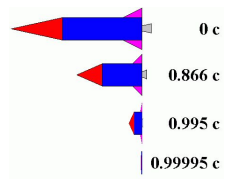
Length contraction is a phenomenon predicted by the theory of special relativity, where objects moving at very high speeds appear shorter in the direction of their motion relative to a stationary observer. This effect only occurs in inertial frames (frames moving at a constant velocity) and is significant at speeds close to the speed of light, .
The proper length of an object is defined as its length when measured by an observer at rest relative to the object. When observed from a frame moving relative to the object, the length appears contracted, and can be calculated using the length contraction formula:
Where:
- is the relative speed of the moving observer with respect to the object,
- is the speed of light in a vacuum. This formula shows that as approaches , the contracted length decreases, making the object appear shorter along the direction of its motion.
Important Note: Only the length in the direction of motion is affected by length contraction. The width and height of the object remain unchanged.
Note
Example of Length Contraction Using Muon Decay
Muon decay experiments provide experimental evidence for length contraction. Muons, particles that decay rapidly, enter Earth's atmosphere at high speeds. The distances they travel are observed to be shorter than expected due to their high velocity, making length contraction a necessary concept to explain their extended observed lifespan from our frame of reference.
Experimental Data:
- Distance between detectors, : 2 km
- Velocity of muons,
- Muon half-life (at rest): 1.5 μs
- Count rates:
- Detector 1: 100 counts per second
- Detector 2: 80 counts per second
Calculation of Expected Count Rate with Length Contraction
In this scenario:
- The proper length is 2 km, as the detectors are stationary relative to each other.
- We calculate the contracted length as seen by the muons, which are moving relative to the detectors.
- Calculate the Contracted Length, : Using the formula:
This contraction means the distance the muons need to travel appears shorter from their own perspective.
- Calculate the Time Taken to Travel the Contracted Distance: Now, we calculate the time it takes for muons to travel this contracted length:
- Calculate the Expected Count Rate: Using the half-life formula for decay:
- First, calculate the number of half-lives ( ):
- Then, calculate the decay factor using:
- Finally, calculate the expected count rate at Detector 2:
Since this expected count rate of 76 s^{-1} closely matches the observed count rate of 80 s^{-1}, this experiment provides strong evidence for length contraction.
Note
Note on Calculations in Special Relativity:
When performing calculations involving special relativity, it is important to use either time dilation or length contraction as appropriate for the frame of reference. Both effects are interrelated, so they should not be applied simultaneously in a single calculation.