Zener diode (AQA A-Level Physics): Revision Notes
📚Revision Notes
13.1.2 Zener diode
Note
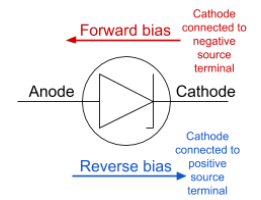
A Zener diode is a specialised type of semiconductor diode that behaves differently in forwards and reverse biases:
- Forward Bias:
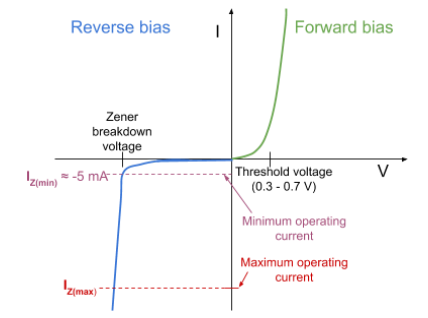
- Acts similarly to a standard diode, allowing current to flow easily in this direction once the applied voltage surpasses a certain threshold voltage. This is the minimum voltage required for current flow.
- Reverse Bias:
- Unlike regular diodes, which are designed to withstand high breakdown voltages without damage, a Zener diode is manufactured with a lower, more specific breakdown voltage.
- The breakdown voltage also called Zener voltage, is the reverse voltage at which a Zener diode begins to conduct significantly without damage. This property allows it to be used reliably at its breakdown voltage.
Key Characteristics of Zener Diodes
- In reverse bias, once the breakdown voltage is reached, the voltage across the Zener diode remains approximately constant even if the current changes. This makes it suitable for applications requiring a steady reference voltage.
- For proper operation, the Zener diode requires a minimum current (often around 5 mA) to maintain its breakdown voltage.
Applications of Zener Diodes
The Zener diode's ability to maintain a stable voltage makes it ideal for:
- Constant Voltage Source:
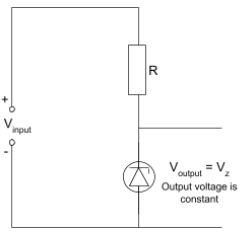
- Supplies a stable voltage even when the input voltage fluctuates.
- Voltage Reference:
- In circuits where a measured voltage needs to be compared to a reference (e.g., sensing circuits), the Zener diode can provide a reliable reference voltage.
Circuit Requirements for Zener Diodes
For a Zener diode to function correctly:
- Input voltage must be greater than the Zener breakdown voltage .
- Current through the diode should remain above a certain minimum level (e.g., 5 mA) but within safe limits to prevent overheating.
- No current should be drawn from the output of the circuit, as this could affect the voltage stability provided by the Zener diode.
Note
Example Problem: Calculating Resistor Value in a Zener Diode Circuit
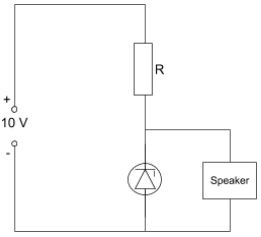
In a practical scenario, a Zener diode is used in a circuit that supplies a constant 4V to a speaker. Here's how to determine the required resistor value:
- Given Values:
- Input Voltage,
- Zener Voltage,
- Minimum Operating Current for Zener, mA
- Speaker Load Current, mA
- Step-by-Step Solution:
- Calculate Voltage Across Resistor:
- The Zener voltage is 4 V, so the resistor must drop the remaining 6 V (i.e., V).
- Determine Total Current:
- Total current flowing through the resistor is the sum of the minimum current required by the Zener and the current for the speaker load, i.e., = .
- Calculate Resistor Value:
- Using Ohm's law, . Thus, a 57 Ω resistor is required to maintain the correct operation of the Zener diode circuit in this configuration.
Note
Important Notes on Zener Diodes in Circuits
- Current Limiting: A resistor is commonly placed in series with the Zener diode to ensure that the current stays within a safe range, preventing damage to the diode.
- Voltage Stability: The Zener voltage will remain stable as long as the diode operates within its specified current range, making it suitable for stabilising the voltage in circuits where stability is crucial.