Principles of communication systems (AQA A-Level Physics): Revision Notes
📚Revision Notes
13.6.1 Principles of communication systems
Note
A communication system is a structured setup used to transfer information from one point to another. The basic structure involves nine components organised into a sequence that allows effective transmission and reception of signals. Here is an overview of each component, along with their roles in the communication process:
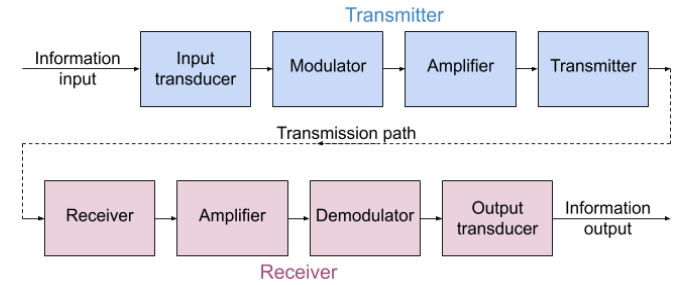
Components of a Communication System
- Input Transducer
- Function: Converts input information into an electrical signal that can be processed within the system.
Note
- Examples:
- Microphones for sound input.
- Cameras for visual input.
- Computers for digital data input.
- Modulator
- Function: Modifies the signal so it is suitable for transmission. This involves superimposing the information signal onto a carrier wave (e.g., radio or infrared waves) to prepare it for transmission.
- Note: Detailed modulation techniques are covered in further sections.
- Amplifier (Transmission)
- Function: Increases the amplitude of the signal, ensuring it is strong enough to travel through the transmission medium and resist interference from noise. Amplification also helps the signal cover greater distances.
- Concept: Signals experience attenuation (loss of strength) when transmitted, so amplification is crucial.
- Transmitter
- Function: Converts the electrical signal into a form suitable for transmission over the chosen medium.
Note
- Examples:
- Aerials convert electrical signals to radio waves.
- Infrared LEDs or Laser diodes convert signals into light waves.
- Transmission Path
- Function: The medium through which the signal travels from the transmitter to the receiver.
Note
- Examples:
- Free Space for radio waves.
- Optical Fibres for light or infrared waves.
- Copper Wires for electrical signals.
- Receiver
- Function: Detects the transmitted signal and converts it back into an electrical form for further processing.
Note
- Examples:
- Aerials for radio waves.
- Photodiodes for light or infrared waves.
- Amplifier (Receiver)
- Function: Similar to the transmission amplifier, this component boosts the received signal to compensate for attenuation and improve the quality of the received signal before further processing.
- Demodulator
- Function: Extracts the original information signal from the carrier wave, isolating the transmitted information in its usable form.
- Output Transducer
- Function: Converts the signal back to its original format, making it usable in its intended application.
Note
- Examples:
- Speakers convert electrical signals to sound.
- Printers convert electrical signals to mechanical outputs.
- Projectors convert electrical signals to light outputs.
Note
Example Walk-through
Consider a communication system designed to transmit voice signals over long distances:
- Input Transducer: A microphone captures the voice and converts it into an electrical signal.
- Modulator: This signal is superimposed onto a carrier wave to prepare it for radio transmission.
- Amplifier (Transmission): The signal's amplitude is increased to ensure it travels far enough without significant loss.
- Transmitter: The modulated signal is sent out through an aerial as radio waves.
- Transmission Path: The signal travels as radio waves through free space.
- Receiver: An aerial at the receiving end detects the radio waves and converts them back to an electrical signal.
- Amplifier (Receiver): This amplifier boosts the received signal, compensating for any attenuation that occurred during transmission.
- Demodulator: The original voice signal is separated from the carrier wave, isolating it for final output.
- Output Transducer: A speaker then converts the electrical signal back into sound, allowing the received voice to be heard.
Note
Key Points for Communication Systems
- Attenuation: Loss of signal strength during transmission. Amplifiers are used to mitigate this.
- Modulation and Demodulation: Modulation allows efficient transmission over long distances, while demodulation recovers the original signal.
- Carrier Waves: Used in modulation to carry information. Examples include radio and light waves.
- Input and Output Transducers: Essential for converting information between physical signals (like sound or light) and electrical signals usable by the communication system.