Transmission media (AQA A-Level Physics): Revision Notes
📚Revision Notes
13.6.2 Transmission media
Note
Transmission media are channels through which data travels from the transmitter to the receiver. The three primary types are metal wire, optical fibre, and electromagnetic waves. Each has distinct properties suited for different applications in data transmission.
1. Metal Wires
Metal wires, such as copper, create a direct electrical connection between the transmitter and receiver. They are typically used for short distances and lower data transfer rates. However, they are susceptible to corrosion and oxidation, which degrades their performance.
Types of Metal Wires:
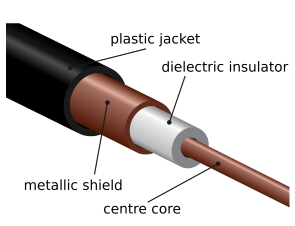
- Coaxial Cable
- Structure: It has a central copper conductor, encased in an insulator, then a braided metal shield, and finally an outer insulating jacket.
- Uses: Effective for short-distance transmission, as signal power is halved every 5 metres.
- Pros: Can handle high frequencies (up to 1 GHz).
- Cons: Low security and suitable only for short distances.
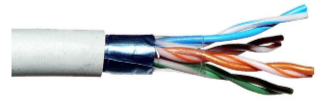
- Twisted Pair Cable
- Structure: Consists of pairs of insulated wires twisted together to reduce interference.
- Uses: Transmits over longer distances than coaxial, with the signal power halving every 12.5 metres.
- Pros: Slightly more secure and can handle frequencies up to 250 MHz.
- Cons: Limited security but less prone to interference than coaxial cable.
- Plain Copper Wire
- Structure: A simple, insulated wire without additional shielding.
- Uses: Basic, low-frequency applications.
- Cons: Very susceptible to interference, insecure, and unsuitable for high frequencies.
2. Optical Fibres
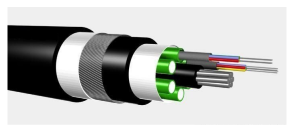
Optical fibres carry data in the form of light, providing a direct optical connection between the transmitter and receiver. These fibres are highly efficient for long-distance and high-frequency transmission.
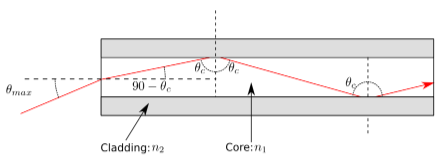
- Structure: Optical fibres consist of a core with high optical density, surrounded by cladding with lower density. This structure ensures total internal reflexion (TIR), preventing light from escaping the core and protecting the signal from degradation.
- Advantages:
- High Security: Difficult to intercept without breaking the fibre.
- Noise Resistance: Light signals are confined, minimising interference.
- Cost-Effective: Made from glass, making it cheaper than metals and more efficient.
Types of Optical Fibres:
- Multi-mode: Allows multiple light rays to pass simultaneously, suitable for short distances.

- Single-mode: Narrower fibres that reduce dispersion, allowing for longer-distance transmission but are costlier.

3. Electromagnetic Waves
Electromagnetic waves enable data transfer without a direct physical link between the transmitter and receiver, often through free space. They are generally insecure as they can be intercepted but can be encrypted for added security.
- Types:
- Longwave (150 kHz - 300 kHz): Large wavelengths allow signals to diffract around obstacles, suitable for long distances.
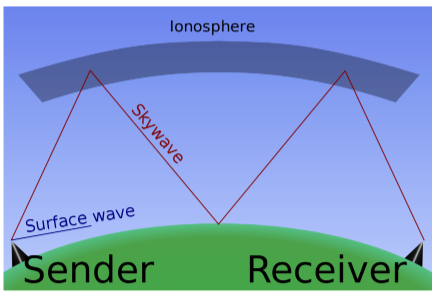
- Shortwave (3 MHz - 30 MHz): Uses ionospheric refraction for long-distance communication, like radio broadcasts.
- Microwave (2 GHz - 100 GHz): Travels in straight lines and requires line-of-sight, commonly used in satellite communications.
4. Satellite Communication
Satellites relay data over vast distances, useful for applications like TV and telephone signals. Two main satellite orbits are used:
-
Geostationary Orbit:
- Completes one orbit in 24 hours, remaining above the same Earth point, ideal for constant connection applications (e.g., TV broadcast).
-
Low-Orbit Satellites:
- Move faster, useful for global coverage, weather monitoring, and scientific research, as they provide coverage across the Earth's surface. Up-link and Down-link Frequencies:
-
Different frequencies are used for transmissions to (up-link) and from (down-link) the satellite to prevent interference.
Comparison of Transmission Media
| Medium | Data Transmission Rate | Cost | Security |
|---|---|---|---|
| Metal Wire | 10 Mbit s⁻¹ to 1 Gbit s⁻¹ | Cheaper for basic rates | Low |
| Optical Fibre | Up to 100 Tbit s⁻¹ | Expensive but better value | Very high |
| EM Waves | 20 kbit s⁻¹ to 275 Mbit s⁻¹ | Economical, no physical link | Low |
| Satellite | Up to 50 Mbit s⁻¹ | Extremely high | Low |