Newton’s law (AQA A-Level Physics): Revision Notes
📚Revision Notes
7.2.1 Newton's law
Understanding Gravity
Note
Gravity is a force that acts on any objects that have mass and is always attractive. Unlike electric forces, which can be either attractive or repulsive depending on the charges involved, gravitational forces only pull objects together. Gravity is the fundamental force that governs the motion of planets, stars, and galaxies, and it plays a central role in the behaviour of objects on Earth as well.
Newton's Law of Gravitation
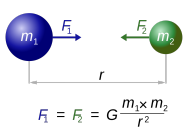
Newton's law of gravitation explains how the gravitational force between two objects depends on their masses and the distance between them.
- Directly Proportional to the Product of the Masses: The gravitational force is stronger if either or both of the masses are larger.
- Inversely Proportional to the Square of the Distance Between Them: As the distance between the two objects increases, the gravitational force between them decreases rapidly. Specifically, if the distance doubles, the force becomes one-fourth as strong. The formula for gravitational force is:
where:
- is the gravitational force between the two masses.
- is the gravitational constant , .
- and are the masses of the two objects.
- is the distance between the centres of the two masses.
Note
Explanation with Example Imagine two objects with masses and placed a distance apart. According to Newton's law of gravitation, each object will exert an equal but opposite gravitational force on the other, directed towards the centre of the other object.
For example, if Earth and the Moon are considered:
- The mass of Earth and the mass of the Moon contribute to the gravitational force between them.
- The force can be calculated by substituting their masses and the distance (average distance between the centres of Earth and the Moon) into the gravitational formula. This gravitational attraction is what keeps the Moon in orbit around Earth.
Note
Key Points
- Gravitational forces are always attractive – they never repel.
- The force is mutual: the force that exerts on is equal in magnitude and opposite in direction to the force that exerts on .
- Inverse-square law: The gravitational force diminishes rapidly with distance. If you triple the distance between two objects, the gravitational force becomes one-ninth as strong.
Important Concepts
- Gravitational Constant : A fundamental constant of nature that appears in the gravitational force equation.
- Vector Nature of Force: Gravitational force has both magnitude and direction, pointing towards the centre of each mass involved.
- Applications of Newton's Law of Gravitation: Used in calculating gravitational forces between astronomical objects, understanding orbits, and explaining phenomena like tidal forces.