Gravitational field strength (AQA A-Level Physics): Revision Notes
📚Revision Notes
7.2.2 Gravitational Field Strength
Gravitational Field:
A gravitational field is a region around a mass where another mass experiences a gravitational force. Gravitational fields can be classified as either:
- Uniform Field
- Radial Field
Types of Gravitational Fields
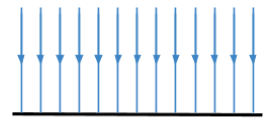
- Uniform Field: In a uniform gravitational field, the field strength is constant everywhere, meaning any object within this field will experience the same gravitational force regardless of its position. This is represented by parallel, equally spaced field lines pointing in the same direction. For example, near the Earth's surface, the gravitational field is approximately uniform over short distances.
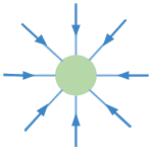
- Radial Field: In a radial gravitational field, the strength of the gravitational force changes with distance from the centre of the mass creating the field. The field lines radiate outward from a central point (for instance, the centre of the Earth or any spherical mass) and become less dense as you move further from the centre, indicating a decrease in field strength. In a radial field, the gravitational force weakens with distance due to the inverse-square law.
Gravitational Field Strength
The gravitational field strength at a point within a gravitational field represents the force exerted per unit mass at that point. It is measured in newtons per kilogramme ().
- In a uniform field, is constant.
- In a radial field, varies with distance from the centre of mass. There are two formulas used to calculate , depending on the nature of the field:
- General Formula:
Where:
- is the gravitational force experienced by an object.
- is the mass of the object. This formula defines as the gravitational force per unit mass.
- Formula for Radial Fields:
Where:
- is the gravitational constant .
- is the mass of the object creating the gravitational field.
- is the distance from the centre of the mass to the point where is being measured. This formula is specific to radial fields and indicates that decreases with the square of the distance from the mass .
Note
Worked Example
Consider a point km above the Earth's surface. Given the Earth's mass and radius , calculate the gravitational field strength at that height.
- Find the distance from the centre of the Earth to the point:
- Use the radial field formula:
Substitute , and :
This shows that gravitational field strength decreases as the distance from the Earth's centre increases.
Note
Key Points
- Uniform Fields have constant values throughout the field, such as near the Earth's surface.
- Radial Fields have values that decrease with distance from the mass centre, following the inverse-square law.
- Gravitational field strength represents the force experienced per unit mass and varies depending on the field type.