Electric field strength (AQA A-Level Physics): Revision Notes
📚Revision Notes
7.3.2 Electric field strength
Definition
Note
Electric Field Strength () is defined as the force per unit charge that is experienced by an object in an electric field. The value of electric field strength is constant in a uniform field, but varies in a radial field.
Electric field strength can be calculated in three different ways depending on the type of field:
- General formula for electric fields:
Where:
- = electric field strength,
- = force on the charge,
- = magnitude of the charge.
- For uniform fields created by parallel plates:
Where:
- = potential difference across the plates,
- = distance between the plates.
- For radial fields (fields that radiate from a point charge):
Where:
- = permittivity of free space,
- = distance from the charge creating the field.
Types of Electric Fields
Electric fields, like gravitational fields, can be uniform or radial and are often represented by field lines:
- Uniform Field: A field with evenly spaced parallel lines, showing a constant electric force in one direction across the field.
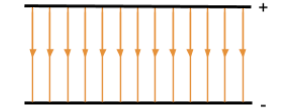
- Radial Field: A field with lines radiating outward or inward from a point charge. The field strength decreases with distance from the charge, as represented by the spacing between lines increasing further from the centre.

Calculating Work Done in an Electric Field
When moving a charged particle between two points in a uniform electric field, you can calculate the work done using the formula:
Where:
- = charge of the particle,
- = potential difference between the two points.
Note
Example Problem: Determining Charge Based on Movement in a Field
In uniform electric fields created by parallel plates, you can use the movement of a charged particle to determine its charge and polarity.
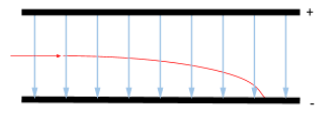
- Setup: A charged particle is fired at right angles to the electric field between parallel plates.
- Observation: The particle follows a parabolic path due to the constant electric force acting on it.
- If the particle's path curves toward the positive plate, it has a negative charge.
- If the particle's path curves toward the negative plate, it has a positive charge. In this way, uniform electric fields allow for the determination of particle charge based on its response to the field.
Note
Key Points
- Uniform fields apply the same electric force throughout, while radial fields have forces that decrease with distance.
- Work done in an electric field can be calculated with , and it's important for moving charged particles.
- Observing the motion of a particle in a uniform electric field can reveal its charge type based on the direction of curvature.