Magnetic flux and flux linkage (AQA A-Level Physics): Revision Notes
📚Revision Notes
7.5.3 Magnetic Flux and Flux Linkage
Magnetic Flux
Magnetic flux is a measure of the magnetic field lines passing through a given area. It quantifies how much of the magnetic field is 'flowing' through a specified surface.
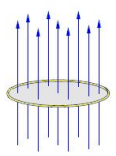
- Formula: Magnetic flux can be calculated using:
where:
- is the magnetic flux density (measured in Teslas, ),
- is the area perpendicular to the magnetic field lines (in square metres, ).
- Concept: If the magnetic field is perpendicular to the area , then all field lines pass directly through, giving the maximum flux. If the field is parallel to the area, no field lines penetrate the area, resulting in zero flux.
Magnetic Flux Linkage
Magnetic flux linkage is used to describe the magnetic flux in a coil of wire, where multiple turns contribute to a stronger total effect. It's defined as the product of the magnetic flux and the number of turns in the coil.
- Formula:
where:
- is the number of turns of the coil.
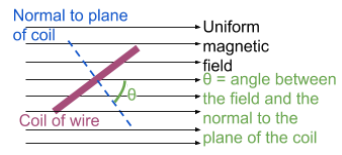
- Impact of Angle: If the magnetic field isn't perpendicular to the coil, you must adjust for the angle ( ) between the field direction and the normal (perpendicular) to the coil surface. The formula then becomes:
and for flux linkage:
where:
- is the angle between the magnetic field direction and the normal to the surface of the coil.
Explanation Using Trigonometry:
When the magnetic field isn't perpendicular to the surface, only the component of perpendicular to contributes to the flux. By resolving into components, you use as the effective field density. This adjustment accounts for the angle and ensures that only the field lines passing perpendicularly through the area contribute to the magnetic flux.
Note
Key Points
- Magnetic Flux : Represents the quantity of magnetic field passing through an area. Calculated as .
- Flux Linkage : For a coil, the total flux is multiplied by the number of turns. Formula .
- Angle Adjustment: When the magnetic field is angled with respect to the surface, adjust with : .