Electromagnetic induction (AQA A-Level Physics): Revision Notes
📚Revision Notes
7.5.4 Electromagnetic induction
Electromagnetic Induction
Electromagnetic Induction occurs when a conducting rod moves relative to a magnetic field. The motion of the rod through the magnetic field causes electrons within the rod (which are charged particles) to experience a force, resulting in an accumulation of charge on one side of the rod. This creates an induced electromotive force () within the rod.
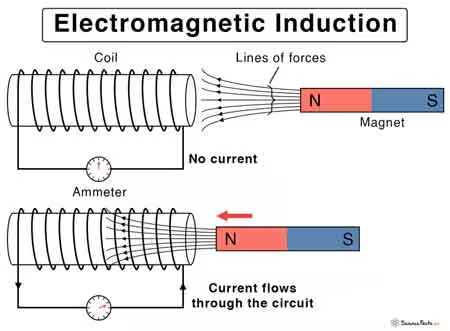
If this rod is part of a closed circuit, the induced emf will cause a current to flow. This principle also applies if a magnet moves relative to a coil; provided the circuit is complete, a current will be induced in the coil.
Laws Governing Electromagnetic Induction
There are two primary laws that describe the phenomena of electromagnetic induction:
- Faraday's Law: The magnitude of the induced emf is equal to the rate of change of magnetic flux linkage through the circuit. This means that a faster change in flux linkage will induce a larger emf.
- Lenz's Law: The direction of the induced current will always be such that it opposes the change in magnetic flux that caused it. This law reflects the principle of conservation of energy, ensuring that the induced emf generates a current that opposes the motion of the magnet or conductor.
Demonstrating Lenz's Law
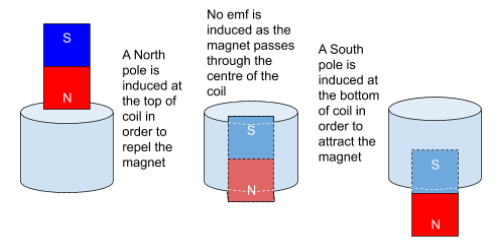
To understand Lenz's law, consider an experiment where a magnet is dropped through a coil of wire:
- As the magnet approaches the coil, the magnetic flux through the coil changes, inducing an emf and current in the coil.
- According to Lenz's law, the direction of this induced current will oppose the motion of the magnet. This effect can be observed by comparing the time taken for a magnet to fall through the coil versus free fall. The magnet will fall slower when it passes through the coil due to the opposing forces created by the induced currents.
Faraday's Law Equation
Faraday's Law can be mathematically represented as:
where:
- = induced emf,
- = number of turns in the coil,
- = rate of change of magnetic flux linkage.
This equation can be further applied to specific scenarios:
- For a straight conductor of length moving at a velocity perpendicular to a magnetic field , we can use:
Induction in a Rotating Coil
When a coil rotates at a constant angular speed within a magnetic field, the induced emf changes over time according to the rate of change of flux linkage:
- The flux linkage in this case is given by:
where:
- = magnetic flux density,
- = area of the coil,
- = number of turns,
- = angular velocity,
- = time.
- The induced emf can be derived as:
Note
Key Points
- Electromagnetic induction occurs when there is relative motion between a conductor and a magnetic field.
- Faraday's Law quantifies the emf induced, showing it depends on the rate of change of magnetic flux.
- Lenz's Law ensures that the induced emf opposes the cause of the induction, supporting energy conservation.
- In rotating coils, the emf varies sinusoidally due to the changing angle between the magnetic field and the coil.