The operation of a transformer (AQA A-Level Physics): Revision Notes
📚Revision Notes
7.5.6 The Operation of a Transformer
Transformers
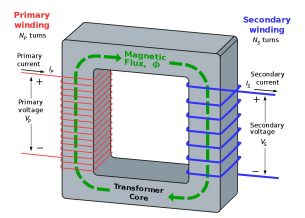
Transformers are electrical devices used to change the voltage of alternating current (AC). They are commonly used to increase (step up) or decrease (step down) voltage levels for efficient transmission of electrical power over long distances. A transformer consists of:
- Primary Coil: Connected to the input (supply) voltage.
- Secondary Coil: Connected to the output voltage.
- Iron Core: Links the magnetic field between the primary and secondary coils, enhancing efficiency. When AC flows through the primary coil, it generates a changing magnetic field. This magnetic field passes through the iron core and interacts with the secondary coil, inducing an emf (electromotive force) in the secondary coil due to Faraday's Law of Electromagnetic Induction.
Transformer Equation
The relationship between the voltage and the number of turns in each coil can be given by:
Where:
- and are the number of turns in the secondary and primary coils, respectively.
- and are the voltages in the secondary and primary coils, respectively. This equation implies that the ratio of the voltages is directly proportional to the ratio of the number of turns in the coils.
Types of Transformers
- Step-Up Transformer: Increases voltage by having more turns on the secondary coil than the primary.
- Step-Down Transformer: Decreases voltage by having fewer turns on the secondary coil than the primary.
Transformer Efficiency
Transformers are designed to be highly efficient, but some energy losses still occur, mainly due to eddy currents and resistance in the coils. The efficiency of a transformer can be calculated by:
Where:
- and are the currents in the secondary and primary coils, respectively.
- and are the voltages in the secondary and primary coils, respectively.
Reducing Energy Losses in Transformers
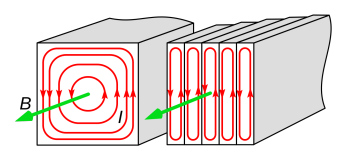
- Eddy Currents: These are loops of electric current induced within the iron core due to the changing magnetic field. They create unwanted heating and energy loss. To reduce this:
- Use a laminated iron core, which restricts the path of eddy currents and minimises heating.
- High-resistivity material can also be used to lessen the intensity of eddy currents.
- Resistance in Coils: Heating due to resistance in the coils can be reduced by:
- Using thick wires with low resistance.
- Magnetic Material: A soft iron core is used as it can be easily magnetised and demagnetised, which is essential for efficient operation of a transformer.
Power Transmission and Voltage Step-Up
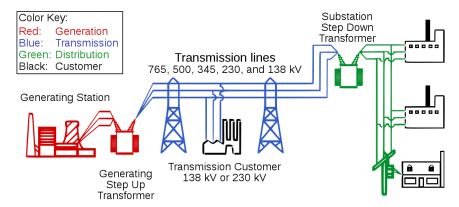
For efficient transmission of power over long distances, step-up transformers are used to increase the voltage, which decreases the current. This minimises the power lost due to resistance in the transmission lines, calculated by:
Where is the resistance of the transmission line. As voltage is stepped up, the current decreases, reducing losses. This is why high-voltage transmission is used in power grids.
Note
Example Calculation: Power Loss in Transmission
An alternating electric current leaves a power station at 25,000 V and passes through a step-up transformer with 50 turns on the primary coil and 750 turns on the secondary coil.
Calculate the output voltage.
- Calculate Output Voltage: Using the transformer equation:
- Calculate Power Loss Over Distance: If 500 MW of power is transmitted along a 225 km line with a resistance of 0.2 Ω per km, the power wasted can be calculated as follows:
- Total Resistance:
- Find Current Using :
- Calculate Power Lost :