Rutherford scattering (AQA A-Level Physics): Revision Notes
📚Revision Notes
8.1.1 Rutherford scattering
Key Concept
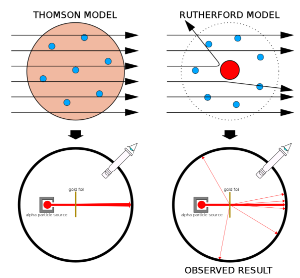
Rutherford scattering provided critical evidence for the existence of a nucleus within the atom. This was a breakthrough as it challenged the previously accepted plum pudding model proposed by J.J. Thomson.
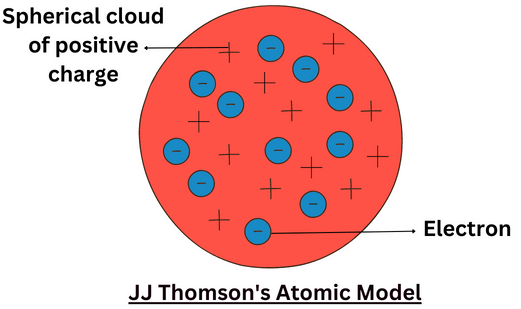
Thomson's Plum Pudding Model
Before Rutherford's experiment, it was widely accepted that an atom consisted of a sphere of positive charge with negative charges (electrons) distributed evenly within it—similar to "plums in a pudding."
Rutherford's Experiment Setup
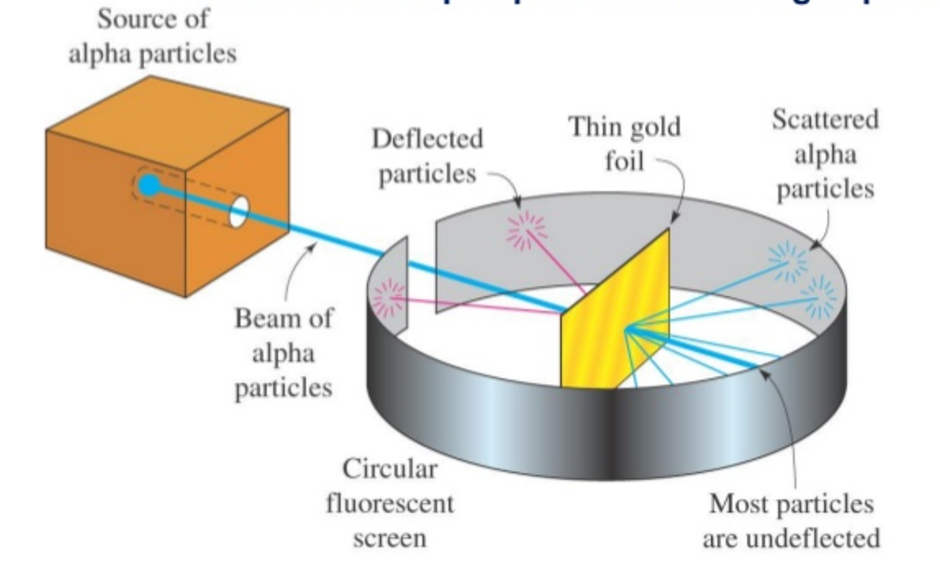
- Alpha Particles: A source emitting alpha particles was aimed at a very thin sheet of gold foil placed inside a chamber.
- Detection: The chamber was coated with a fluorescent material that would emit light upon being struck by alpha particles, making it possible to observe their paths.
- Observation: A microscope was used to examine the scattering angles of the alpha particles after they struck the foil.
Expected vs. Observed Results
If the plum pudding model were accurate, most alpha particles would pass through with minimal deflexion, as the charge in the atom would be spread out evenly.
However, Rutherford observed:
- Most alpha particles passed straight through with no deflexion, indicating that atoms are mostly empty space.
- A small fraction of particles were deflected at large angles, suggesting a concentrated positive charge repelling them.
- A very few particles were deflected back by angles greater than 90°, implying that the positive charge was in a small, dense central region.
Conclusion: The Nuclear Model
Rutherford's findings led to a new model, known as the nuclear model:
- The atom has a small, dense nucleus that is positively charged.
- Electrons exist outside the nucleus, meaning that most of the atom is empty space.