Limitations of ground-based optical telescopes (AQA A-Level Physics): Revision Notes
📚Revision Notes
Limitations of ground-based optical telescopes
Introduction
Ground-based optical telescopes face several challenges that limit the quality of astronomical observations. These limitations arise primarily from Earth's atmosphere, which both absorbs and distorts incoming light from celestial objects. Understanding these constraints helps explain why astronomers seek alternative observing locations and techniques.
Note
Understanding atmospheric limitations is essential for appreciating why modern astronomy increasingly relies on space-based observatories and why ground-based telescopes are built in specific, carefully chosen locations.
Atmospheric absorption
The atmosphere absorbs electromagnetic radiation across various wavelengths, reducing the amount of light that reaches ground-based telescopes. Several atmospheric components contribute to this absorption:
- Ozone absorbs ultraviolet and some visible wavelengths, preventing certain frequencies from reaching the surface.
- Oxygen also absorbs specific wavelengths of light passing through the atmosphere.
- Water vapour significantly absorbs infrared radiation and contributes to absorption across other parts of the spectrum.
- Carbon dioxide absorbs infrared and some visible light wavelengths.
- Dust particles within the atmosphere both absorb and scatter incoming light. This scattering redirects photons away from their original path, further reducing the light intensity reaching the telescope.
Important
The combined effect of these absorbing components means that not all light from astronomical objects successfully reaches ground-based optical telescopes, limiting their sensitivity and the range of objects they can observe. This is why even the most powerful ground-based telescopes cannot match the clarity achieved by space-based observatories.
Atmospheric distortion and turbulence
Beyond absorption, the atmosphere also distorts incoming light, degrading image quality. This distortion occurs because air is not perfectly uniform in density or temperature.
Atmospheric turbulence results from convection currents within the atmosphere. As pockets of air at different temperatures move and mix, they create regions with varying refractive indices. When light passes through these turbulent regions, it bends and wobbles, causing stars to appear to twinkle and making images less sharp. This effect is called astronomical seeing and represents a major limitation for achieving high-resolution images.
The constantly shifting atmosphere causes stellar images to blur and dance, preventing telescopes from achieving their theoretical maximum resolution based solely on their aperture size.
Note
The twinkling of stars that we see with the naked eye is actually evidence of atmospheric turbulence at work. While this twinkling appears charming to casual observers, it represents a significant challenge for astronomers trying to capture sharp, detailed images of celestial objects.
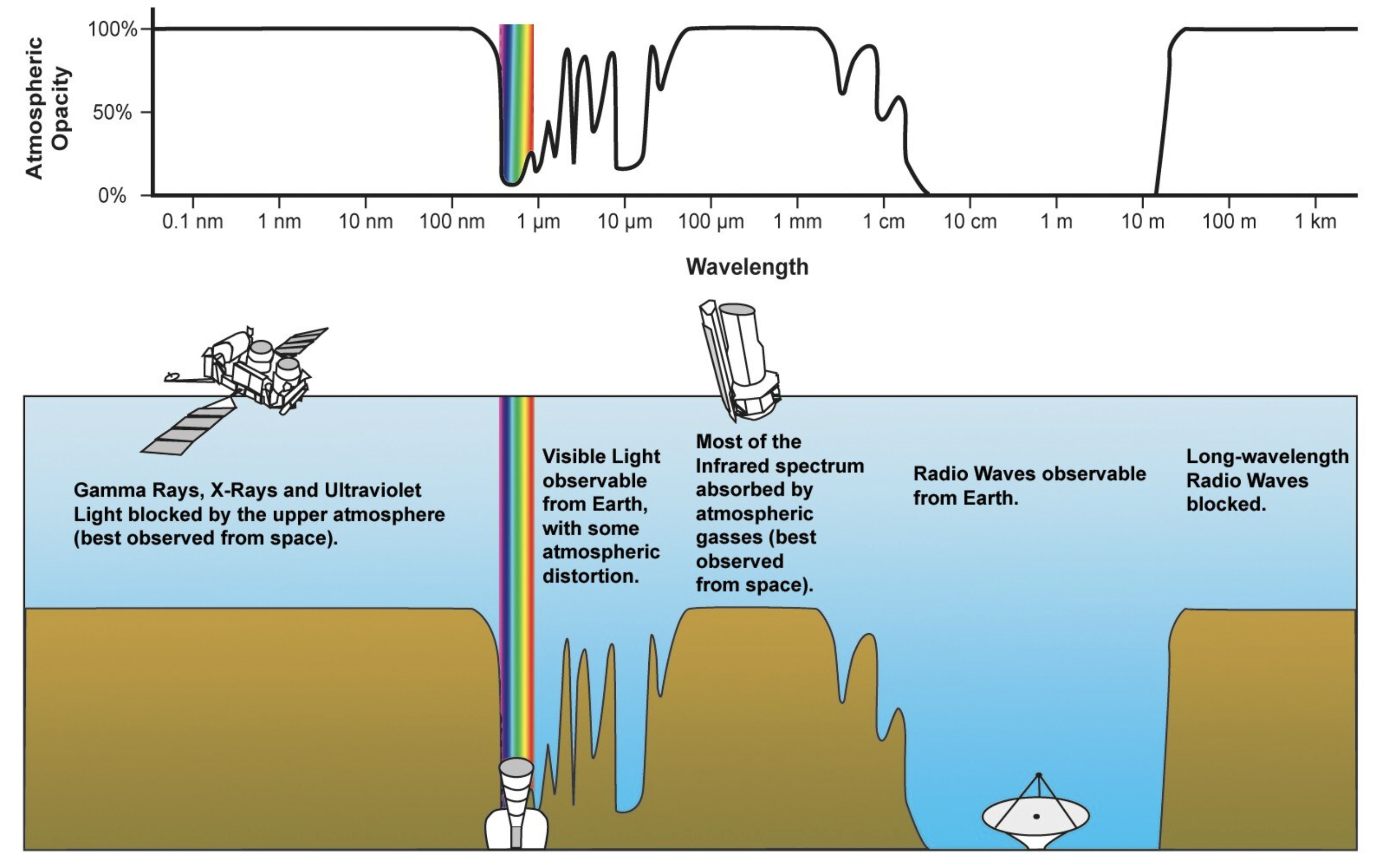
Atmospheric opacity
Atmospheric opacity measures how much electromagnetic radiation the atmosphere absorbs as a function of wavelength. Higher opacity means more absorption and less transmission.
The atmosphere shows varying opacity across the electromagnetic spectrum:
- Visible wavelengths: The atmosphere is relatively transparent, allowing optical telescopes to function from ground level, though some distortion occurs
- Radio wavelengths: A range of radio waves can pass through the atmosphere, enabling ground-based radio astronomy
- Gamma rays and X-rays: These are strongly absorbed by the upper atmosphere and cannot reach ground level
- Ultraviolet: Most ultraviolet radiation is blocked by the atmosphere
- Infrared: Much of the infrared spectrum is absorbed by atmospheric gases, though some infrared windows exist where observations are possible
- Long wavelength radio waves: These are blocked by the atmosphere despite shorter radio waves passing through
Note
This selective transparency explains why certain types of astronomy must be conducted from space while others can operate successfully from Earth's surface. The atmosphere essentially acts as a natural filter, determining which wavelengths of light can be studied from the ground.
Solutions to atmospheric limitations
Astronomers employ several strategies to minimize atmospheric effects on optical observations:
Ground-based solutions
Building observatories at carefully selected locations helps reduce atmospheric problems:
- High altitude sites: Placing telescopes at high elevation means they sit above a significant portion of the atmosphere, particularly the densest, most turbulent lower layers
- Dry locations: Areas with low humidity reduce water vapour absorption and distortion
- Pollution-free areas: Remote sites away from cities minimise light pollution and atmospheric contamination from dust and aerosols
Example
Real-World Observatory Locations
Many modern observatories are located on mountain peaks in desert regions that combine all these advantages:
- Mauna Kea, Hawaii: At 4,207 meters elevation, this volcanic peak sits above 40% of Earth's atmosphere and has extremely dry, stable air
- Atacama Desert, Chile: This high-altitude desert hosts multiple world-class observatories, benefiting from minimal water vapour and over 300 clear nights per year
Space-based solutions
The most effective way to eliminate atmospheric limitations is to place telescopes beyond Earth's atmosphere entirely. Space-based telescopes avoid all absorption, scattering, and turbulence effects.
The Hubble Space Telescope, orbiting above the atmosphere, has provided exceptionally clear images since its deployment. Its successor, the James Webb Space Telescope, operates in space to observe primarily in the infrared spectrum without atmospheric interference.
Important
Space-based telescopes can also observe wavelengths that are completely blocked by the atmosphere, such as ultraviolet, X-rays, and most infrared wavelengths, opening up entirely new windows for astronomical observation. This capability has revolutionized our understanding of the universe by revealing phenomena invisible from Earth's surface.
Beyond visible light
While optical telescopes observe in the visible spectrum, many astronomical phenomena emit radiation at other wavelengths. Some objects and events are only detectable, or appear much more clearly, when observed beyond the visible range.
However, since the atmosphere blocks many non-visible wavelengths, specialised non-optical telescopes (such as radio or X-ray telescopes) are required. For wavelengths strongly absorbed by the atmosphere, these instruments must typically operate from space-based observatories.
Note
Some exceptions exist: certain infrared windows allow limited ground-based infrared observations at high altitudes, and highly energetic gamma rays can be detected indirectly through the particle showers they create in the upper atmosphere.
Remember!
Summary
Key Points to Remember:
- Earth's atmosphere absorbs light through ozone, oxygen, water vapour, carbon dioxide, and dust, reducing the sensitivity of ground-based optical telescopes
- Atmospheric turbulence, caused by convection currents, distorts incoming light and degrades image sharpness
- Atmospheric opacity describes how much radiation the atmosphere absorbs at different wavelengths; the atmosphere is relatively transparent to visible light and some radio waves but blocks gamma rays, X-rays, most ultraviolet, and much of the infrared spectrum
- Ground-based solutions include building observatories at high altitude in dry, pollution-free locations
- Space-based telescopes completely avoid atmospheric limitations and can observe wavelengths blocked by Earth's atmosphere