Elections and Electoral Systems (AQA A-Level Politics): Revision Notes
📚Revision Notes
Elections and Electoral Systems
Both the UK and USA are liberal democracies that share fundamental democratic principles. These include the secret ballot, universal suffrage, free speech, and a choice of parties. Direct bribery and corruption are illegal in both countries. Since 1945, both nations have experienced regular rotation of power between major parties, without single-party dominance. However, beneath these basic similarities lie important structural, cultural, and rational differences in how elections and electoral systems operate.
Note
Despite their shared democratic foundations, the UK and USA differ significantly in how they structure and conduct elections. Understanding these differences requires examining structural frameworks, rational campaign strategies, and cultural influences on voting behaviour.
The structural aspect of elections and electoral systems
Structural aspects refer to the formal rules and frameworks that govern elections in each country. These are set by constitutional arrangements and legislation.
Terms of office
Both countries establish limited terms for elected offices. In the USA, these terms are constitutionally fixed. For example, senators serve 6-year terms, House Representatives serve 2-year terms, and presidents serve 4-year terms with a maximum of two terms under the Twenty-Second Amendment. Any change to these terms would require a formal constitutional amendment.
The UK has greater flexibility. MPs serve for a maximum of 5 years, but this can be changed through an Act of Parliament. Historically, the Septennial Act 1716 allowed parliaments to last 7 years, reduced to 5 years by the Parliament Act 1911. Crucially, there is no term limit for the UK Prime Minister. While no US president has served more than 8 years since 1945, two UK prime ministers have served 10 or more continuous years: Margaret Thatcher and Tony Blair.
Important
Key Constitutional Difference:
The USA's constitutionally fixed terms require formal amendments to change, making the system more rigid. The UK's flexible system allows Parliament to alter terms through simple legislation, demonstrating the principle of parliamentary sovereignty.
Elections and elected posts
The USA holds significantly more elections than the UK and has a much longer list of elected positions.
In the USA:
- Primary elections and caucuses are universal for candidate selection
- Presidential elections every 4 years
- Congressional elections every 2 years (all House seats, one-third of Senate)
- State-level elections for governor and state legislature
- Local officials including mayors, school board officials, sheriffs, agricultural commissioners, and even judges
- Ballot initiatives allow direct democracy at state level
In the UK:
- General elections at least every 5 years
- Local council elections
- Limited use of primaries (only a handful after the MPs' expenses scandal)
- Some directly elected mayors in cities like London and Manchester
- Elected police and crime commissioners
- Since 1997, devolved assemblies in Scotland, Wales, and Northern Ireland have elections
Note
The Scale of Elections
Americans vote far more frequently than UK citizens. A typical US voter might participate in primary elections, general elections, state elections, local elections, and ballot initiatives all within a two-year cycle. This reflects the American emphasis on direct democratic participation at multiple levels of government.
Devolution in the UK has created some parity with the USA's federal system, as Westminster elections are no longer the only significant elections in Scotland, Wales, and Northern Ireland.
Electoral systems
Both countries primarily use first-past-the-post (FPTP) for their main legislatures. This is a majoritarian electoral system where the candidate with the most votes wins, even without an absolute majority.
UK electoral systems:
- House of Commons: FPTP
- Devolved assemblies: various systems including Additional Member System (AMS) and Single Transferable Vote (STV)
- European Parliament (until 2020): proportional representation
- Result: coalition or minority governments are common in devolved assemblies
USA electoral systems:
- House of Representatives: FPTP (except Maine's ranked choice voting)
- Senate: FPTP
- Presidential election: Electoral College system
- Result: coalition governments do not occur at any level
Important
Critical Difference in Outcomes:
Despite the UK using various proportional systems in devolved assemblies, the USA exclusively uses FPTP and the Electoral College system. This means coalition governments are impossible in the USA but common in Scotland, Wales, and Northern Ireland. This fundamental difference shapes political dynamics and party strategies in each country.
The rational aspect of elections and electoral systems
Rational aspects concern how parties and candidates strategically campaign to maximise their chances of winning elections.
Similarities in campaign strategies
Both countries employ remarkably similar strategic approaches to winning elections, despite their different electoral structures.
Policies for natural supporters
Parties in both countries target their core voters with policies designed to appeal to their natural base.
Right-wing parties focus on issues like immigration:
- Republicans under Trump promised a wall on the Mexican border and faster removal of illegal immigrants
- Conservatives in 2010 promised to reduce net immigration to the "tens of thousands"
- Conservatives in 2019 proposed a points-based immigration system
Left-wing/liberal parties emphasise social justice and reducing poverty:
- Labour in 2019 promised to abolish Universal Credit and "End poverty by guaranteeing a minimum standard of living"
- Democrats in 2020 spoke of an economy "rigged against working families" where the rich capture a larger share while "working families' incomes have been largely stagnant"
- This echoes Labour's mantra under Jeremy Corbyn: "For the many not the few"
Example
Worked Example: Immigration Policy Messaging
Conservative/Republican messaging (2016-2020):
- Trump: "Build the wall" - direct, memorable slogan targeting concerns about illegal immigration
- UK Conservatives: Points-based system - appeals to voters wanting controlled immigration while sounding policy-focused
- Both messages targeted core voters concerned about immigration levels
Result: Both parties successfully mobilised their base voters on this issue, demonstrating how similar policy positions resonate across both countries.
The use of social media
Both countries make sophisticated use of social media to send targeted advertisements to potential supporters.
In the 2019 UK election, parties used gender-specific ads. Labour targeted women aged 55+ with ads about compensating 'Waspi' women affected by state pension age changes. These ads were viewed over 3 million times exclusively by this demographic.
In the USA, Trump's team posted over 2,000 Facebook ads in the first 8 months of 2019 using the term 'invasion' in relation to immigration, specifically targeting voters concerned about this issue.
Note
Micro-targeting Revolution
Modern campaigns use data analytics to identify and target specific voter demographics with tailored messages. This allows parties to speak directly to individual concerns, whether it's pension changes for older women or immigration policy for concerned voters, making campaigns more efficient but potentially more divisive.
Leaders' personal qualities
Both countries emphasise the skills and qualities of their candidates and leaders:
- Trump's campaign highlighted his business 'dealmaker' skills
- Johnson's campaign promoted his experience as two-term Mayor of London
Capturing swing states/marginal constituencies
Swing states (USA) and marginal constituencies (UK) are crucial to election outcomes.
In the 2019 UK campaign, 36 out of 61 constituencies visited by Johnson were marginals, while 58 out of 76 visited by Corbyn were marginals.
In the 2020 US campaign, Biden made 40% of his campaign visits to the crucial Midwest Rust Belt states, including 16 to Pennsylvania alone. Trump made 14 stops in Pennsylvania and 12 in Florida.
Note
The Electoral Mathematics
Both party leaders focus campaign resources on winnable seats rather than safe seats or unwinnable territory. This rational approach explains why vast areas of both countries see minimal direct campaigning, as parties concentrate efforts where they can make a difference to the overall outcome.
Differences between the systems
Personal attacks in campaigning
Campaigns in both countries criticise opponents, but attacks are more personal and vitriolic in the USA. The Trump rally chants of "Lock her up" (referring to Hillary Clinton) represented a new level of personal political assault. Historically, US campaigns have used highly negative advertising, such as opponents of George Wallace in 1968 using slogans like "If you liked Hitler, you'll love Wallace."
Important
Tone and Civility
While UK campaigns can be combative, they rarely reach the personal intensity seen in US elections. This reflects different cultural norms around political discourse, with the USA's First Amendment protections allowing more aggressive political speech than would be acceptable in UK political culture.
Focus on midterm elections
The USA devotes far more time, money, and focus to campaigning between presidential elections due to midterm elections. Winning or maintaining control of Congress midterm is crucial for the executive to deliver on promises requiring legislation, such as tax cuts and healthcare reform.
In the UK, general elections remain the focal point of electioneering, except for relatively infrequent referendums on issues like Brexit and Scottish independence. National referendums are not provided for in the US Constitution; direct democracy is entirely state-based.
The cultural aspect of elections and electoral systems
Cultural aspects reflect societal values and traditions that shape how elections are conducted and perceived.
Personalities
US elections have long been dominated by personalities as much as parties, reflecting the individualist nature of American society and culture. The presidential system emphasises the personal qualities, skills, and vision of candidates. This was true for Franklin D. Roosevelt in 1932 with his New Deal and Brain Trust, and remained true for Donald Trump in 2020.
However, the UK is increasingly similar. Winston Churchill campaigned on his personal wartime leadership record in 1945. Margaret Thatcher and Tony Blair ran highly personalised campaigns. Theresa May ("Brexit means Brexit") and Boris Johnson ("Get Brexit done") based campaigns on personal slogans in recent elections.
Note
The Presidentialisation of UK Politics
Despite having a parliamentary rather than presidential system, UK elections increasingly focus on party leaders' personalities and personal brands. This "presidentialisation" reflects changing media dynamics and voter behaviour, making UK elections more similar to American campaigns than ever before.
Televised debates between candidates emphasise personality focus. These debates started in the USA in 1960 but only began in the UK in 2010. UK debates typically include leaders of parties other than Labour and Conservatives, while US debates largely exclude third parties and independents (though Ross Perot appeared in 1992). The USA also has vice presidential debates, which have no UK equivalent.
Candidate selection
The USA uses primaries and caucuses for candidate selection, which have been fundamental for about 50 years. This system allows ordinary voters broad opportunities to participate, possibly a legacy from the earliest days of the republic and town hall meetings.
UK voter participation in candidate selection has historically been limited to party members in declining numbers, making the process much less democratic.
Important
Democratic Participation
The American primary system represents a fundamentally more democratic approach to candidate selection than the UK's party member system. Millions of ordinary Americans can vote in primaries, while UK candidate selection is typically restricted to a few hundred local party members. This gives American voters significantly more influence over who appears on the ballot.
Voting behaviour
Voting patterns reveal important cultural similarities and differences between the two countries.
Age
In both countries, younger voters strongly favour more liberal or progressive parties.
In the UK 2017 election, the gap between Labour and Conservatives among 18-29-year-olds was the largest on record: 60% to 27% respectively. Even in 2019, Labour won the majority of the youth vote, with support for Conservatives increasing with voter age.
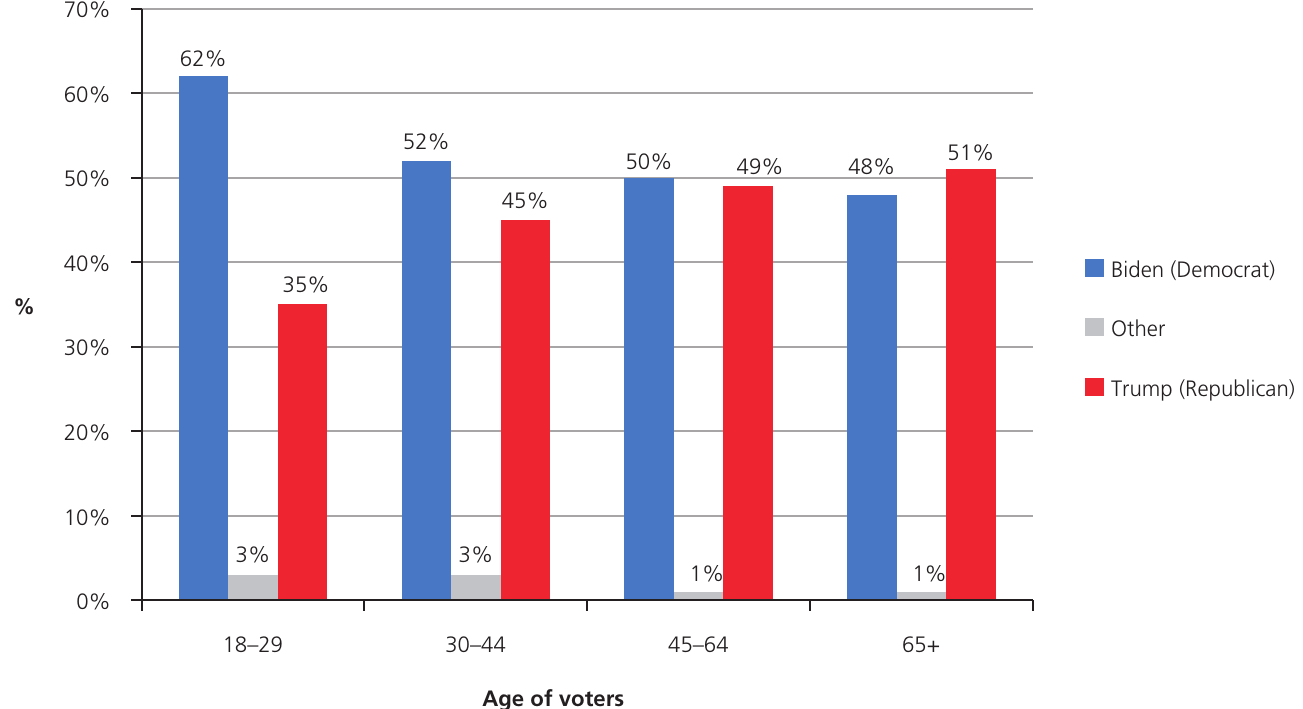
In the USA 2018 midterms, 68% of voters aged 18-24 chose Democrats, helping boost overall turnout and secure Democrat House gains. The 2020 presidential election showed the same pattern:
Example
Worked Example: Age-Based Voting Patterns
2017 UK General Election:
- 18-29 age group: 60% Labour, 27% Conservative (33 percentage point gap)
- Each age bracket shows increasing Conservative support
2018 USA Midterm Elections:
- 18-24 age group: 68% Democrat
- Youth turnout helped Democrats gain House control
Analysis: Both countries show identical trends - younger voters overwhelmingly support left/liberal parties. This pattern has strengthened over time, creating a significant generational divide in political preferences.
Younger voters prefer liberal/left-wing parties for several reasons:
- Policies on university/college tuition fees
- More liberal views on immigration
- Both Brexit and the Mexican border wall were linked to immigration concerns
Religion
The UK lacks the 'religious right' voting bloc seen in the USA. Issues such as abortion and same-sex marriage are less partisan in UK politics, reflecting the country's more secular character overall.
Note
The Role of Religion
Religious affiliation and church attendance are powerful predictors of voting behaviour in the USA, with white evangelical Christians forming a core Republican constituency. In the UK, religion plays a much smaller role in determining political allegiance, reflecting Britain's more secular society and the absence of religion as a major political dividing line.
Race and ethnicity
In both countries, ethnic minorities trend Labour/Democrat, but this is even more pronounced in the USA. With greater ethnic diversity in the USA, mobilising the minority vote is arguably more significant, especially in states like Texas and Florida with substantial Hispanic populations.
Household income
Differences have emerged in voting patterns based on income, though these are diminishing in the UK after 2019. Traditionally, wealthier UK areas like the Home Counties were solidly Conservative, while Labour heartlands were in deprived areas like the northeast. However, 2019 saw Conservative breakthroughs in economically poor but ethnically homogeneous seats in South Yorkshire and County Durham.
This corresponds to a longer-established pattern in the USA, where some of the poorest and least ethnically diverse areas are Republican strongholds (Deep South, West Virginia). A populist message of patriotism combined with 'taking back control' appeals to many voters in these areas.
By contrast, both Conservatives and Republicans increasingly struggle to win wealthy middle-class suburban seats or those with many well-educated voters who tend to have a more cosmopolitan and globalist outlook.
Important
The Realignment of Class Voting
Traditional class-based voting patterns are breaking down in both countries. Wealthy, educated suburban areas are trending Labour/Democrat, while economically deprived areas with less diversity are moving Conservative/Republican. This represents a fundamental shift from economic to cultural factors as the primary driver of voting behaviour.
Exam guidance
Note
Comparative Analysis Tips
When comparing elections and electoral systems in the UK and USA, ensure you:
- Identify clear structural differences (constitutional vs. legislative changes, fixed vs. flexible terms)
- Analyse how rational factors influence campaign strategies in both countries
- Consider how cultural factors shape voting behaviour and candidate selection
- Use specific, recent examples to support your arguments
- Recognise both similarities (FPTP, targeting swing voters) and differences (frequency of elections, role of personalities)
Always structure your answer around the three key aspects: structural, rational, and cultural, providing balanced coverage of both similarities and differences.
Remember!
Summary
Key Points to Remember:
-
Both the UK and USA are liberal democracies with fundamental similarities: secret ballot, universal suffrage, and rotation of power between major parties
-
Structural differences: USA has constitutionally fixed terms and many more elections; UK has flexible terms changed by Parliament and fewer elected positions
-
Electoral systems: Both primarily use FPTP, but UK devolved assemblies use AMS and STV, creating coalition governments
-
Campaign strategies: Similar targeting of core voters, swing states/marginals, and use of social media; USA campaigns are more personal and vitriolic
-
Voting behaviour: Age is a key predictor in both countries, with youth favouring liberal/left parties; religion and race play larger roles in USA; income patterns are converging in both countries
-
Cultural convergence: UK elections are becoming more "presidential" with increased focus on party leaders' personalities, though the USA still leads in this trend