The Relationship Between the Prime Minister and the Cabinet (AQA A-Level Politics): Revision Notes
📚Revision Notes
The Relationship Between the Prime Minister and the Cabinet
Understanding the relationship between the prime minister and the cabinet requires examining three fundamental questions: what powers and resources each possesses, what factors influence that power, and where the balance of power truly lies between these two institutions.
The powers and resources of the prime minister
Prime ministerial power can be divided into two categories: institutional powers available to all occupants of Number 10, and personal and political powers that vary according to circumstances and individual capability.
Institutional powers
Every prime minister, regardless of their political strength or personal qualities, has access to certain formal powers:
Patronage powers allow the prime minister to appoint and dismiss ministers and conduct cabinet reshuffles (when ministers' roles are changed within the cabinet). This power requires no approval from anyone else.
The prime minister exercises authority over cabinet meetings by deciding when and where they meet (typically weekly on Tuesday, Thursday or Friday mornings), setting the agenda, and chairing proceedings. The cabinet is formally the ultimate decision-making body in UK government, as stated in the Cabinet Manual.
Note
Prime ministers arrange and sometimes chair cabinet committees, which are smaller groups of ministers that make decisions on specific policy areas. These reduce the burden on full cabinet by allowing detailed work to happen before formal cabinet approval.
The prime minister can dictate policy priorities, setting the government's agenda and determining which issues receive attention and resources.
The Cabinet Office, employing around 2,050 civil servants, provides crucial support. It acts as the corporate headquarters for government, coordinating work between departments, circulating papers, taking minutes, and leading on certain policy areas.
As party leader, the prime minister usually commands a Commons majority, enabling them to pass legislation. This position is strengthened by their election by MPs and party members, conferring legitimacy.
Prime ministers can issue honours, particularly life peerages, to reward supporters and potentially alter the balance in the House of Lords.
Personal and political powers
These variable powers depend heavily on circumstances and include:
Political capital - the momentum and trust that comes from leading the party to electoral victory. This enables more effective persuasion and leadership. Success breeds authority; failure erodes it.
Effective management of colleagues in both cabinet and the backbenches. This requires political skill and judgement.
Personal qualities as a communicator and national leader matter enormously. The ability to unite and rally the party, handle economic challenges, and respond to unexpected crises all determine a prime minister's strength.
Factors affecting prime ministerial power
Several circumstances beyond immediate control influence prime ministerial power:
- Opinion poll ratings and results from by-elections and local elections provide a running commentary on the prime minister's standing
- Personalities in cabinet and the parliamentary party at any given time can either support or constrain the leader
- Potential leadership challenges always lurk in the background, particularly when a prime minister appears vulnerable
- The strength of the opposition affects how united the governing party remains behind its leader
How these powers work in practice
Patronage powers and the cabinet
On the surface, patronage appears highly powerful. Prime ministers can hire and fire ministers without requiring approval. When first appointed, prime ministers often radically reshape their cabinet.
Example
Cabinet Reshuffles: The "Summer's Day Massacre"
In 2016, Theresa May removed 15 ministers including chancellor George Osborne and justice secretary Michael Gove. In 2019, Boris Johnson dismissed 11 senior ministers and saw six more decline to serve. Conservative MP Nigel Evans described this as "not so much a reshuffle as a summer's day massacre".
However, important limitations exist. Prime ministers must maintain balance within the cabinet - not only regarding diversity of gender and ethnicity, but also policy positions. May had to include both Leave and Remain supporters. Tony Blair needed to include "big political beasts" like Gordon Brown as chancellor and John Prescott as deputy prime minister, whose working-class background complemented Blair's public school education.
Important
Prime ministers must be careful about who and how many they sack. An ex-minister on the backbenches can cause serious damage.
Margaret Thatcher's demotion of foreign secretary Geoffrey Howe in 1989 and his resignation in 1990 triggered a leadership challenge from Michael Heseltine that led to her downfall. Howe's resignation speech devastatingly criticised Thatcher's European policy, comparing her approach to "sending your opening batsmen to the crease, only to find their bats have been broken before the game by the team captain".
Note
Coalition government brings additional constraints. Under the 2010-15 Coalition Agreement, David Cameron effectively surrendered patronage power over five cabinet-ranking posts to Liberal Democrat leader Nick Clegg.
Authority over the cabinet
Prime ministers exercise formal control over cabinet. They determine when and where it meets, decide the agenda, and chair proceedings. All cabinet members must support cabinet decisions through collective responsibility - the requirement that all members publicly support government policy. Any minister unable to support a decision must resign.
Yet agreement is never automatic. Much depends on personalities, issues and political context. Blair could never persuade Brown to support adopting the euro. May's "Chequers deal" on Brexit quickly unravelled. When journalists refer to "full and frank discussions", they often mean strong disagreements or heated arguments.
Note
Wise prime ministers use cabinet partly as a sounding board to test ideas before making final decisions. Although meetings should be private, disgruntled ministers often leak details to the media. When Johnson became prime minister, he issued a new edition of the Ministerial Code stating clearly: "there must be...no leaking".
Arranging and sometimes chairing cabinet committees
Most decisions formally made by cabinet have effectively been decided in advance by cabinet committees. Prime ministers can structure these committees however they wish. They allow smaller groups to handle specific policy areas, reducing the full cabinet's workload. These committees have existed since the early twentieth century.
In early 2021, the 11 main cabinet committees included:
- EU Exit Strategy
- EU Exit Operations
- Economic Operations Committee
- Parliamentary Business and Legislation
- National Security Council
- Climate Change
- Covid-19 Strategy
- Domestic and Economic Strategy
- Crime and Justice Task Force
- Union Policy Implementation
- National Space Council
Note
The government can create other types too. Cameron introduced implementation taskforces in 2015 to "monitor and drive delivery of the government's most important cross-cutting priorities", though Johnson discontinued these in 2019. In March 2020, Johnson created four new implementation committees responding to coronavirus, focusing on healthcare, public sector, economic and business matters, and international response.
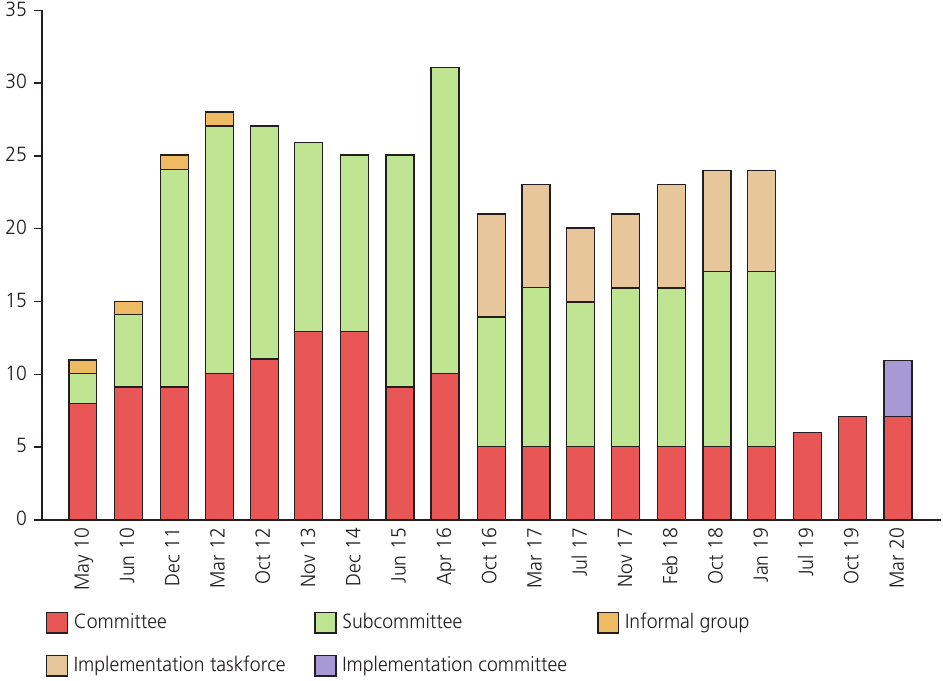
As the figure shows, the number and types of cabinet committees fluctuate considerably depending on the prime minister and current priorities. Committees are often created to reflect immediate concerns. May established several Brexit-related committees, whilst Johnson created the Climate Change Committee before the UK hosted COP26.
Important
However, existence doesn't guarantee significance. Although Blair created numerous committees, one former cabinet secretary noted that "Blair's style of government didn't fit easily with the cabinet committee system... [his] preference was for ad hoc meetings and other ways of managing the government."
Cabinet committees proved more important under the 2010-15 coalition. Oliver Letwin said they helped "ensure that the government as a whole would abide by and enforce those rules that underpinned the coalition". However, George Osborne "didn't really believe in cabinet committees", according to Liberal Democrat minister Vince Cable, so economic committees rarely met.
Under May, inconsistency prevailed. She initially reduced committees to just five main ones and ten sub-committees. By March 2017, she chaired every committee she attended, indicating her control. The 2017 election undermined her power, reflected by delegation to David Lidington, her de facto deputy, who chaired more committees than the prime minister in 2018.
Cabinet committees exemplify a resource that different prime ministers deploy, rearrange or largely ignore as they see fit. They remain widely seen as important for smooth cabinet operation, even if only as a way of delegating decisions away from full meetings.
Dictating policy priorities
The ability to set priorities and control the cabinet agenda is clearly important. Many modern prime ministers have exerted their influence and political principles. This is especially true for those with strong majorities and mandates like Thatcher and Blair, but also those elected on clear platforms like Johnson's "Get Brexit done" campaign in 2019.
Example
Policy Priorities Under Strong Prime Ministers
Thatcher achieved a major privatisation programme and significantly reduced trade union power. Blair prioritised constitutional modernisation and demonstrated that New Labour had departed considerably from traditional socialism.
Yet prime ministers don't enjoy unlimited freedom when deciding policy. They are bound by manifesto pledges and constrained by unfolding developments. Economic recession can derail plans to boost public spending or lower taxes. Many policies, especially in foreign affairs, require cooperation from political players outside the UK.
Important
Brexit exemplified this - the EU and member states also had to agree to the prime minister's desired deal. Prime ministers may determine priorities, but cannot always determine outcomes.
The Cabinet Office
Created in 1916, the Cabinet Office provides support for the cabinet system. Around 2,050 civil servants work in this department. Its official role is to "support the prime minister and ensure the effective running of government". It acts as the corporate headquarters and secretariat for central government, leading on certain policy areas and providing administrative support like circulating papers and taking minutes. It coordinates work between departments. The head of the civil service attends cabinet meetings as cabinet secretary.
Note
Individual prime ministers often adapt the Cabinet Office's priorities to reflect current issues. During the coronavirus pandemic, the Cabinet Office established the Rapid Response Unit to combat misinformation about the virus by working with social media platforms like Facebook to block false narratives.
Party leader
As party leader, the prime minister enjoys significant resources. The governing party's overall majority usually guarantees that policies and legislation pass through parliament. The leader is elected by MPs and party members, conferring strong legitimacy.
The party recognises that divided parties constantly criticising their own leader rarely win elections. Yet party loyalty is conditional, not absolute. Several recent prime ministers, most notably Thatcher, were effectively forced out by their own MPs.
Example
Leadership Challenges: John Major's "Back Me or Sack Me" Tactic
In 1995, John Major called a leadership contest - a "back me or sack me" tactic - to neutralise growing critics, mainly Eurosceptics. Although he won, over a quarter of his MPs backed opponent John Redwood.
Blair, Brown and May all faced efforts and plots to force them from office. In December 2018, May survived a no-confidence motion by 200 votes to 117, but the result showed high discontent within her party.
Note
The party can also influence policy. Conservative rebellions over Europe led Cameron to promise an in/out referendum on EU membership.
Dispensing honours
As part of their prerogative powers, prime ministers can award life peerages to former MPs or party supporters. This is often used to alter the House of Lords balance for party advantage. Blair and Brown made 173 Labour peers but allowed only 66 Conservative nominations. By contrast, under Cameron and May, 136 Conservative life peers were appointed but only 59 Labour.
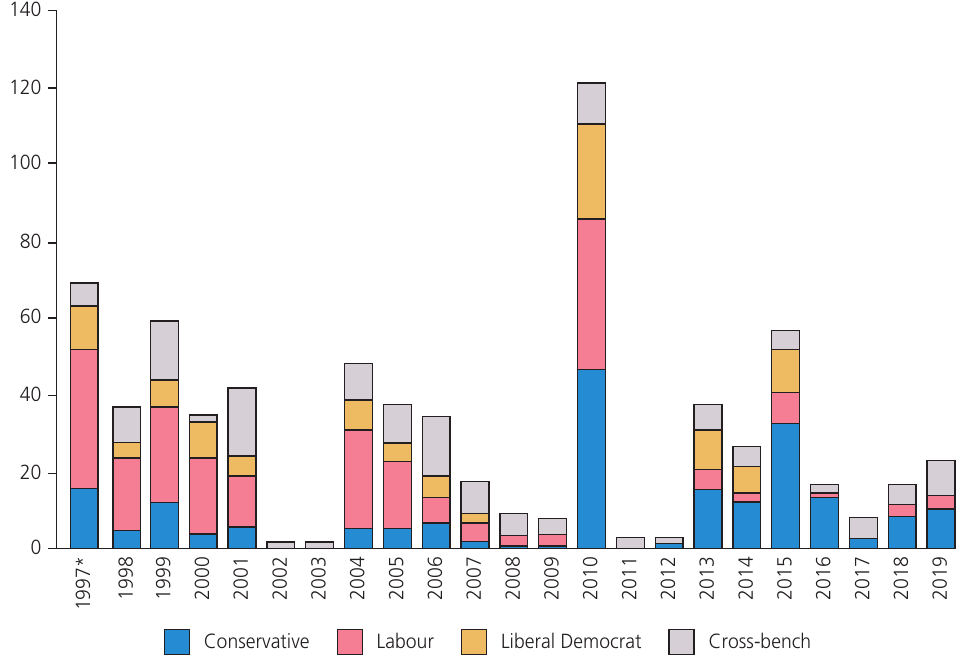
An independent Appointments Commission makes recommendations for non-party political peerages and vets all party nominations for "propriety", defined on the commission's website as:
- The individual should be in good standing in the community generally and with public regulatory authorities particularly
- The past conduct of the nominee would not reasonably be regarded as bringing the House of Lords into disrepute
Important
Despite such checks, Cameron's resignation honours in August 2016 sparked controversy. The Independent headline stated: "David Cameron Honours list would embarrass a medieval court". He rewarded 46 former aides, advisers and ministers with honours. George Osborne received the rarely awarded Companion of Honour, whilst former chief of staff Ed Llewellyn received a peerage. More controversially, generous Tory donors were rewarded, including Andrew Cook, a former Tory treasurer who gave over £1 million and received a knighthood for political service. Johnson's award of a peerage to his own brother, former minister Jo Johnson, in 2020 also attracted heavy criticism.
Awarding honours, especially life peerages, is tricky for prime ministers to navigate. It rewards the loyal and generous but used unwisely can lead to accusations of cronyism and "cash for honours".
Personal and political powers in action
By their nature, personal and political powers are harder to quantify than formal institutional powers. They are, however, very important in helping a leader dominate, if only temporarily, their cabinet and government.
Perhaps the most important ingredient is political capital - the trust and readiness to follow a leader due to previous achievements. Even ideological opponents within the party usually fall silent when the prime minister wins elections and polls well. Political capital is enhanced when prime ministers "get it right" with high-risk policies. Conversely, it is jeopardised by miscalculation. Exercising good political judgement is crucial to continued tenure.
Example
The Falklands War (1982): Thatcher's Calculated Risk
Thatcher showed resolve and political courage undertaking a major military operation to retake the Falkland Islands after Argentina invaded. A large task force was quickly assembled and dispatched. The 10-week war resulting in victory contributed to Thatcher's landslide election victory in 1983.
Her decision wasn't clear-cut - some ministers and advisers urged caution and negotiation. By taking a risk that paid off, she considerably boosted her authority.
Example
Scottish Independence Referendum (2014): Cameron's Gamble
Cameron agreed to a vote on Scottish independence. As a committed unionist, he was gambling, though partly forced into it. The pro-independence Scottish National Party had won an overall majority in 2011 Scottish Parliament elections and strongly pushed for a referendum.
By actively campaigning for Scotland to remain in the UK, Cameron put his political authority on the line. When Scotland voted to remain, he gained political stature - his strategy was vindicated.
Example
Blair's Early Elections: Cementing Authority
Blair called and comprehensively won early elections in 2001 and 2005, albeit with reduced majorities both times. This cemented his position and authority within the party, although it didn't deflect mounting internal criticism of controversial policies like the Iraq War and university tuition fees.
Enhanced political capital enables prime ministers to shift the power balance and policy positions within their cabinets over time, promoting loyalists and marginalising critics. They must always be careful, though, to avoid creating an "echo chamber" in the Cabinet Room and to stay in touch with wider party sections.
The powers and resources of the cabinet
Compared to the prime minister, the cabinet collectively has far fewer resources. Members' positions are entirely due to the prime minister. Too much dissent can easily lead to being sidelined or demoted in the next reshuffle. Certain departments are more prestigious than others. In the past, posts like Northern Ireland or agriculture were often seen as places of political banishment. Press coverage after reshuffles often refers to "winners" and "losers".
Yet cabinet ministers are far from powerless. They can and do exercise power and check the prime minister in several ways:
Departmental autonomy: Most ministers run their own departments and, while adhering to commonly agreed policies, have considerable autonomy over policy details. Prime ministers are unlikely and should be unwilling to micromanage all senior ministers. Many policies, like introducing Universal Credit or organising the 2012 London Olympics, are complex and complicated. Prime ministers set the tone and clarify expectations, but rarely get involved in minutiae.
Media links: Ministers have their own links to the media and, through their departments, to key pressure groups. In extreme cases they can leak information and brief journalists against policies the prime minister wishes to pursue.
Example
Ministerial Leaks: The Gavin Williamson Affair
In 2019, defence secretary Gavin Williamson was sacked for allegedly leaking details from a National Security Council meeting about security threats posed by allowing Chinese tech giant Huawei a role in constructing Britain's 5G network. The implication (strenuously denied by Williamson) was that he had been critical and deliberately leaked to undermine the policy.
Refusing reshuffles: In certain situations, powerful ministers can refuse to be moved. In January 2018, health secretary Jeremy Hunt refused to be moved and, after an hour of talks with May, ended up with an enhanced role adding social care to his portfolio. This reflected the weakened power of a prime minister with diminished political capital.
Real debate: Cabinet meetings can involve genuine debate and discussion. Prime ministers often use such meetings to gauge opinions and reflect before committing to major policy initiatives.
Important
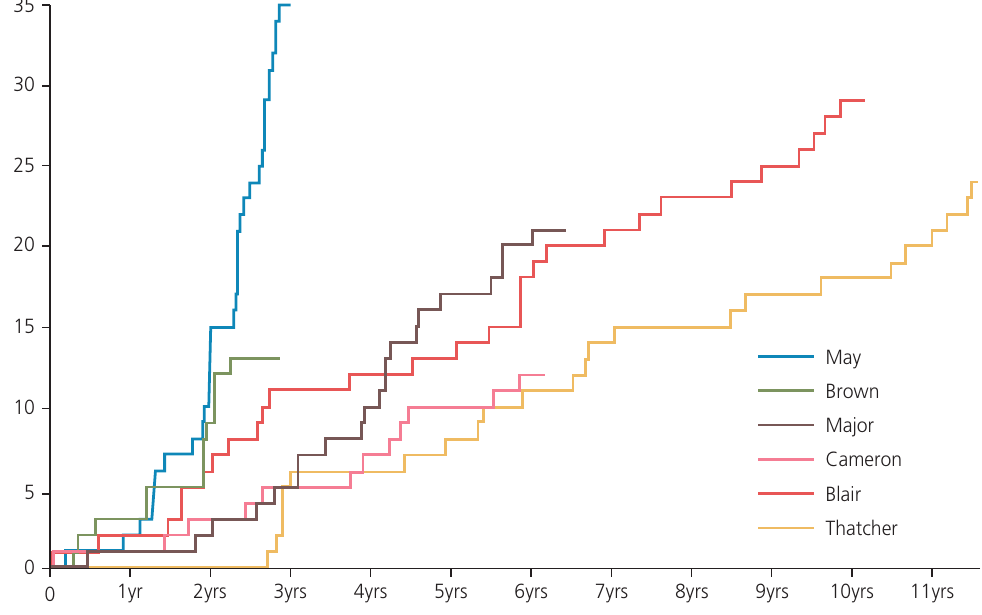
Resignation: Perhaps the biggest weapon available is resignation. Figure 3.5 reveals much about May's relatively brief tenure and Brexit's negative impact on establishing strong, stable government. Large numbers of ministers resigning implies a weak and divided government.
Does cabinet government still exist?
This question generates considerable debate among political commentators and academics. The following table summarises the key arguments:
| Yes | No |
|---|---|
| Cabinet remains the key forum for high-level policy decisions. | Many decisions are made at cabinet committee level or in bilateral meetings. |
| Cabinet can still influence policy and can prove very useful to a prime minister to take soundings (find out ministers’ opinions on a subject) and promote a more coordinated approach to policy. | Many meetings are quite brief, often not much more than 30 minutes. Cabinet is used more frequently to resolve or arbitrate disputes between departments, especially over allocation of funding. |
| Senior and influential ministers can be hard or even impossible to sack or remove, for example Gordon Brown as chancellor under Blair and Jeremy Hunt as health secretary under May. | Cabinet ministers are appointed by the prime minister and must do their bidding. Those who resist or who are deemed poor parliamentary performers can be easily removed by means of sacking or demotion in a reshuffle. |
| Too many cabinet resignations can be a sign of weakness not strength, and on the backbenches, former ministers can often be a focus for internal opposition to a prime minister. | Prime ministers can appear strong and decisive by removing opponents and, over time, can mould a ‘cabinet of compliance’. |
| Government departments contain their own senior civil servants who provide ministers with policy support and expertise. Ministers also have their own political advisers. | The Cabinet Office, as well as special advisers, plays a greater and increasing role in providing research and policy advice across departments and therefore can bypass the formal cabinet structure. |
While prime ministers retain very significant resources and levers of power, they are not sole masters. Much depends on context and circumstances. Success, whether with policy or at the polls, brings added authority. Failures and growing unpopularity with both public and party spell disaster for even the most self-assured and once invincible prime minister. The relationship between a prime minister and their cabinet is not one of equals but is full of relationship dynamics that make for an interesting political saga.
Summary
Key Points to Remember:
-
Institutional powers are available to all prime ministers and include patronage, chairing cabinet, arranging committees, setting policy priorities, using the Cabinet Office, leading the party, and dispensing honours.
-
Personal and political powers vary according to circumstances and include political capital from electoral success, effective management skills, personal communication abilities, and capacity to unite the party.
-
Prime ministerial power has significant limitations: balance must be maintained in cabinet appointments, sacked ministers can cause trouble from the backbenches, coalition government restricts patronage, and policy outcomes depend on factors beyond the PM's control.
-
Cabinet ministers possess important powers: they run their own departments with considerable autonomy, have media links and can leak information, can sometimes refuse reshuffles, participate in real debate, and can damage the PM through resignation.
-
The balance of power shifts: success, high poll ratings and political capital strengthen the prime minister; failure, unpopularity and party disunity weaken them. The relationship is dynamic, not static.