Types of Democracy (AQA A-Level Politics): Revision Notes
📚Revision Notes
Types of Democracy
Democracy in the UK operates primarily through representative democracy, with occasional use of direct democracy for specific constitutional matters. Understanding the distinction between these systems, along with their respective advantages and limitations, is essential for evaluating democratic participation in the UK political system.
Note
The UK employs two distinct forms of democracy: representative democracy for day-to-day governance through elected MPs, and direct democracy through referendums for major constitutional decisions. While representative democracy dominates the political system, direct democracy serves as a supplementary mechanism for particularly significant issues.
Representative democracy
Representative democracy is the predominant form of democratic governance in the UK. In this system, citizens elect representatives to parliament and local councils who then make decisions and pass legislation on their behalf. At Westminster level, virtually all MPs belong to political parties, which helps voters understand the policy positions their representatives will adopt once in office.
The UK holds regular elections for various levels of government, including parliamentary elections, local council elections, and until 2020, European Parliament elections. These elections serve as mechanisms of accountability, allowing voters to endorse or reject candidates based on their performance and policy positions.
Advantages of representative democracy
Representative democracy offers several important benefits that make it practical for governing modern states:
Expertise and knowledge: Elected representatives possess the specialist knowledge and skills necessary to make complex policy decisions on behalf of voters. Many political issues require detailed understanding of economics, law, international relations and other technical subjects that most citizens may not have time to master.
Note
Why expertise matters:
Representatives can dedicate their full time and resources to understanding complex policy areas. They have access to civil service briefings, expert advisors, and research facilities that enable informed decision-making on technical matters ranging from economic policy to international treaties.
Broader perspective: Representatives handle virtually all areas of policy and decision-making, enabling them to take a comprehensive view of issues and balance competing claims effectively. This holistic approach proves particularly valuable when setting spending priorities, balancing budgets and determining tax levels, where difficult trade-offs must be made between different policy areas.
Political party affiliation: The party system enables voters to predict how their representatives will act once in power. Party manifestos clearly outline positions on key issues such as taxation levels, public spending priorities (like health versus defence), and welfare policy. This gives voters meaningful choice and helps ensure accountability.
Efficiency: Representative government functions more efficiently than requiring the entire electorate to vote on numerous individual decisions and laws. The sheer volume and complexity of modern legislation would make direct popular approval of every measure impractical and time-consuming.
Direct democracy
Direct democracy operates on fundamentally different principles from representative democracy. Rather than delegating decision-making to elected officials, direct democracy involves citizens participating directly in policy choices. In the UK context, this primarily takes the form of referendums - votes on specific questions put directly to the electorate.
Direct democracy remains relatively rare in UK politics, used almost exclusively for major constitutional questions rather than routine policy matters. This contrasts with the day-to-day operation of representative democracy through Parliament.
UK referendums
The UK has held several significant referendums, demonstrating the occasional use of direct democracy for constitutional issues:
- 1973 — Northern Ireland: Vote on whether Northern Ireland would remain part of the United Kingdom
- 1975 — Whole of UK: Vote on continued membership of the European Economic Community (EEC)
- 1979 and 1997 — Scotland and Wales: Proposals for introducing devolution to these nations
- 1998 — London: Referendum on creating a directly elected Mayor of London and establishing the Greater London Authority
- 1998 — Northern Ireland: Vote on the Good Friday Agreement peace settlement
- 2011 — Whole of UK: Proposal to replace the First Past the Post (FPTP) electoral system with the Alternative Vote (AV) system
- 2011 — Wales: Vote on transferring additional powers to the Welsh Assembly
- 2014 — Scotland: Independence referendum asking whether Scotland should become an independent country
- 2016 — Whole of UK: Referendum on continued membership of the European Union (Brexit referendum)
Important
Exam tip: It would be inaccurate to claim that referendums like the Brexit vote make the UK a direct democracy. The UK remains fundamentally a representative democracy that occasionally employs direct democratic mechanisms for certain constitutional matters. Parliamentary sovereignty continues to underpin the UK constitutional system.
Direct democracy in other countries
The UK's limited use of direct democracy contrasts sharply with countries where these mechanisms feature more prominently in political culture.
Switzerland provides the most striking example, with direct democracy deeply embedded in its political system. Swiss citizens can trigger an optional referendum by gathering 50,000 signatures within 100 days of parliament adopting legislation, providing a clear check on representative government. Additionally, 100,000 signatures collected within 18 months enables citizens to propose their own laws. Swiss voters have decided on diverse issues including UN membership and banning minaret construction for mosques.
Note
Switzerland's direct democracy in practice:
Switzerland demonstrates how extensive direct democracy can function in a modern state. Citizens regularly vote on multiple referendums each year, covering everything from infrastructure projects to social policy changes. This system has operated successfully for decades, showing that direct democracy can work alongside representative institutions when properly structured.
The Republic of Ireland has also made extensive use of referendums, particularly on ethical and social issues. Irish citizens have voted directly on legalising both abortion and same-sex marriage through referendum processes.
E-petitions
Beyond referendums, the UK employs e-petitions as another form of direct democratic participation. This system, originally launched in 2006 and relaunched in 2011, allows members of the public to raise issues directly with government.
The system operates on two thresholds:
- Petitions receiving more than 10,000 signatures trigger an official government response
- Petitions exceeding 100,000 signatures are considered for parliamentary debate
Notable e-petitions
Several e-petitions have attracted substantial public support:
- 2019 — Revoke Article 50: Approximately 6 million signatures supported a petition requesting the UK remain in the EU by revoking Article 50
- 2019 — Opposition to prorogation: Around 1.7 million signatures opposed the planned prorogation of Parliament during the Brexit debate and deadlock
- 2017 — Donald Trump state visit: Approximately 1.86 million signatures opposed President Donald Trump making a state visit to the UK
- 2007 — Road pricing: Around 1.8 million signatures opposed government plans to introduce road pricing that would charge motorists based on actual road usage
Note
Despite these substantial numbers, petitioners rarely succeeded in changing government policy directly. Road pricing was subsequently abandoned, and the Supreme Court ruled the parliamentary prorogation unlawful, though these outcomes resulted from multiple factors beyond the petitions themselves.
This highlights an important limitation: while e-petitions enable public voice and can raise awareness of issues, they do not guarantee policy changes and lack the binding force of referendums.
Should there be greater use of direct democracy in the UK?
The question of expanding direct democracy in the UK generates substantial debate within political discourse. Both advantages and disadvantages merit careful consideration.
Advantages of direct democracy
Political participation: Direct democracy promotes active engagement by enabling people to participate directly in decision-making rather than merely voting for representatives every few years. This deeper involvement can strengthen democratic culture and civic responsibility.
Enhanced accountability: Elected representatives and government cannot ignore the expressed wishes of the people when they vote directly on issues. Direct democracy can provide a valuable corrective when MPs' views diverge from public opinion, as demonstrated by the Brexit referendum outcome.
Note
Direct democracy and accountability:
When citizens vote directly on specific issues, politicians face clear mandates that are difficult to ignore. This contrasts with general elections where voters choose representatives based on entire manifestos, making it harder to identify public opinion on individual issues.
Political education: The process of researching issues before voting can motivate citizens to become politically informed. People may study relevant material and consider different perspectives before arriving at rational, considered decisions on important questions.
Greater legitimacy: Decisions carry the direct authority and mandate of the people, conferring greater democratic legitimacy. When citizens vote in general elections, they may not necessarily support all policies in their chosen party's manifesto, whereas referendums allow focused decisions on specific issues.
Popular engagement: Direct democracy proves popular with voters and achieves strong participation levels. The 2014 Scottish independence referendum achieved a record 84.6% turnout, demonstrating high public engagement. The system also functions effectively in countries like Switzerland.
Purer democracy: Direct democracy can be viewed as a more authentic form of democracy because it trusts the entire adult population to decide issues directly rather than through intermediaries. This approach takes democratic principles to their logical conclusion.
Disadvantages of direct democracy
Lack of political education: The public may not fully understand complex questions they are voting on, or the broader implications of different choices. Elected representatives, with access to expert advice and time for detailed analysis, may be better positioned to evaluate issues properly. Extensive use of direct democracy could undermine representative government.
Important
The knowledge gap:
Complex policy decisions often involve technical details, economic projections, legal implications, and international considerations that require extensive research and expertise to evaluate properly. While citizens can become informed on issues, they may lack the time, resources, or background knowledge to fully understand all dimensions of complicated questions.
Non-binding nature: In the UK, referendums are not legally binding on government because parliamentary sovereignty prevails under constitutional terms. Parliament retains the ultimate authority to make laws, even following referendum results.
Populist outcomes: People may vote based on emotional responses or short-term populist appeals rather than taking considered, long-term perspectives. Many information sources during referendum campaigns prove one-sided and sensationalist in their approach, potentially distorting public understanding.
Low turnout: Some referendums attract disappointingly low turnout. The 2011 referendum on introducing the Alternative Vote system achieved only 42% turnout, significantly reducing claims of democratic legitimacy for the result.
Note
Turnout variations:
Different referendums attract vastly different levels of participation. While the Scottish independence referendum achieved 84.6% turnout, the AV referendum managed only 42%. This variation suggests that public engagement depends heavily on how significant and relevant voters perceive the issue to be.
Tyranny of the majority: Direct democracy risks the majority voting to undermine minority group rights. This raises fundamental questions about whether basic rights can ever be legitimately removed through popular vote in a democracy, even with majority support.
Impracticality: In large, diverse countries, extensive use of referendums would prove costly and time-consuming. Allowing the public to propose legislation could make effective government impossible in certain areas. For example, voters might simultaneously choose to lower taxes and increase public spending, creating impossible policy contradictions.
Example
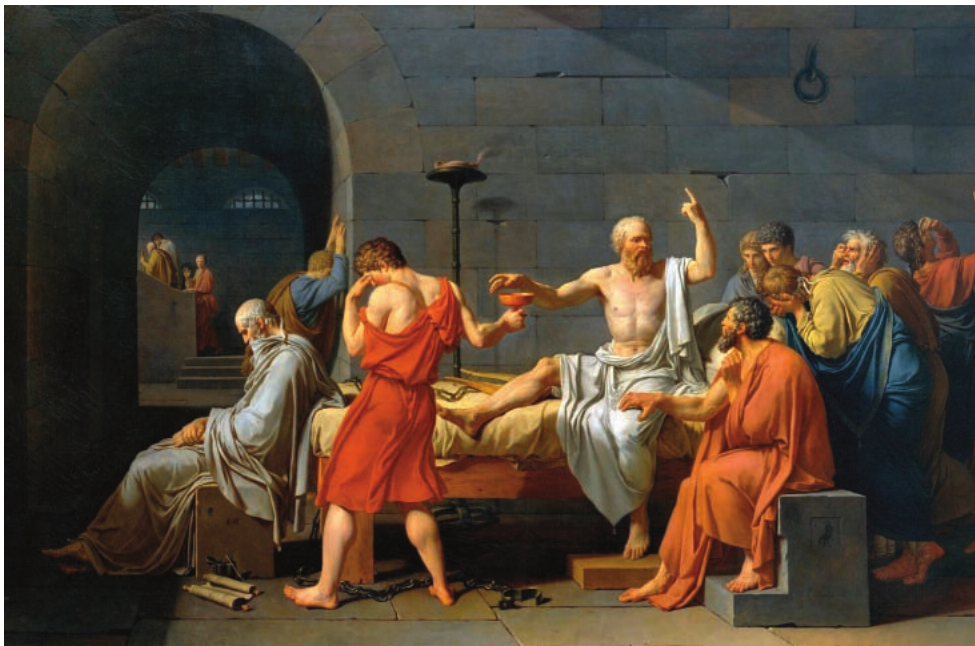
Historical Warning: The Death of Socrates
The execution of Socrates in ancient Athens illustrates potential dangers of direct democracy. Socrates was condemned to death by poisoning in 399 BC following a popular vote (more accurately, a mass citizen-jury trial) for allegedly corrupting Athens' youth and violating religious practices.
This case demonstrates how majority decisions can lead to injustice against individuals, highlighting the "tyranny of the majority" concern. Even in what was considered a democratic system, popular opinion led to the execution of one of history's greatest philosophers, showing that majority rule does not automatically produce just outcomes.
Summary
Key Points to Remember:
-
Representative democracy is the predominant system in the UK, where elected MPs and councillors make decisions on behalf of voters, providing expertise, efficiency and accountability through regular elections
-
Direct democracy involves citizens voting directly on issues through referendums and is used rarely in the UK, primarily for major constitutional questions
-
Key UK referendums include the 1975 and 2016 EU votes, the 2014 Scottish independence referendum, devolution referendums, and the 2011 AV referendum
-
E-petitions allow public participation with government responses for 10,000+ signatures and potential parliamentary debates for 100,000+ signatures
-
The UK remains a representative democracy that occasionally employs direct democratic mechanisms - it is not a direct democracy despite holding referendums
-
Switzerland demonstrates extensive direct democracy with citizens able to challenge legislation (optional referendum) and propose laws through signature collection
-
Direct democracy offers benefits including enhanced participation, legitimacy and accountability, but faces challenges including potential for populist outcomes, low turnout, tyranny of the majority, and practical difficulties in complex modern states