Pressure Groups (AQA A-Level Politics): Revision Notes
📚Revision Notes
Functions and Categories of Pressure Groups
Introduction
Pressure groups are organisations that aim to influence government policy and political decision-making without seeking to hold elected office themselves. They represent a diverse range of viewpoints and causes across the political spectrum, from local community issues to major national and international concerns.
Political agenda refers to the issues currently being debated and decided upon by those with political power. The agenda changes depending on circumstances and which party holds power. Pressure groups work to ensure their policy concerns are prioritised and shaped according to their views.
Note
Pressure groups differ from political parties in one crucial way: they seek to influence those in power rather than become the government themselves. This allows them to focus on specific issues and causes without the need to develop comprehensive policy platforms across all areas of governance.
Main functions of pressure groups
Pressure groups serve several important functions in the UK political system:
Influencing policy and decisions: All pressure groups share the primary goal of shaping government policy. This influence can be focused on specific, short-term objectives (such as preventing a hospital closure or amending particular legislation) or broader, long-term goals (such as environmental protection or advancing minority rights).
Providing representation and participation: Pressure groups offer citizens opportunities to engage in politics beyond voting. Supporters can donate money, volunteer time for campaigns, and actively participate in political activities. Groups also provide representation for causes that cross traditional party lines—issues like animal welfare attract support from across the political spectrum.
Complementing political parties: While political parties seek to hold office and govern, pressure groups focus exclusively on influencing those who already hold power. They target elected officials and government institutions, using various tactics from discreet lobbying to high-profile public demonstrations.
Competing for influence: Pressure groups often face opposition and competition. Some issues have groups campaigning on opposing sides (such as same-sex marriage). In other cases, groups compete for limited resources—for example, cancer research charities and mental health organisations both seek government funding and prioritisation.
Important
The effectiveness of pressure groups depends heavily on their ability to gain access to decision-makers and mobilise public opinion. Groups must carefully choose their tactics and maintain credibility to achieve their objectives.
Main categories of pressure groups
Pressure groups can be categorised in two main ways: by their relationship with government (insider versus outsider status) and by the purpose of their campaigning (interest versus promotional groups).
Insider and outsider groups
Insider groups maintain close ties and regular contact with government. They typically represent well-resourced organisations (such as business or industry bodies) or possess specialist knowledge valuable to policy-makers when drafting legislation.
Outsider groups lack strong established links with government. They often represent more marginalised or radical policy positions and frequently employ direct action to publicise their objectives.
Interest and promotional groups
Interest groups (also called sectional groups) exist primarily to defend and advance the specific interests of their members. Examples include trade unions and business associations. These groups might be characterised as pursuing narrower interests, though they typically argue their aims benefit the wider national interest.
Promotional groups (also termed causal groups) campaign to achieve aims that do not directly benefit their members' self-interest. These include causes such as human rights or nuclear disarmament. Such groups are often seen as pursuing more selfless objectives based on ethical principles.
Insider groups
Characteristics and examples
Insider groups generally possess more influence than outsider groups. Classic examples include the National Farmers' Union (NFU) and the British Medical Association (BMA), which have long maintained privileged access to government departments, civil servants and ministers.
The NFU historically maintained a strong presence in Brussels, as agricultural policy was determined at European level. Following Brexit, the NFU successfully campaigned for short-term seasonal work visas, allowing fruit and vegetable growers to continue hiring labour from Eastern Europe.
Example
Example: Trade Unions and Insider Status
Trade unions provide an interesting example of fluctuating insider status. Under Labour governments (especially pre-1997), unions enjoyed significant insider status, being widely consulted on industrial and economic policy. The phrase "beer and sandwiches at No. 10" described this close relationship. This reflected Labour's historical origins in the labour movement and the substantial financial contributions some unions make to the party.
For example, Unite donated over £4 million to Labour in the final quarter of 2019, while Unison contributed over £500,000.
However, insider status for trade unions has varied considerably:
- Tony Blair's "New Labour" deliberately distanced itself from such ties
- Jeremy Corbyn's leadership restored close relationships, particularly with Unite
- Under Conservative governments, trade unions have never enjoyed comparable insider status
Labour's 2019 manifesto promised to "repeal anti-trade union legislation, including the Conservatives' undemocratic Trade Union Act 2016"—clear evidence of pressure group influence, though Labour's election defeat prevented policy implementation.
Non-party political groups can also achieve insider status. The Royal Society for the Prevention of Cruelty to Animals (RSPCA) maintains close parliamentary ties through involvement with All-Party Parliamentary Groups (APGs). In 2017, the RSPCA contributed £16,500 to the APG for Animal Welfare (APGAW). In return, APGAW raises issues reflecting the RSPCA's objectives—for example, providing evidence to a 2019 inquiry on UK abattoir provision and drafting recommendations for the Department for Environment, Food and Rural Affairs (DEFRA).
Note
All-Party Parliamentary Groups (APGs) provide an important mechanism for pressure groups to influence policy. These groups bring together MPs and Lords from different parties to discuss specific issues, creating opportunities for insider groups to share their expertise and perspectives with decision-makers.
Business organisations represent another important insider category. These include the Confederation of British Industry (CBI) and British Finance (formed in 2017 from a merger of several banking and finance associations, including the British Bankers' Association). Following the 2008 banking crisis, the UK government provided support totalling £850 billion, including loans and temporary nationalisation. While this reflected lobbying by banking industry groups, the government arguably had little choice—complete bank collapse would have devastated millions of savers and caused economic chaos.
Subdivisions of insider groups
Political scientists sometimes divide insider groups into smaller categories:
Core insiders have longstanding bilateral relationships with policy-makers over broad issue ranges. The NFU exemplifies this category.
Specialist insiders possess insider status only within narrow, specific areas requiring their expert knowledge. For example, the British Meat and Poultry Federation is consulted only on issues specific to that farming sector.
Peripheral insiders have insider status but are rarely needed due to the nature of their interest. The Stillbirth and Neonatal Death Society (SANDS) successfully lobbied for the Still-Birth (Definition) Act 1992, which lowered the stillbirth definition from 28 to 24 weeks. This was highly specialised—the government does not routinely consult SANDS on wider child health matters.
Prisoner groups find it nearly impossible to break away from insider status due to government funding reliance or being public bodies themselves. Historic England, funded via the Department for Digital, Culture, Media & Sport (DCMS), aims to conserve historic buildings and sites. However, its lack of state independence could make resisting government-generated policy (such as HS2, which impacts landscapes and historic buildings) more difficult.
Important
Common Pitfall: Having insider status does not guarantee policy success. Groups can become trapped in "policy entrapment"—becoming so close to government that they lose their independence and become reluctant to criticise policies that conflict with their objectives.
Advantages and disadvantages of insider groups
| Category | Advantages | Disadvantages |
|---|---|---|
| Proximity to government | Good communication channels with government and Whitehall departments enable informal lobbying before draft legislation, ensuring their views are incorporated | Getting too close to government can lead to "policy entrapment"—unwillingness to criticise the political establishment, diminishing independence and freedom of action |
| Resources | Usually well-funded, often hiring professional lobbyists and sponsoring relevant APGs | Superior resources and professional PR are no guarantee of success. Unlike in the USA, UK pressure groups cannot air political advertisements and have limited involvement in election campaigns |
| Government inquiries | Often invited to give evidence to select or public bill committees. For example, in 2013, the King's Fund gave evidence to the Health Select Committee inquiry into emergency services | Not exclusively insider groups give evidence. In March 2020, the UK Cladding Action Group (more of an outsider group) provided evidence to the Communities select committee following the Grenfell Tower fire tragedy |
| Historic ties to political parties | Some groups (such as certain trade unions) have close historical and institutional ties to major parties and can be important donors | When such parties are out of office, associated pressure groups are left outside power. Most groups prefer maintaining good terms with a range of political parties |
| Laws and regulations | Public consultation processes (such as during the Green Paper legislation stage) can involve evaluating large amounts of specific information. Technical knowledge often lies with trade associations, unions and professional bodies, not Whitehall, giving insider groups direct legislative influence | Pressure groups and their members are often most directly affected by law changes. They should not, therefore, play major roles in writing rules by influencing initial consultation and drafting stages of parliamentary bills. Pressure groups have a "policy axe to grind" |

Case study: The National Trust
The National Trust was founded in 1895 and is Europe's largest conservation charity, with over 5 million members—far exceeding any political party or trade union. It owns over 600,000 acres of land in England, Wales and Northern Ireland (Scotland has a separate but parallel charity).
Key aims and objectives:
- Preservation through ownership of the nation's most beautiful, iconic and vulnerable countryside and threatened historical properties
- Preserving these buildings and landscapes forever (motto: "For ever for everyone")
- Promoting biodiversity/nature conservation (reintroducing hedgerows and wildflower meadows)
- Lobbying government on issues such as green belt preservation, climate change, arts and culture spending
Example
Example: The National Trust as an Insider Group
The National Trust exemplifies the insider group. It is long-established, with membership probably still disproportionately white and middle class. It has a formal organisational structure, with senior officials drawn from top civil service ranks or other public bodies. For example, former director-general Dame Helen Ghosh had previously been a senior Home Office civil servant.
Insider characteristics demonstrated:
- Under various Acts of Parliament from 1907 onwards, the Trust can uniquely declare its land "inalienable"—meaning it can never be built upon or compulsorily purchased without specific parliamentary approval
- Although completely independent of the state, it sometimes receives government grants for specific projects from the National Heritage Memorial Fund
- It is routinely consulted on arts and cultural issues
However, the Trust occasionally opposes government policies detrimental to its objectives. In 2011, it took a strong public stance against government-proposed changes to land-use planning in England, arguing changes would make building on greenfield sites easier, had been rushed through parliament, and represented a serious countryside threat. It established a petition signed by thousands, and the government later modified aspects of its national planning policy to accommodate concerns raised by the Trust and other environmental groups.
Note
The Trust has also been influenced by other pressure groups. Following Black Lives Matter protests, it accelerated research into links between some historic properties and the slave trade, pledging to inform visitors about these connections. This demonstrates how pressure groups can influence each other as well as government.
The National Trust exemplifies a pressure group with large "chequebook membership"—many paid-up members join mainly for services offered (such as free parking at coastal sites and free property admission). Relatively few actively participate in campaigning and lobbying work, though nearly all would presumably support such work passively.
Outsider groups
Characteristics and examples
Outsider groups are much less likely to enjoy close, enduring ties with government and its agencies. Their campaigning is often more militant and publicity-seeking, sometimes involving law-breaking. Many use stunts or high-profile direct action to publicise their cause.
Direct action refers to campaign tactics employing direct power and activity to advance aims. These can be both legal and non-legal, violent or non-violent, including boycotting products, striking, mass street demonstrations, or even riots and blockades.
Example
Example: Plane Stupid and Direct Action
In July 2015, members of anti-aviation group Plane Stupid cut the Heathrow perimeter fence and chained themselves together on the runway, leading to 25 flight cancellations. They were protesting air travel's impact on climate change and specifically against planned Heathrow expansion. Thirteen members were prosecuted.
Their defence statement exemplifies direct action rationale:
"When the democratic, legislative processes have failed it takes the actions of ordinary people to change them. Climate change and air pollution from Heathrow are killing people now and the government's response is to spend millions making the problem bigger."
Other examples of outsider group campaigns:
Fathers' rights: Fathers 4 Justice was established in 2001 by Matt O'Connor. Many protests involved supporters wearing superhero costumes to emphasise that fathers are superheroes.
Militant animal welfare: The Animal Liberation Front has broken into laboratories using animals for scientific testing and harassed involved scientists. Anti-blood sport groups such as the Hunt Saboteurs Association deliberately disrupt hunting with hounds using false scent trails and similar methods.
Tax avoidance challenges: In 2010, 70 UK Uncut activists stormed Vodafone's Oxford Street shop, temporarily shutting it down, protesting claims that Vodafone had dodged $6 billion in tax.
Terrorism: Perhaps the most extreme outsider group action is terrorism. Suicide bombers advocating radical Islamist beliefs, such as those responsible for London Bridge and Manchester Arena attacks, could be argued to represent such groups, claiming inspiration from fundamentalist militant groups such as Islamic State (IS).
Important
Important Distinction: While most outsider groups use non-violent direct action, some employ illegal or violent tactics. It's crucial to understand that outsider status does not automatically imply violence—many outsider groups remain peaceful while using publicity-seeking tactics to advance their cause.
Penal reform: Groups campaigning for less popular or minority causes can also be termed outsider groups. The Howard League and the Prison Reform Trust often champion causes that may not reflect public mood, including voting rights for prisoners and early release of some inmates during the COVID-19 pandemic. Interestingly, both groups would normally be invited to give evidence to government inquiries into penal policy given their specialist knowledge and focus. In 2020, Lord Ken MacDonald QC, a former director of public prosecutions, became Howard League president. Being an outsider group does not always preclude involvement with political insiders.
Note
Shifting Status: Some groups beginning as outsiders may gradually move toward the political mainstream. Gay rights pressure group Stonewall was an outsider group in the 1980s when formed in 1989 by political activists lobbying against Section 28 of the Local Government Act 1988, which prohibited promoting homosexuality in UK schools.
As public and cultural attitudes shifted, Stonewall's aims became more mainstream. In July 2019, Ofsted head Amanda Spielman spoke at a Stonewall conference, concluding: "teach about the wonderful diversity of humanity in modern Britain: a diversity of race, gender, faith and love. Education shouldn't sow the seeds of discord, it should prepare the citizens of tomorrow to create a more tolerant, respectful and hopeful world."
Arguably, groups holding more traditional views of sexual relationships (some Christian and Muslim bodies) are the new outsiders. Pressure group status always has fluidity.
Subdivisions of outsider groups
Potential insiders are groups that, while currently outsiders, seek insider status but lack experience and connections. Insider status can sometimes be achieved through successful but usually peaceful high-profile campaigns.
Example
Example: The Gurkha Justice Campaign
The Gurkha Justice Campaign spent 4 years lobbying Blair and Brown governments for equal rights for all Gurkhas to settle permanently in the UK. The group gained much higher profile when celebrity Joanna Lumley joined the campaign in November 2008. In 2009, the government conceded settlement rights to all Gurkhas.
This demonstrates how outsider groups can achieve their objectives through sustained campaigning, celebrity endorsement, and public support—eventually gaining enough influence to change government policy.
Outsiders by necessity are forced to operate as outsiders due to either their cause or tactics. Violent actions and law-breaking make it very difficult for such groups to have realistic government consultation, which invariably wants to avoid suggesting illegality yields positive results. At its most extreme, this takes the form of the "we don't deal or negotiate with terrorists" approach adopted by all UK governments. Some outsider group aims may also be viewed as too far outside the current political mainstream for policy-makers to take seriously. One current example could be the Campaign for Nuclear Disarmament, whose objectives include stopping costly Trident nuclear submarine replacement—directly at odds with government policy.
Outsiders by choice include some groups (such as those campaigning for civil liberties, including Liberty and Amnesty International) that may deliberately choose to stay outside government and establishment circles to retain independence and ability to critique policies, avoiding cosy government relationships that could jeopardise neutrality and objectivity.
Advantages and disadvantages of outsider groups
| Category | Advantages | Disadvantages |
|---|---|---|
| Media | High-profile and sometimes illegal protests make headlines, raising publicity and promoting awareness of a group's cause | Making headlines may not translate into public support growth. Too much disruption can lead to negative publicity and deter potential supporters |
| Direct action | Direct action such as striking or closing airports can result in fines or imprisonment, demonstrating supporters' commitment to a particular cause | Those facing prosecution for protests are easily labelled fanatics or extremists, potentially doing more harm than good |
| Links to government | Freedom to act and take policy stances without being constrained by close government ties | The close ties and regular consultation enjoyed by insider groups can often lead to significant policy-making influence, sometimes even taking a "critical friend" form |
| Developing insider status | Some will achieve insider status in due course, either due to public attitude shifts (such as LGBTQ+ rights) or through government change | Many outsider groups never achieve insider status. Additionally, some are outsiders by choice |
Case study: Extinction Rebellion
Extinction Rebellion (XR) is a prominent, high-profile outsider group and an example of a holacratic pressure group—organisations rejecting formal hierarchical leadership structures, preferring instead flat structures that distribute authority and power across membership.
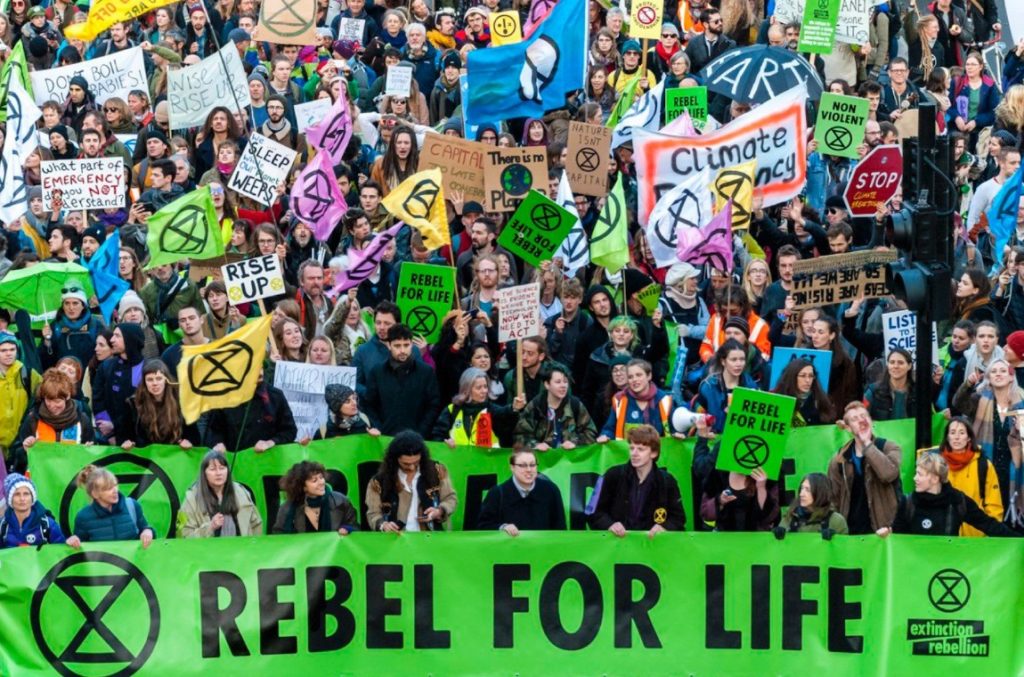
Launched in the UK in 2018, XR has frequently made headlines through mass demonstrations such as blocking roads and bridges. The group's first major action was in August 2018, blocking a road on Trafalgar Square. Many subsequent protests have focused on central London. An 11-day wave of demonstrations in April 2019 saw thousands of climate activists participate, causing major London traffic disruption, with protesters gluing themselves to the London Stock Exchange building and train carriages. Around 500,000 commuters were affected.
Note
A central part of XR's tactics has been encouraging mass arrests to completely fill police cells. October 2019 protests led to 1,828 arrests from around 30,000 protesters. In September 2020, smaller XR groups blockaded three News Corp printing sites, affecting several national newspapers' printing and leading to accusations of attacking press freedom.
XR's main demands:
- Tell the truth: Government must declare a climate and ecological emergency, working with other institutions to communicate urgency for change
- Act now: Government must act now to halt biodiversity loss and reduce greenhouse gas emissions to net zero by 2025
- Beyond politics: Government must create and be led by a Citizens' Assembly on climate and ecological justice—bringing together ordinary people to investigate, discuss and make recommendations on climate emergency response
Assessing XR's success:
Environmental concerns moved up the political agenda during the 2019 election cycle. In May 2019, Corbyn called on the government to declare a national environment and climate emergency during an Opposition Day Debate. In the election lead-up, 26% of voters (rising to 45% among 18–24-year-olds) cited the environment as one of their top three issues—compared to just 8% in the corresponding pre-2017 period. Climate change had clearly become much more high-profile.
Example
Example: XR's Policy Influence
Theresa May, in her final speech as prime minister, announced the UK would seek to cut greenhouse gas emissions to zero by 2050 (though XR's target is 2025). One XR founder gave oral evidence to the Business, Energy and Industrial Strategy select committee in June 2019, arguing for a Citizens' Assembly. By year's end, plans for such an assembly were established, supported by six select committees. The 100-strong Climate Assembly UK met over four 2020 weekends to discuss and produce climate change suggestions.
Although focused on non-violent direct action, XR has achieved some insider status elements, such as being invited to give select committee evidence.
However, propaganda stunts haven't always been well-received. A failed attempt to spray the Treasury building with "fake blood" from a fire engine elicited this response from the (far from reactionary) Independent newspaper:
"It just looks like a lot of angry people shouting and throwing stuff. Their surfeit of passion doesn't compensate for their weirdness, and failure to persuade decent people who are sympathetic but not earth murderers."
Direct action tactics were affected during the first COVID-19 lockdown. The group emerged from "hibernation" (as XR termed it) in September after several months of relative inactivity, during which it also faced competition for publicity and activists from the Black Lives Matter movement.
Important
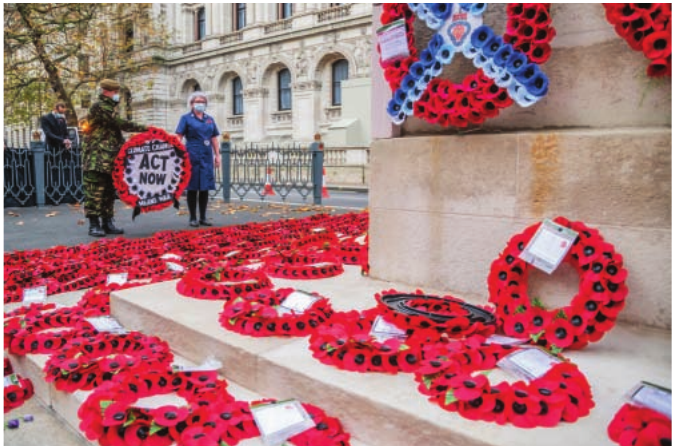
On Remembrance Day 2020, XR members, including British Army veteran Donald Bell, drew controversy by laying a wreath of poppies and a banner reading "climate change means war" on the Cenotaph war memorial. Bell justified his action: "Unchecked climate change means a return to a world at war. I cannot stand by and let that happen."
This incident highlights a key challenge for outsider groups: balancing the need for publicity with the risk of alienating public opinion through controversial tactics.
Like many activist groups (including Fathers 4 Justice), XR has been prone to splits centring on tactics, aims and personalities. Co-founder Gail Bradbrook commented: "One of the tensions in XR are people who want to slow down and be strategic and then people who think it's an emergency, let's get out on the streets now." Another co-founder, Roger Hallam, split from XR and founded a new movement, the Beyond Politics party, more radical in its aim of bringing down the government and replacing it with citizens' assemblies. Activities included walking out of supermarkets with shopping trolleys filled with food without paying, then giving away the food free to protest poverty.
Note
While XR has raised climate change profile and the notion of emergency, it has campaigned against a background of increasingly supportive public opinion, stronger scientific evidence, and growing willingness by all politicians to engage seriously with environmental issues. This raises questions about whether XR's success stems from its direct action tactics or from riding a wave of changing public attitudes.
Remember!
Summary
Key Points to Remember:
-
Pressure groups aim to influence policy without seeking elected office, using various tactics from discreet lobbying to high-profile direct action
-
Insider groups maintain close government ties, are typically well-resourced, and enjoy regular consultation, though this can lead to "policy entrapment" and loss of independence
-
Outsider groups lack established government links, often use publicity-seeking tactics and direct action, and may face prosecution but retain greater independence
-
Interest groups defend members' specific interests (trade unions, business associations), while promotional groups campaign for causes not directly benefiting members (human rights, environmental protection)
-
Pressure group status is fluid—groups can move from outsider to insider status (Stonewall), and insider status can vary with which party holds power (trade unions under Labour versus Conservative governments)
-
Success depends on multiple factors including resources, tactics, timing, public opinion, and political context—no single approach guarantees policy influence