Key EU Institutions (AQA A-Level Politics): Revision Notes
📚Revision Notes
Key EU Institutions
Understanding EU institutions
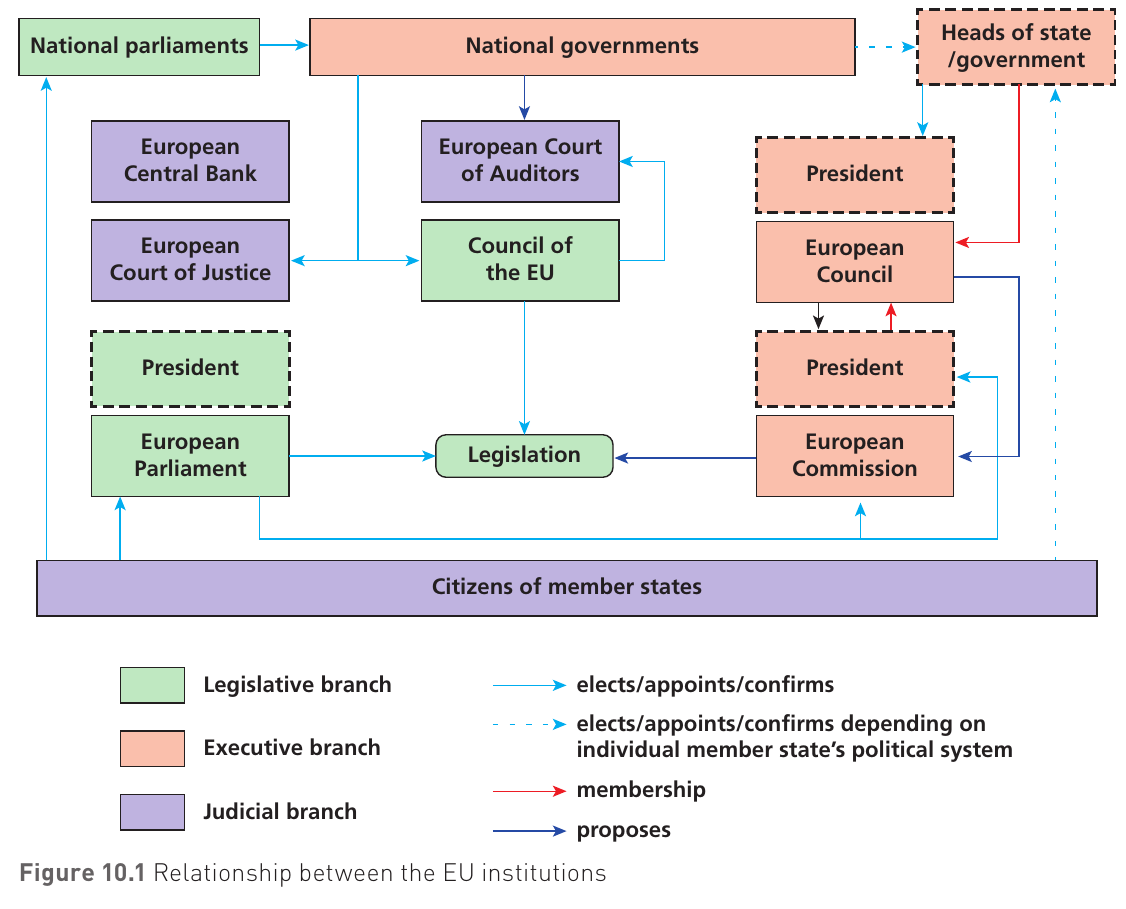
The European Union has five main institutions that work together to govern the EU. These institutions have different functions, membership structures, and levels of democratic accountability.
Note
EU institutions are the principal bodies of the EU that comprise its legislative, executive, judicial and administrative branches. Understanding how these institutions interact is fundamental to grasping how the EU functions as a whole.
Intergovernmental vs supranational bodies
EU institutions can be categorised into two types that reflect different approaches to governance:
Intergovernmental institutions comprise representatives of national governments. These include:
- Council of the European Union
- European Council
Supranational institutions possess their own independent authority and can impose decisions on national governments. These include:
- European Commission
- European Parliament
- Court of Justice of the European Union
Important
The distinction between intergovernmental and supranational institutions is crucial for understanding EU power dynamics. Intergovernmental bodies preserve national sovereignty by requiring government representatives, while supranational bodies can make binding decisions independent of individual member states' wishes.
The relationships between these institutions are complex and interconnected, with each playing a distinct role in EU governance.
European Commission
The European Commission serves as both the civil service and policy-making body of the EU. It operates from Brussels and consists of 27 commissioners, one from each member state.

Membership and appointment
The Commission president (Ursula von der Leyen since December 2019) is nominated by the European Council but must receive approval from the European Parliament. Individual commissioners are nominated by their national governments and then voted on by the European Parliament. The president allocates specific policy areas to each commissioner.
Note
This appointment process demonstrates the EU's system of checks and balances, where no single institution has complete control. The European Parliament's approval power gives democratic legitimacy to the Commission's executive authority.
Functions
The Commission has several crucial roles within the EU framework:
Law proposal: The Commission is the only EU body with the power to propose new laws. This gives it significant influence over the EU's legislative agenda.
Policy management: It manages EU policies and allocates EU funding across member states and policy areas.
Law enforcement: Working alongside the Court of Justice of the European Union, the Commission enforces EU law and ensures member states comply with their obligations.
International representation: The Commission represents the EU in international negotiations and agreements with non-EU countries.
Important
The Commission's exclusive right to propose legislation is one of the most significant powers in the EU system. This means that even though the Parliament and Council make the final decisions on laws, they can only consider proposals that originate from the Commission.
Examples of work
Example
Example: Budget Allocation
In June 2020, the Commission announced a 9% reduction in funding for the Common Agricultural Policy, demonstrating its role in budget allocation and its influence over EU spending priorities across different policy areas.
Example
Example: Safety Regulation
The Commission issued the Seveso Directive in 1982 (since updated), which deals with the storage of dangerous substances in the oil and chemical industries to minimise major accident risks. This directive affects over 12,000 industrial establishments across the EU, showing the wide-reaching impact of Commission directives on business operations throughout member states.
Council of the European Union
The Council of the European Union (previously known as the Council of Ministers) is the main decision-making body of the EU. It meets in Brussels and has a unique membership structure.

Membership and composition
Rather than having fixed members, the Council comprises government ministers from each EU country. Which ministers attend depends on the policy area being discussed. This means membership is effectively decided by national governments.
Note
This flexible membership structure allows relevant expertise to be brought to discussions. For example, when discussing agriculture policy, each country sends their agriculture minister, ensuring decisions are made by those with specialist knowledge.
The Council operates through ten sectional councils, each dealing with a specific policy area such as Agriculture and Fisheries.
Functions
Legislative power: The Council shares legislative power with the European Parliament through a process known as 'co-decision'. This means both institutions must agree for laws to be passed.
Policy coordination: It coordinates economic policy across member states.
Law approval: The Council negotiates and approves laws proposed by the European Commission regarding policy and directives.
Voting system: Most decisions are agreed using Qualified Majority Voting (QMV), though in sensitive areas like foreign policy and taxation, unanimity is required.
Important
The co-decision process is fundamental to EU democracy. By requiring both the Council (representing national governments) and the Parliament (representing citizens directly) to agree, the EU ensures laws have both intergovernmental and democratic legitimacy.
Example of work
Example
Example: International Trade
The Council negotiates trade deals with non-EU states. In 2019, it successfully negotiated a trade agreement with Japan, demonstrating its role in international economic relations and its power to shape the EU's external trade policy.
European Council
The European Council should not be confused with the Council of the European Union. It serves as the EU's strategic body, setting overall direction rather than making specific laws.
Important
Don't Confuse These Two Bodies!
Despite similar names, these are distinct institutions with different roles:
- Council of the European Union: Ministers, makes laws, meets frequently
- European Council: Leaders, sets strategy, meets quarterly
The European Council is about big picture strategy, while the Council of the European Union focuses on detailed law-making.
Membership and meetings
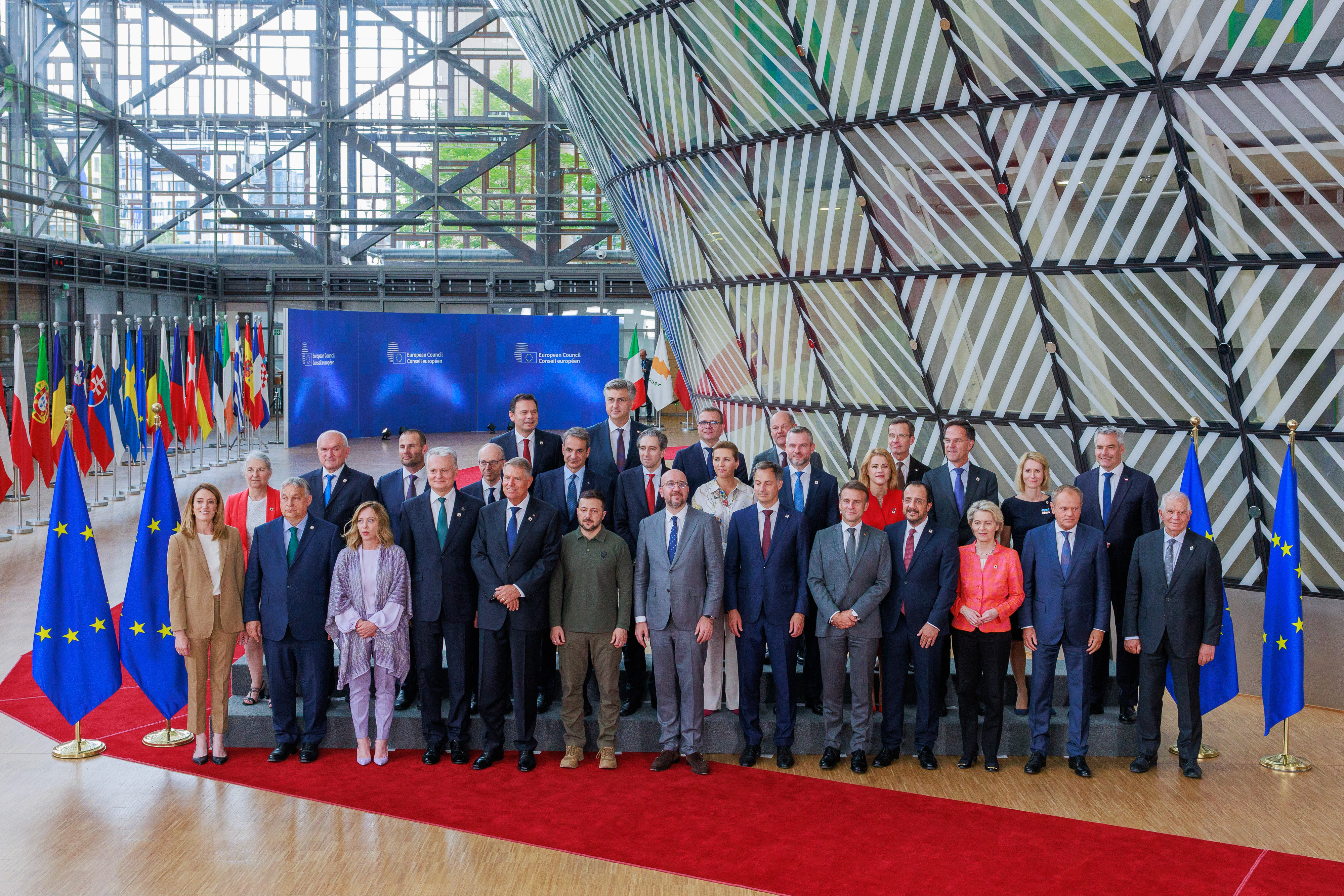
The European Council consists of the leaders of all member states who meet quarterly in summit meetings. These meetings usually take place in Brussels, though they are held in Luxembourg City during April, June and October.
The Council selects a president to serve a 5-year term. In 2019, Charles Michel was selected as president, replacing Donald Tusk. The president of the European Commission also attends meetings but does not have a vote.
Functions
Agenda setting: The European Council's primary role is defining the EU's overall direction and priorities.
Strategic leadership: It provides strategic guidance but is not one of the EU's legislating institutions, so it does not negotiate or adopt EU laws directly.
Examples of work
The European Council oversees major political issues and crises.
Example
Example: Brexit Negotiations
The European Council oversaw Brexit negotiations with the UK, establishing the EU's negotiating position and terms. This demonstrates its role in handling major political crises that affect the entire EU.
Example
Example: Ukraine Crisis Response
The European Council formulated the EU's response to unrest in Ukraine and the threat posed by Russia. Former president Donald Tusk emphasised Ukraine's importance to European security, stating:
"There can be no just Europe without an independent Ukraine. There can be no safe Europe without a safe Ukraine. To put it simply: there can be no Europe without Ukraine!"
This illustrates how the European Council addresses critical geopolitical challenges facing the EU.
European Parliament
The European Parliament is the only directly elected EU institution, giving it significant democratic legitimacy. However, its structure and powers differ from traditional national parliaments.
Location and structure
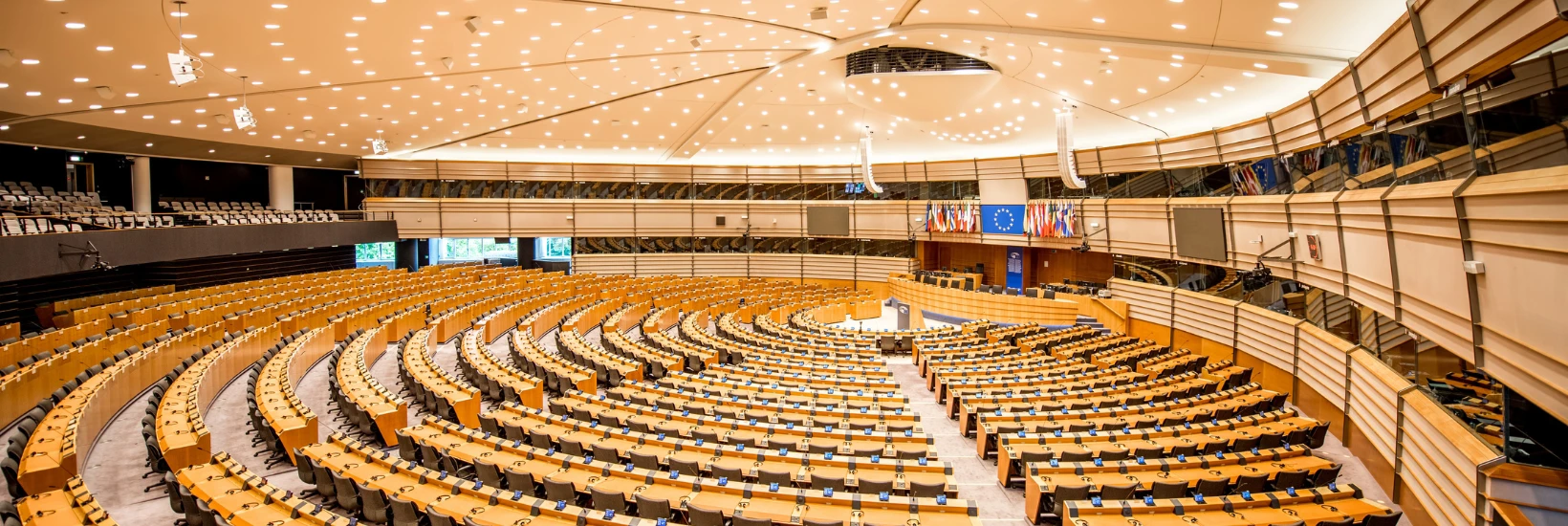
The Parliament has a complex multi-location structure defined by EU treaties. Its main seat is in Strasbourg, though some meetings are held in Luxembourg and its secretariat is based in Brussels. The Parliament itself cannot change this arrangement.
Note
This unusual multi-location structure reflects the EU's origins and political compromises. While it ensures geographical distribution of EU institutions, it has been criticized for inefficiency and increased costs due to the need to move between locations.
Membership
Following Brexit, the Parliament contains 705 members known as MEPs (Members of the European Parliament). MEPs are directly elected by citizens of member states.
The number of MEPs per country is determined by population size. For example, Germany has 96 MEPs while Malta has just six.
Note
Within the Parliament, MEPs do not sit as national delegations. Instead, they organise themselves into pan-European political groupings based on ideology, such as the Group of the Progressive Alliance of Socialists and Democrats. This encourages MEPs to think in terms of European-wide interests rather than purely national concerns.
Functions
Budget approval: The Parliament approves the annual EU budget, giving it significant financial oversight.
Legislative power: It amends and can veto EU legislation as proposed by the Council of the European Union and drafted by the Commission. However, unlike most national parliaments, the European Parliament cannot propose its own legislation.
Appointment confirmation: It confirms the appointment of commissioners nominated by national governments.
Oversight: The Parliament oversees the work of EU institutions, notably scrutinising the European Commission.
Important
Key Limitation of the European Parliament
Unlike most national parliaments, the European Parliament cannot propose its own legislation - it can only amend or veto proposals from the Commission. This is often seen as a democratic deficit in the EU system, as the directly elected body cannot initiate laws, only react to proposals from the unelected Commission.
Examples of work
Example
Example: Commissioner Nomination Veto
The Parliament occasionally vetoes commissioner nominations. In 2019, Romanian nominee Rovana Plumb was vetoed by the parliament's oversight committee due to irregularities in her wealth declaration form. This demonstrates the Parliament's power to hold nominees accountable and exercise meaningful oversight over appointments.
Example
Example: Copyright Law Reform
In 2019, the Parliament approved a controversial new EU copyright law including Article 11 and Article 13. These articles required social media platforms such as YouTube, Facebook and Twitter to take greater responsibility for copyrighted material being shared illegally.
While industry groups supported the law as protecting creative artists' rights, critics argued it would stifle social media creativity and potentially ban memes. This example shows how the Parliament makes decisions that directly affect millions of EU citizens' daily lives and highlights the balance between different interests.
Court of Justice of the European Union
The Court of Justice of the European Union (CJEU) is the EU's supreme judicial authority. It operates from Luxembourg and ensures EU law is applied uniformly across all member states.

Structure and membership
The CJEU is divided into two courts:
Court of Justice: Deals with requests for preliminary rulings from national courts.
General Court: Rules on actions for annulment brought by individuals, companies and, in some cases, EU governments. In practice, this court deals mainly with competition law, state aid, trade, agriculture and trademarks.
Note
Each judge is appointed for a renewable 6-year term by national governments. Within each court, the judges select a president who serves a renewable 3-year term. This structure balances national representation with judicial independence.
Functions
Upholding EU laws: The CJEU ensures EU laws are implemented fairly and uniformly across member states. Many cases are brought by the Commission when it believes laws are being infringed.
Ultimate legal authority: The CJEU is the final source of legal authority in the EU. Its decisions cannot be overruled by any other EU body or by national governments.
Important
Supreme Authority of the CJEU
The CJEU's role as the ultimate legal authority means that its interpretations of EU law are binding on all member states and cannot be challenged. This gives the court enormous power in shaping how EU law develops and is applied, sometimes even against the wishes of national governments.
Example of work
Much of the CJEU's work concerns trade and copyright matters. Importantly, it does not always support the European Commission.
Example
Example: Court Independence
In 2020, the General Court overturned the Commission's decision to block the merger of two UK mobile telecoms companies, O2 and Three.
This demonstrates the court's independence and its role in checking the Commission's power. The CJEU acts as a genuine check on other EU institutions, ensuring they operate within the law rather than simply rubber-stamping their decisions.
Remember!
Summary
Key Points to Remember:
-
The EU has five key institutions: European Commission, Council of the European Union, European Council, European Parliament, and Court of Justice of the European Union.
-
Intergovernmental institutions (Council of the EU and European Council) represent national governments, while supranational institutions (Commission, Parliament, CJEU) have independent authority.
-
The European Commission is the only body that can propose new EU laws, making it highly influential in shaping policy.
-
Co-decision between the Council of the European Union and European Parliament means both must agree for laws to pass, creating a system of checks and balances.
-
The European Parliament is directly elected by EU citizens but cannot propose its own legislation, unlike most national parliaments.
-
The CJEU is the ultimate legal authority in the EU, and its decisions cannot be overruled by any other body, including national governments.