Significance of Constitutional Principles (AQA A-Level Politics): Revision Notes
📚Revision Notes
Significance of Constitutional Principles
The US Constitution remains the foundation of American government and politics over two centuries after its creation. Understanding how its principles work in practice is essential for evaluating the effectiveness of the American political system. This note examines the ongoing relevance and impact of key constitutional principles.
Note
Despite being written in the 18th century, the Constitution continues to shape American politics today. Its principles—both clear and vague—determine how government operates and how political conflicts are resolved.
Vagueness and silence in the Constitution
The Constitution's mixture of vagueness and silence on certain issues represents both its greatest strength and its most significant weakness. This dual nature has profoundly shaped American political development.
Constitutional flexibility as a strength
The Constitution's vague language has enabled it to evolve and adapt to changing circumstances across more than 200 years. Key phrases like general welfare have taken on very different meanings since the eighteenth century. The necessary and proper clause, often called the elastic clause, empowers Congress to make laws "necessary and proper" to carry out federal duties. This flexibility has allowed the legislature to respond to new challenges and reflect evolving social values.
Note
Constitutional Adaptation in Action
The dramatic shift from the Immigration Act 1924—which reflected clear racial bias by banning all Asian immigration to the USA—to the Voting Rights Act 1965, which explicitly forbade racial discrimination in voting, demonstrates how constitutional vagueness has permitted American law to change with society's values.
Problems created by vagueness
However, constitutional vagueness has also created serious problems. The original Constitution's complete silence on slavery sowed the seeds for a deep sectional divide that culminated in the bloody Civil War of the 1860s. Only after this devastating conflict was slavery finally banned through the Thirteenth Amendment (1865).
Important
The Constitution's lack of explicit democratic principles suggests it was not the enlightened, visionary document some claim. The USA required decades of struggle and several constitutional amendments before becoming a fully democratic state.
Similarly, the Nineteenth Amendment (1920), which granted women the right to vote, came over 130 years after the Constitution's adoption. Like Britain and other Western nations, America's journey towards full democracy was long and difficult.
The Second Amendment: a case study in ambiguity
Perhaps the most frustrating example of constitutional vagueness concerns gun rights. The Second Amendment contains the famous phrase "the right to bear arms," but this seemingly straightforward right is preceded by the phrase "A well-regulated Militia, being necessary for the security of a free state."
Important
The Gun Rights Dilemma
This creates fundamental questions: Does this guarantee all Americans an unlimited right to private gun ownership, or only members of organised militias like the National Guard?
There is also ambiguity in the term "arms" itself. In the 1780s, "arms" referred to single-shot muskets. Does this now extend to semi-automatic weapons, handguns, or even more lethal devices?
Retired Supreme Court Justice John Paul Stevens suggested rephrasing the amendment for clarity: "A well-regulated militia, being necessary to the security of a free state, the right of the people to keep and bear arms when serving in the militia shall not be infringed."
Note
Exam tip: When discussing constitutional vagueness, always provide specific examples like the Second Amendment or war powers. Explain both the advantages (flexibility) and disadvantages (uncertainty) of vague wording.
War powers: who decides on military action?
Similar uncertainty surrounds whether Congress or the president holds ultimate responsibility for initiating military action. The Constitution gives Congress sole power to formally declare war, yet it also grants the president the title of commander-in-chief. The Founding Fathers likely envisaged Congress as the primary decision-maker, whilst accepting that emergencies might require immediate presidential action—for instance, if the British or Indigenous Americans launched unexpected attacks.
In practice, the reality has differed significantly from this intention. Presidents typically order military action first, then seek Congressional approval retrospectively. Such interventions have often involved secrecy and deception, exemplified by the secret bombing campaigns in Laos and Cambodia during the Vietnam War (1955-75).
Note
The combination of silence and ambiguity has proved a mixed blessing. Whilst it has enabled the Constitution to adapt without formal amendment, it has also created uncertainty and lack of clarity. When such uncertainty arises, the Supreme Court must step in to provide definitive interpretation.
The need for a referee
Judicial review represents the Supreme Court's most important power, effectively granting it authority to interpret the Constitution and declare laws or executive actions unconstitutional and therefore illegal. Remarkably, judicial review is not explicitly mentioned in the Constitution—it emerged through the precedent established in the 1803 case Marbury v Madison.
The Supreme Court's interpretive role
Due to areas of doubt and uncertainty in the Constitution, there have been numerous occasions requiring authoritative interpretation. Charles Evans Hughes, before becoming a Supreme Court justice, expressed this succinctly in 1907:
Important
We are under a Constitution, but the Constitution is what the judges say it is.
— Charles Evans Hughes
This quote captures a crucial reality: the Supreme Court's interpretations effectively rewrite constitutional meaning for each generation.
Judicial review has become crucial to the Supreme Court's function but has also led to its inevitable politicisation. Many contentious issues—ranging from abortion to same-sex marriage—ultimately reach the Supreme Court. Matters that other Western democracies might settle through legislation or referendums are, in the USA, often decided by the courts. This reflects the Constitution's vagueness and the need for definitive legal opinions on what is constitutional and lawful.
Landmark cases as ongoing battles
This situation has produced numerous landmark cases throughout US history. However, such cases often represent commas rather than full stops—they are not final victories but contests requiring rematches. The Court can and does revise its opinions over time.
Example
Landmark Case Reversal: Segregation Laws
The Plessy v Ferguson case (1896) upheld racial segregation laws, establishing the "separate but equal" doctrine. Yet these were effectively reversed in Brown v Board of Education of Topeka (1954), which declared school segregation unconstitutional.
This demonstrates how constitutional interpretation changes over time, even on fundamental issues like racial equality.
Therefore, the Supreme Court has become a battleground for ongoing legal challenges in controversial areas. The Constitution may have the last word, but the Supreme Court frequently retypes it.
Note
Exam tip: When discussing judicial review, explain that it gives the Supreme Court power to interpret the Constitution, making it highly political. Use specific landmark cases to illustrate how interpretations change over time.
The game of gridlock
The Constitution was designed to promote cooperation and compromise between different branches of government—between Congress and the president, and between the Senate and the House of Representatives. By requiring mutual agreement—for example, all laws must pass both congressional chambers—the hope was that branches would work together.
Note
George Washington allegedly described the Senate as a "senatorial saucer" to cool legislation coming from the more passionate and populist House, explaining this concept to Thomas Jefferson.
Deadlock instead of cooperation
Reality has proved otherwise. All too frequently, there is competition and deadlock between different branches rather than cooperation. The budget process provides a clear example: the president proposes a budget and submits it to Congress for approval. In recent years, this has often led to standoff and gridlock. In the worst scenarios, limited government shutdowns have occurred.
Important
Government Shutdowns: When Gridlock Becomes Crisis
The longest government shutdown lasted 35 days between December 2018 and January 2019, partly due to President Trump's insistence on greater funding for his border wall.
The presidential veto (or threat of one), and equally Congress's refusal to pass legislation requested by the president, has led to important reforms—such as immigration reform—not being passed.
Arguably, instead of uniting Americans, the Constitution has often inadvertently led to division and deadlock.
Note
Exam tip: Gridlock demonstrates how the separation of powers can create paralysis rather than effective government. Use recent examples like the 2018-19 government shutdown to show this principle in action.
Elections: a match still played out in 50 states
The Constitution places organisation of elections firmly in the hands of the 50 individual states. Whilst some main rules and requirements for voting are uniform across the USA—mandated by laws like the Voting Rights Act 1965 and the Help America Vote Act 2002—many practical aspects of conducting elections remain state-specific. This state-based approach is ultimately down to the Constitution itself.
Variations across states
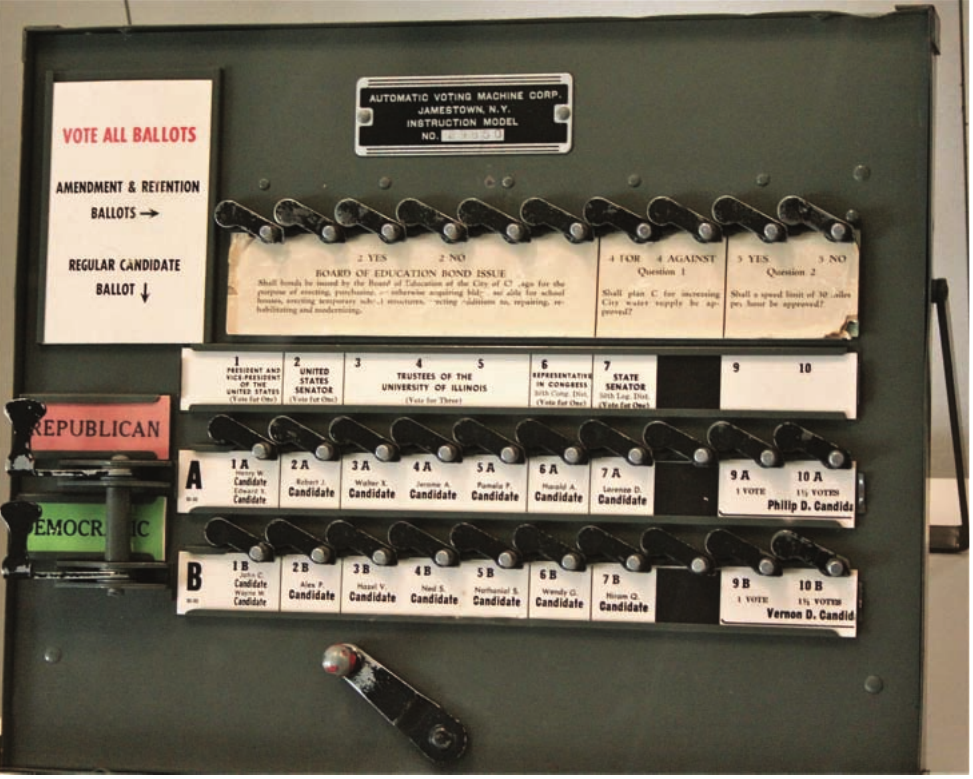
This creates wide variations in numerous electoral aspects: the use of postal ballots, early voting provisions, how primaries and caucuses are organised, and the voting rights of ex-felons. There is no national voter register, and states employ different voting methods. Some use electronic voting machines (direct-recording electronic systems), whilst others maintain traditional paper ballots. A handful of states, including Utah, automatically mail ballots to all voters.
Historically, lever machines were commonly used across America until the 1990s. New York was the last state to employ them, finally ending their use as late as 2009. Following the 2020 elections, Georgia state law required runoff elections in January 2021 for its two senatorial races, as neither candidate achieved over 50% of the vote in November.
Voter ID controversies
This state-based focus has also raised controversy over stricter voter ID laws. Some states, mainly those with Republican control, have sought to toughen identification requirements, claiming this prevents voter fraud. States including Kansas and Mississippi have strict requirements regarding acceptable forms of photo ID.
Important
The Voter ID Debate
Critics argue these measures constitute voter suppression, deliberately making it harder for certain groups to vote.
Despite loud claims by Trump and many Republican supporters that the 2020 election was "stolen," voter fraud actually remains extremely rare in the USA. Numerous court cases and investigations found no evidence of widespread fraud.
Note
Exam tip: The state-based election system demonstrates federalism in practice. Be prepared to discuss both its benefits (local control, experimentation) and problems (inconsistency, potential for suppression).
Remember!
Summary
Key Constitutional Principles to Remember:
-
Constitutional vagueness acts as both strength (allowing evolution) and weakness (creating uncertainty). Examples include the Second Amendment and war powers.
-
Judicial review gives the Supreme Court power to interpret the Constitution, making it the referee of American politics. This power emerged from Marbury v Madison (1803), not from the Constitution itself.
-
The separation of powers often produces gridlock rather than cooperation, with different branches blocking each other instead of working together. Recent government shutdowns demonstrate this problem.
-
Elections remain state-controlled, creating significant variations in voting methods, ID requirements, and access across America. This reflects federalism but raises concerns about consistency and fairness.
-
Key amendments expanded democracy over time: the Thirteenth Amendment (1865) banned slavery, whilst the Nineteenth Amendment (1920) granted women voting rights, showing the Constitution's original limitations.