Formal and Informal Powers (AQA A-Level Politics): Revision Notes
📚Revision Notes
Formal and Informal Powers
The president of the United States wields both formal powers, which are rooted in the Constitution, and informal powers, which are political in nature and have developed through practice. Understanding the distinction between these powers is essential for analysing presidential effectiveness.
Formal powers are constitutional and consist of enumerated powers (explicitly stated in the Constitution), implied powers (reasonably inferred from the Constitution), and inherent powers (derived from the president's role as head of state). In contrast, informal powers are not mentioned in the Constitution but form the basis of all successful presidencies.
Formal powers
The president possesses several key formal powers that enable them to govern effectively. These powers include executive authority, legislative influence, appointment powers, foreign policy powers, and the power to grant pardons.
Executive powers
As chief executive of the federal government, the president controls the federal bureaucracy. This vast administrative structure comprises 15 executive departments, each responsible for different policy areas, plus numerous independently run federal agencies.
The president also prepares the annual federal budget through the Office of Management and Budget (OMB). This crucial document sets out government spending for the coming year. For example, Trump's February 2020 budget proposed record spending of $4.8 trillion, even before COVID-19 costs were factored in. However, the president cannot pass the budget independently – this requires congressional approval, demonstrating the system of checks and balances in action.
Note
Congress holds the 'power of the purse', which limits presidential control over government spending. This represents a fundamental constraint on executive power, as the president must negotiate with Congress to secure funding for their policy priorities.
The power to influence the passage of legislation through Congress
The president has four distinct powers to influence legislation: one at the start of the legislative process and three at the end.
At the start of the legislative process:
- The president can propose legislation to Congress
- This occurs most prominently in the annual State of the Union Address, usually delivered in January
- The president presents legislative priorities to a joint session of both houses of Congress
- New policy initiatives can be proposed at any time through speeches or press conferences
At the end of the legislative process, the president has three options:
- Sign the bill into law – the bill becomes an Act of Congress and part of US law
- Leave the bill unsigned – the bill becomes law after 10 working days without signature. This option might be used for minor legislation or bills the president dislikes but cannot prevent Congress passing. If the congressional session ends during these 10 days, the bill is lost. This is known as a pocket veto.
- Veto the bill – the president sends the bill back to Congress with a message explaining their reasons. Congress can override a presidential veto with a two-thirds majority in both houses, but this is very difficult to achieve.
Important
Pocket Veto Definition
A pocket veto is a constitutional power allowing the president to veto a bill by not signing it before the end of the current legislative session. Unlike a standard veto, Congress cannot override a pocket veto. Bill Clinton last used this power in 2000.
This makes the pocket veto more powerful than a regular veto, as Congress has no recourse to revive the legislation.
The threat of a veto can be powerful during the legislative process. Through veto signalling, the president uses a Statement of Administration Policy to communicate their views on a bill to Congress, potentially pressuring legislators to make changes.
Different presidents have used their veto power to varying extents:
| President (years) | Vetoes | Overridden by Congress |
|---|---|---|
| Ronald Reagan (1981-89) | 78 | 9 |
| George H.W. Bush (1989-1993) | 44 | 1 |
| Bill Clinton (1993-2001) | 37 | 2 |
| George W. Bush (2001-9) | 12 | 4 |
| Barack Obama (2009-17) | 12 | 1 |
| Donald Trump (2017-21) | 10 | 1 |
Example
Worked Example: Trump's Border Wall Vetoes
Trump used the veto twice to block legislation that would have ended the state of national emergency at the southwestern US border.
Background: He had declared this emergency in February 2019 to access federal funds for building the border wall promised during his campaign. Congress had previously refused to fund the wall and twice voted to terminate the emergency.
Outcome: Trump's vetoes allowed him to maintain the emergency and continue construction.
Analysis: This demonstrates how powerful the veto can be in protecting presidential priorities, even when Congress opposes the president's actions. The difficulty of achieving a two-thirds override majority meant Trump could prevail despite congressional opposition.
Appointment powers
The president nominates officials to key posts in the executive branch. When a new president takes office, approximately 4,000 positions in the executive branch can be filled with appointments. More than 700 of these require Senate confirmation by a simple majority vote.
Positions requiring Senate confirmation include:
- Heads of executive departments
- Heads of many independent federal agencies
- US ambassadors (diplomatic representatives overseas)
- All federal judges, including Supreme Court justices
Important
Unlike executive branch positions, which are political appointments ending with each new presidency, judges are appointed for life. This means the impact of presidential judicial appointments can continue long after a president has left office. Supreme Court justices determine how the Constitution is interpreted, making their appointment one of the most important presidential powers.
The Senate provides a crucial check on presidential appointment power through its confirmation process.
Foreign policy powers
As commander-in-chief of the US military, the president serves as overall head of the armed forces and can initiate military action. While the Constitution grants only Congress the power to declare war, Congress has not done so since 1941.
The War Powers Act 1973 theoretically requires presidents to seek congressional approval before military action. However, some presidents have acted without this approval:
- Clinton sent US troops into Kosovo and several other countries in the 1990s
- Obama ordered military intervention in Libya
Twenty-first century conflicts:
- George W. Bush ordered invasions of Afghanistan (2001) and Iraq (2003) as part of his 'war on terror' following the 9/11 attacks
- Obama initiated military action in Libya (2011) and Syria (2015)
- Obama and Trump used drone strikes to target terrorist suspects in Pakistan, Yemen and Somalia
- Obama authorised the killing of Osama bin Laden, leader of al Qaeda, in 2011
- Trump ordered the death of Abu Bakr al-Baghdadi in 2019
- Trump controversially authorised a drone strike killing Iranian general Qasem Soleimani in 2020, leading to Iranian military retaliation
Note
The Nuclear Option
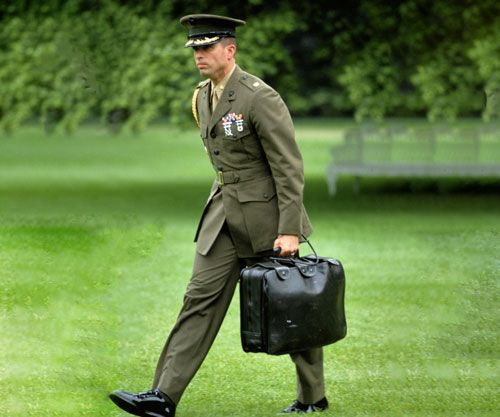
The most deadly power of commander-in-chief is the ability to use nuclear weapons. When away from the White House, the president is accompanied by a military officer carrying the 'nuclear football' – a black briefcase containing nuclear codes and guidance for their use.
Only one president has ever authorised the use of nuclear weapons: Harry Truman ordered two bombs dropped on Hiroshima and Nagasaki in August 1945, killing more than 250,000 people to hasten the end of the Second World War.
Treaty negotiation:
The president has the power to negotiate treaties with other countries, though these must be ratified by the Senate with a two-thirds supermajority.
Power to grant pardons
The president can pardon anyone convicted of a federal crime, with the exception of cases of impeachment. Pardons can be granted after the convicted individual has died, as when Trump pardoned African-American boxer Jack Johnson in 2019 for a 1913 offence. The president can even give a pre-emptive pardon for crimes already committed that an individual may be charged with in future. In 1974, Gerald Ford pardoned Richard Nixon for any crimes he might have committed in the Watergate scandal.
Presidents can also show clemency by commuting a sentence, which releases the prisoner but does not give them a formal pardon.
Note
Controversial Uses of Pardons
The pardon power has been used controversially by several presidents:
- Bill Clinton pardoned his own brother for a drug offence and granted 140 pardons on his final day in office ('Pardongate')
- Trump tweeted in 2018: "I have the absolute right to PARDON myself" – a claim widely disputed by legal experts
- Trump commuted the sentence of his adviser Roger Stone in July 2020, who was convicted of obstructing the investigation into Russian interference in the 2016 election
- Trump pardoned his former advisor Steve Bannon in the last hours of his presidency, who had been charged with fundraising fraud
These examples demonstrate how the pardon power can be abused for personal or political purposes, with few constitutional constraints.
Informal powers
Informal powers are not explicitly mentioned in the Constitution but have become essential tools for presidential effectiveness. These powers are political in nature and involve the stretching of implied powers.
The power to persuade
Professor Richard Neustadt famously argued: "Presidential power is the power to persuade." Writing in 1960, Neustadt explained that because power is shared between the executive, legislature and judiciary, and between states and federal government, persuasion is the key skill needed for effective presidential leadership.
Political scientist Matt Glassman, writing in the New York Times in 2020, explained: "Presidents compete with numerous actors for influence over public policy. The president must rely on his informal ability to convince other political actors it is in their interest to go along with him, or at least not stand in his way."
Presidents use several tools to persuade:
- Personal influence
- The authority of their office
- Political capital (public support and political goodwill)
- Support from the vice president, cabinet officers and lobbyists in the Office of Legislative Affairs
The president's power to persuade is heavily constrained by the extent of their control over Congress. The presidential support score measures the percentage of congressional votes where the president took a position and won.
Presidential support scores vary significantly:
- During unified government (president's party controls both houses), scores are much higher:
- Obama: 96.7% in 2009 (Democrats controlled both houses)
- Trump: 98.7% in 2017 (Republicans controlled both houses)
- During divided government (opposing party controls one or both houses), scores typically fall:
- Obama: 57% in 2011 (Republicans won House)
- Obama: 45.7% in 2015 (Republicans won Senate in 2014 midterms)
Important
Exam Tip: Unified vs. Divided Government
When analysing presidential power, always consider whether the government is unified or divided. This is one of the most important factors affecting presidential effectiveness.
Unified government dramatically increases the president's ability to pass legislation, while divided government forces the president to rely more heavily on persuasion and deal-making.
Deal-making
Presidents need congressional support to pass legislation and may make deals with politicians to achieve this. The president might offer to:
- Support a policy that a legislator is championing
- Provide election campaign support (if same party)
- Deliver funding to their home state or district
During divided government, bipartisan deal-making is essential to avoid gridlock (legislative paralysis).
Example
Worked Example: Trump's Bipartisan Deals
Despite frequent conflict with Democrats, Trump successfully made bipartisan deals on several occasions:
- First Step Act 2018 (criminal justice reform)
- 2019 trade deal with Mexico and Canada
- $1.4 trillion spending bill in December 2019 (avoiding another government shutdown)
Analysis: These examples show that even during periods of high partisan tension, presidents can achieve legislative success through bipartisan cooperation when both parties share common goals.
Most presidents must make concessions to the opposing party to pass their budgets.
Setting the agenda
Presidents command the media spotlight and can set the political agenda. More than any other figure in the USA, the president determines what issues are discussed by journalists, political commentators and the public. They shape public opinion through speeches and statements arguing their position.
Note
Trump's Controversial Use of Agenda-Setting
Trump used Twitter extensively to commandeer the political agenda:
- Tweeted that four Democrat congresswomen of colour ('The Squad') should "go back and help fix the totally broken and crime infested" countries they came from (all four are US citizens; widely condemned as racist)
- Described COVID-19 as the "Chinese virus" and blamed China for the pandemic
- When Trump caught COVID-19 in October 2020, told the public "don't let it take over your lives" (despite 200,000+ American deaths)
- Trump's relaxed attitude to the pandemic likely contributed to partisan divide in COVID-19 responses, with Republican counties showing less physical distancing and higher infection/death rates
- Claimed 2020 presidential elections were "stolen" and told supporters to "fight like hell" before Capitol attack on 6 January 2021
- Consequently impeached for "incitement of insurrection" and blocked by Twitter and Facebook
This demonstrates both the power of agenda-setting and how it can be misused to promote divisive or dangerous messages.
De facto party leader
The president effectively serves as head of their party and can influence its membership. This is particularly helpful during unified government when the president's party controls both houses of Congress, making it easier to convince Congress to pass legislation.
During divided government, party leadership is of limited use in passing legislation. Obama's low presidential support scores in his final years demonstrate this.
Important
However, even during unified government, presidents may not have unconditional support. In 2017, Republicans controlled both houses but Trump could not convince Congress to fully repeal Obama's Affordable Care Act 2010, despite this being a major campaign pledge.
This shows that party control does not guarantee legislative success – presidents must still persuade members of their own party.
World leader
The USA is the most powerful liberal democracy and military superpower in history, and its president is often described as the "leader of the free world". The USA dominates global politics and international institutions including:
- United Nations (UN)
- North Atlantic Treaty Organization (NATO)
- G7 group of advanced economies
- World Trade Organization (WTO)
Examples of presidential world leadership:
- Reagan led Western democracies against the USSR during the Cold War (1945-91)
- George W. Bush led an international coalition in the 'war on terror' following 9/11
- Obama convinced nations to sign the 2015 Paris Agreement on climate change and the 2015 Iran nuclear deal
Trump's different approach:
Trump showed less interest in international leadership through institutions:
- Withdrew the USA from the Paris Agreement and Iran nuclear deal
- Sent mixed signals about US commitment to NATO
- Preferred developing bilateral relationships with international powers
- "America First" policy led to abrasive approach with traditional allies
- Started a trade war with China
- Terminated USA's relationship with World Health Organization (WHO) during COVID-19 pandemic
Note
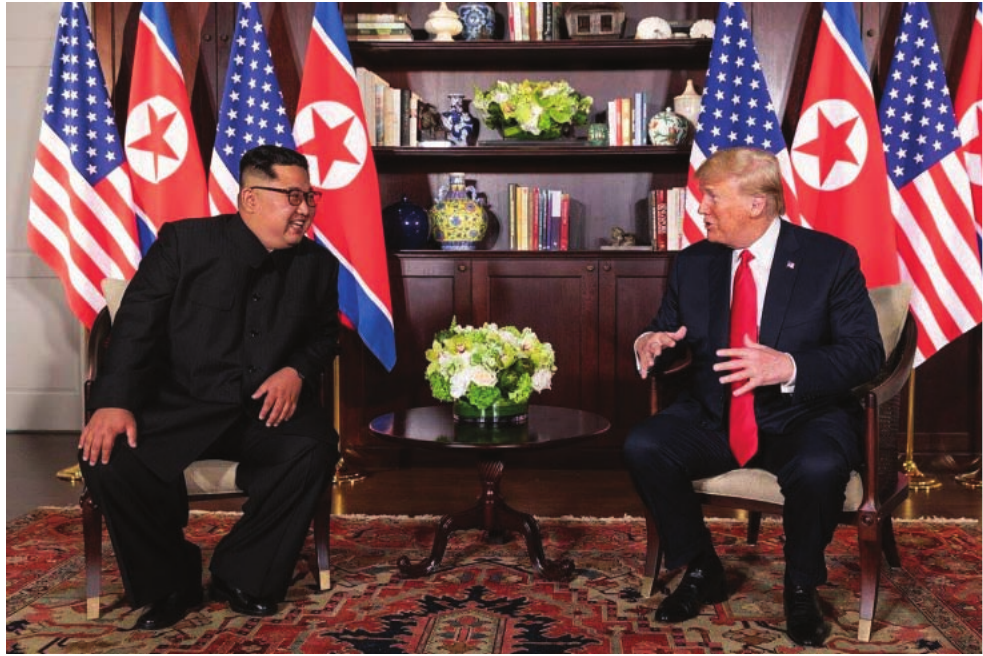
Trump met with North Korean leader Kim Jong Un in Singapore in 2018, demonstrating his preference for bilateral agreements over multilateral institutional cooperation. This represented a significant shift from traditional American foreign policy approaches.
Direct authority and the stretching of implied powers
Direct authority means the power of the president to take action directly, without consulting Congress. Franklin D. Roosevelt used direct authority frequently, and subsequent modern presidents have followed his example. This is achieved by 'stretching' the president's implied powers to create new informal powers beyond those in the Constitution.
Important
Expansion of Presidential Power
Franklin D. Roosevelt fundamentally transformed the presidency by expanding the use of direct authority. Modern presidents have continued this trend, significantly increasing executive power beyond what the Founding Fathers originally envisioned.
This expansion remains controversial, with critics arguing it undermines the system of checks and balances.
Executive orders
An executive order is an official order made by the president directly to the federal government. It has the effect of law but can be easily reversed by the next president, unlike actual legislation passed by Congress.
The power to issue executive orders is not mentioned in the Constitution. However, Article II grants the president executive power, and from this, presidents have claimed an implied right to issue executive orders.
Historical use of executive orders:
- Franklin D. Roosevelt issued 3,721 executive orders (the most of any president)
- Dwight D. Eisenhower used an executive order in 1957 to send federal troops to enforce racial desegregation of Central High School in Little Rock, Arkansas
- George W. Bush authorised controversial anti-terror measures after 9/11, including surveillance of suspects without a court order
- Obama used executive orders after becoming frustrated with congressional resistance, including increasing the federal minimum wage and outlawing discrimination against married same-sex couples by health insurance companies
- Trump signed more executive orders in his first 3 years than Obama did over the same period, despite criticising Obama's use as "power grabs" during his campaign
Signing statements
Presidents use signing statements when they sign a bill into law but wish to comment on it. The president may:
- Make a positive comment
- Argue that aspects of the bill are unconstitutional and that the government will not enforce them
Note
Signing statements are controversial because presidents can effectively use them to achieve a line-item veto (vetoing a portion of a bill). The Supreme Court declared line-item vetoes unconstitutional in 1996, but signing statements provide a workaround.
Example: Trump used a signing statement to criticise a 2017 bill imposing sanctions on Russia, Iran and North Korea, claiming it affected his constitutional powers to conduct foreign policy.
Executive agreements
An executive agreement is made between the USA and an international government. Executive agreements are signed by the president and do not require Senate ratification as a formal treaty would.
Getting a treaty ratified by the Senate requires a two-thirds majority, making it complex and time-consuming. Presidents use executive agreements to avoid lengthy and potentially unproductive negotiations with senators.
Since the Second World War, the number of executive agreements relative to treaties has increased dramatically.
Criticism of executive agreements:
- Presidents circumvent Senate oversight
- They are easier to remove than ratified treaties
- Can simply be abandoned by subsequent presidents
Example: Trump withdrew from Obama's 2015 Paris Agreement on climate change and 2015 Iran nuclear deal.
Bureaucratic power
The Executive Office of the President (EXOP) is a collection of offices providing policy advice and administrative support to the president. Together these offices help the president to:
- Run the federal government
- Develop policy
- Write legislation
- Communicate with the public
- Communicate with members of Congress
- Negotiate trade deals
- Promote their agenda
Note
EXOP was established by Franklin D. Roosevelt, representing yet another example of how he expanded presidential power. EXOP has grown significantly over time and now provides the president with substantial institutional support that was not available to earlier presidents.
Summary
Key Concepts to Remember
Power Types:
- Formal powers are constitutional (enumerated, implied, inherent)
- Informal powers are political and not mentioned in the Constitution
Five Main Formal Powers:
- Executive powers (federal bureaucracy, budget)
- Legislative powers (propose, sign, veto, pocket veto)
- Appointment powers (executive branch, judiciary)
- Foreign policy powers (commander-in-chief, treaties)
- Pardon powers
Critical Informal Powers:
- "Presidential power is the power to persuade" (Neustadt) – persuasion is key because power is shared in the US system
- The presidential support score is much higher during unified government than divided government
- Presidents can stretch implied powers through executive orders, signing statements, and executive agreements to bypass Congress
Historical Context:
- Modern presidents have significantly expanded informal powers, particularly since Franklin D. Roosevelt established the Executive Office of the President (EXOP)
- The balance between presidential power and congressional oversight remains contested