Landmark Rulings and Related Controversies (AQA A-Level Politics): Revision Notes
📚Revision Notes
Landmark Rulings and Related Controversies
What are landmark rulings?
A landmark ruling is a Supreme Court decision that creates a new legal principle or fundamentally changes how the law is interpreted. These judgements are among the most politically controversial decisions made by the Court, often reshaping American society and law. Two of the most significant landmark rulings in US history are Brown v Topeka Board of Education (1954) and Obergefell v Hodges (2015).
Note
Landmark rulings represent the Supreme Court's most powerful tool for social change, but they are also the most contested because unelected judges make decisions that affect millions of Americans.
Brown v Topeka Board of Education (1954)
Background and context
Before Brown v Topeka, racial segregation was legally enforced across the American South. This policy separated white people from African-Americans in virtually all public spaces, including schools, restaurants, libraries, public transport, toilets and water fountains.
The legal foundation for segregation came from an 1896 Supreme Court case called Plessy v Ferguson, which established the "separate but equal" doctrine. This ruling allowed Southern state legislatures to pass segregation laws, known as Jim Crow laws, which mandated separate facilities for white people and African-Americans. However, these facilities were far from equal—those designated for white people received substantially better funding and resources. Segregation therefore legitimised and entrenched racial inequality throughout the South.
Example
The Case: Brown v Topeka Board of Education
The Challenge: In 1954, thirteen African-American families from Topeka, Kansas brought a lawsuit challenging their children's exclusion from the local all-white school. The families had to send their children miles away to attend an all-black school instead. The National Association for the Advancement of Colored People (NAACP) supported their legal challenge.
Legal Representation: The families were represented by lawyer Thurgood Marshall, who would later become the first African-American Supreme Court Justice. Marshall asked the Supreme Court to reconsider its Plessy v Ferguson judgement from nearly 60 years earlier, arguing that segregation violated citizens' constitutional rights.
The Ruling: The Supreme Court ruled unanimously that the doctrine of "separate but equal" was fundamentally unequal and therefore violated the Fourteenth Amendment, which guarantees citizens equal protection under a state's laws.
Important
Chief Justice Earl Warren's Reasoning:
Even if the tangible aspects of education (such as school resources and teaching quality) were equal between segregated schools, the intangible psychological result of segregation created feelings of inferiority in African-American children and reduced their educational attainment. In a follow-up judgement in 1955, the Court ordered local school authorities to integrate public schools.
Significance and impact
Brown v Topeka is arguably the most significant landmark case in US history. It ended more than half a century of legal segregation and transformed the rights of African-American citizens. The case is particularly significant because:
- States' rights conflict: In the South, the decision was viewed as an attack on states' rights by the federal Supreme Court, creating significant tension between state and federal authority.
- Little Rock confrontation: The ruling led to direct confrontation in Little Rock, Arkansas in 1957, when the state governor supported the local high school's decision not to admit nine African-American students. President Dwight D. Eisenhower eventually ordered federal troops to escort the "Little Rock Nine" into the school, demonstrating federal power to enforce the Court's ruling.
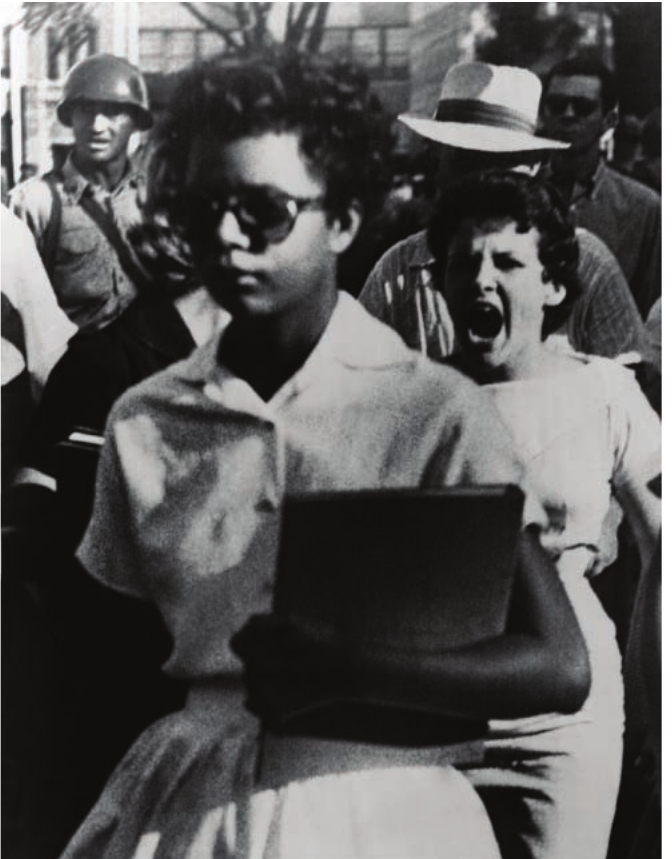
- Civil rights movement victory: The decision represented a key victory for the growing civil rights movement and strengthened the NAACP's campaign for racial equality.
- Judicial activism: The case demonstrated the power of an activist court, led by Chief Justice Earl Warren, willing to overturn long-standing precedent to protect constitutional rights.
Obergefell v Hodges (2015)
Background and context
James Obergefell married his husband in Maryland, where same-sex marriage was legal. However, when he returned to Ohio, where same-sex marriage was illegal, the state refused to recognise their marriage. Obergefell made a legal challenge that reached the Supreme Court, which also considered several similar cases from the states of Michigan, Kentucky and Tennessee in the same ruling.
Example
The Case: Obergefell v Hodges
Constitutional Basis: Like Brown v Topeka, this judgement centred on the equal protection clause of the Fourteenth Amendment.
The Ruling: The Supreme Court ruled 5-4, with the majority arguing that the right to marry was fundamental and supported by the equal protection clause. This decision legalised same-sex marriage across the entire USA, giving same-sex couples the same rights as any other married couples.
Significance and controversies
Obergefell v Hodges is significant because it demonstrates several important aspects of Supreme Court power and contemporary controversies:
- Loose constructionism: The majority of justices took a loose constructionist approach, interpreting the Constitution in the context of modern liberal ideas about sexuality rather than strict adherence to the original text.
- Unelected power: The judgement made a fundamental change to US law through an unelected body, raising questions about democratic legitimacy.
- Judicial activism debate: Strict constructionists condemned the judgement as judicial activism and "legislating from the bench", arguing that such changes should come through the democratic legislative process, not judicial interpretation.
- Religious freedom concerns: The judgement horrified many Christian and conservative groups who viewed marriage as a union "between a man and a woman". Dissenting justices argued that the right to religious freedom was being infringed by the ruling.
- Federal authority over states: Like Brown v Topeka, this case saw the Supreme Court rule against states' claims to determine their own marriage laws, extending federal constitutional protections across state boundaries.
Note
The Controversy:
Unlike the unanimous Brown v Topeka decision, Obergefell was decided by a narrow 5-4 margin, reflecting deep divisions within both the Court and American society about constitutional interpretation and the proper role of the judiciary.
Constitutional interpretation and federalism
Both Brown v Topeka and Obergefell v Hodges illustrate the tension between different approaches to constitutional interpretation:
Loose constructionism involves interpreting the Constitution flexibly, applying its principles to contemporary contexts and evolving social values. The majority in Obergefell exemplified this approach by applying the equal protection clause to same-sex marriage, a concept not contemplated when the Fourteenth Amendment was ratified.
Strict constructionism insists on adhering closely to the Constitution's original text and the Framers' intent. Critics of both landmark rulings argue that judges should not impose their own values through constitutional interpretation.
Important
Key Distinction:
- Loose constructionists believe the Constitution is a "living document" that should adapt to changing social values and contemporary contexts
- Strict constructionists argue the Constitution should be interpreted based on the original meaning and intent of the Framers, with changes made through the amendment process, not judicial reinterpretation
Federalism implications
Both landmark cases had profound implications for federalism—the division of power between federal and state governments:
- In Brown v Topeka, the state of Kansas defended educational segregation as a matter of state law. The Supreme Court ruled that federal constitutional protections (the Fourteenth Amendment) overrode state segregation laws.
- In Obergefell v Hodges, states claimed the right not to recognise same-sex marriages performed in other states. Again, the Supreme Court determined that federal constitutional protections trumped state marriage laws.
Note
Complexity of Federalism:
The Supreme Court's relationship with federalism is complex. Whilst it has extended federal law into areas such as segregation, abortion and same-sex marriage, it has also limited Congress's power to pass laws that infringe on states' rights, as demonstrated in Murphy v National Collegiate Athletic Association (2018).
Exam guidance
When discussing landmark rulings in essays, you should:
- Clearly explain the legal principle established or changed by the ruling
- Demonstrate understanding of the constitutional basis for the decision (particularly the Fourteenth Amendment's equal protection clause)
- Analyse the political and social significance of the ruling
- Consider both the case's immediate impact and long-term consequences
- Address the federalism implications and tensions between state and federal authority
- Evaluate different perspectives on judicial activism and constitutional interpretation
- Use specific examples and case details to support your arguments
Summary
Key Points to Remember:
-
Landmark rulings are Supreme Court decisions that establish new legal principles or fundamentally change legal interpretation, making them highly controversial.
-
Brown v Topeka Board of Education (1954) unanimously overturned the "separate but equal" doctrine established in Plessy v Ferguson (1896), ending legal segregation and declaring it violated the Fourteenth Amendment's equal protection clause.
-
Thurgood Marshall represented the families in Brown v Topeka and later became the first African-American Supreme Court Justice. The decision sparked the Little Rock confrontation (1957), where President Eisenhower sent federal troops to enforce school integration.
-
Obergefell v Hodges (2015) ruled 5-4 that same-sex marriage was legal nationwide, based on the Fourteenth Amendment's equal protection clause, though it was criticised as judicial activism by strict constructionists.
-
Both landmark cases illustrate the tension between states' rights and federal authority, with the Supreme Court asserting federal constitutional protections over state laws. They also demonstrate the debate between loose constructionism (interpreting the Constitution flexibly) and strict constructionism (adhering to original text and intent).