The Judiciary and Abortion (AQA A-Level Politics): Revision Notes
📚Revision Notes
The Judiciary and Abortion
Introduction to the Supreme Court and abortion policy
The Supreme Court has played a dominant role in shaping public policy on abortion since its landmark decision in Roe v Wade (1973). Before this ruling, abortion was either illegal or highly restricted in many states across the USA. The Roe decision made abortion legal in every state, establishing a constitutional right that fundamentally changed American society.
However, the ruling has remained deeply controversial. Pro-life supporters have never ceased to challenge the judgement, and since the Supreme Court acquired a conservative majority in 2018, many critics have aimed at reversing or eroding Roe completely. The debate between pro-choice and pro-life positions has become one of the most divisive issues in US politics, with most Democrats identifying as pro-choice and most Republicans and evangelical Christians as pro-life.
Note
The abortion debate has become a defining political dividing line in American politics, with the issue becoming increasingly polarized along party lines. This division reflects broader cultural and religious differences between the two major political parties.
Roe v Wade (1973): The landmark decision
Background to the case
The case involved a woman named Norma McCorvey who used the alias 'Jane Roe' to protect her anonymity. McCorvey was a 21-year-old pregnant woman living in Texas, where abortion was illegal. Two young female lawyers took on her case and challenged the right of Texas law to deny her an abortion. The case took several years to reach the Supreme Court, during which time McCorvey gave birth and gave her baby up for adoption.
The Supreme Court's ruling
The Court ruled 7-2 in favour of abortion rights. The justices considered the due process clause in the Fourteenth Amendment, which states: "nor shall any state deprive any person of life, liberty or property, without due process of law". The Court found that this clause implied a right to privacy from the government, which Texas had breached by denying McCorvey an abortion.
Note
The Right to Privacy
The right to privacy is not explicitly mentioned in the Constitution. Instead, the Supreme Court identified it as an implied right within the due process clause of the Fourteenth Amendment. This interpretive approach would later become a major point of contention in debates about the legitimacy of the Roe decision.
The ruling established a trimester framework for abortion regulation:
- First trimester: Women had an unrestricted right to abortion
- Second trimester: States could regulate abortion, but only in the interests of the mother's health
- Third trimester: When the foetus could survive outside the womb, abortion could be banned unless there was a risk to maternal life or health

Significance of Roe v Wade
The decision was significant for several key reasons. It was a landmark case for the women's movement, giving women a constitutional right to personal choice regarding their bodies. The ruling transformed abortion into a hugely divisive political issue in US politics, creating a clear divide between pro-choice and pro-life camps.
Important
Critics argued that the ruling had the same effect as passing a law to legalise abortion, meaning that unelected justices were legislating from the bench. Some commentators suggested that a law passed by Congress would have proved broader support and provided a democratic mandate for abortion rights, rather than having the policy decided by nine justices.
This criticism highlights a fundamental tension in American constitutional law: the role of the judiciary in making policy versus interpreting existing law.
Planned Parenthood v Casey (1992): Weakening the trimester framework
The health provider and non-profit organisation Planned Parenthood challenged the right of Robert Casey, governor of Pennsylvania, to introduce several regulations on abortions. At the time, the Court had a conservative majority, but to the relief of liberals, it applied stare decisis (the principle of following precedent) and did not overturn Roe.
However, the Court did accept the right of states to regulate abortion in the early stages of pregnancy, provided that regulation was not an undue burden on women seeking an abortion. This significantly weakened abortion rights because the first trimester was no longer protected from restrictions. Most of Pennsylvania's regulations were allowed to stand, representing a partial victory for pro-life advocates.
Note
The "Undue Burden" Test
The "undue burden" test became the new standard for evaluating abortion restrictions, replacing the strict trimester framework established in Roe. Under this test, a law is unconstitutional if its purpose or effect is to place a substantial obstacle in the path of a woman seeking an abortion before the foetus attains viability.
This new standard proved more flexible for states wishing to regulate abortion, marking a significant shift away from Roe's protections.
Gonzales v Carhart (2007): Upholding the partial-birth abortion ban
Background to the case
This case involved a challenge by doctors to the Partial-Birth Abortion Ban Act 2003. The Act had been passed by Congress and signed into law by President George W. Bush. It banned a specific type of abortion used in late-term pregnancies, in which the head or upper body of the foetus is extracted from the mother's womb before the foetus dies. Significantly, the ban did not include an exception for the health of the mother. The lower federal courts ruled the ban unconstitutional before it reached the Supreme Court.
The Court's decision
The Court's 5-4 judgement upheld the ban, reducing women's abortion rights as that type of abortion was no longer available even if their health was affected. All five justices in the majority were Catholic. The only woman on the Court at the time, liberal Justice Ruth Bader Ginsburg, opposed the decision and argued that the Court was hostile to women's abortion rights.
Note
The religious composition of the Court's majority in this case drew significant attention. Critics argued that the justices' personal religious beliefs may have influenced their interpretation of constitutional law, raising questions about the relationship between religion and judicial decision-making.
Important
Strategic Shift in the Pro-Life Movement
The judgement was a triumph for religious and conservative pressure groups. Following this success, many pro-life advocates switched to a strategy of eroding abortion rights through legislation and legal challenges, rather than simply attempting to overturn Roe v Wade entirely.
This incremental approach proved highly effective, as it was politically easier to pass specific restrictions than to overturn a major precedent entirely.
TRAP laws and restricting abortion access
The conservative strategy of using legislation to reduce access to abortions led state legislatures to pass a series of restrictions. Pro-choice advocates labelled these Targeted Regulation of Abortion Providers (TRAP) laws and criticised them as medically unnecessary and intended to reduce the availability of abortions.
Examples of TRAP laws included:
- Restrictions on the corridor width of medical facilities where abortions are carried out
- Specific size requirements for procedure rooms
- Minimum distance requirements from the nearest hospital (which clinics in rural areas could not comply with)
Note
The Impact of TRAP Laws
These restrictions led to the closure of many abortion clinics in states with legislatures hostile to abortion. By 2017, six states had only one abortion provider remaining. This dramatic reduction in access to abortion services effectively limited abortion rights even without directly overturning Roe v Wade.
The strategy demonstrated how abortion access could be restricted through regulatory barriers rather than outright bans.
Whole Woman's Health v Hellerstedt (2016): A victory for abortion rights
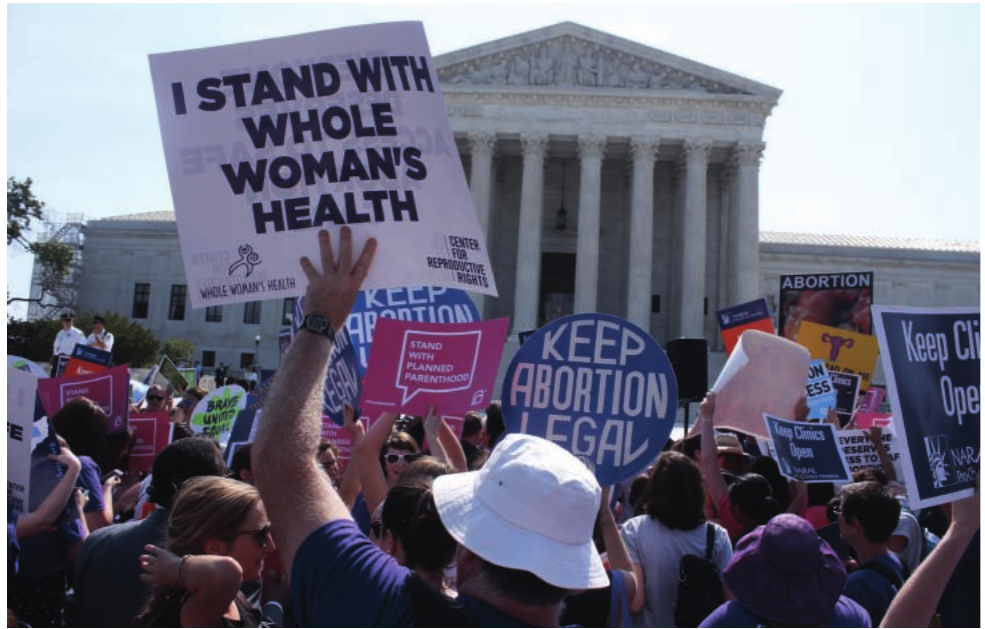
Woman's Health v Hellerstedt (2016) was a challenge to several TRAP laws enacted by the Texas state legislature. The Court ruled 5-3 that these restrictions placed an undue burden on women by failing to provide a medical benefit significant enough to justify limiting access to abortion.
The case was hailed as the greatest success for the pro-choice movement in decades, suggesting that the Court was defending abortion rights. The composition of the Court had changed considerably since Gonzales v Carhart (2007). The three liberal female justices (Ruth Bader Ginsburg, Elena Kagan and Sonia Sotomayor) all voted with the majority, as did liberal Justice Stephen Breyer and the crucial swing vote on the Court, Justice Anthony Kennedy.
Note
Justice Kennedy's vote was particularly significant, as he had been the deciding vote in many closely divided cases. His position as the Court's ideological center made him the most influential justice on contentious issues like abortion. His retirement in 2018 would dramatically alter the Court's balance.
However, the election of Donald Trump in 2016 presented the greatest challenge yet to Roe v Wade.
Trump's conservative Court and the future of abortion rights
Trump's appointments
In his 2016 presidential debate against Hillary Clinton, Trump claimed that Roe v Wade would be overturned "automatically" if he were president, as he would be appointing pro-life justices. However, the first two justices appointed by Trump, Neil Gorsuch and Brett Kavanaugh, both expressed their commitment to "following precedent" during their confirmation hearings. This suggested they would practise judicial restraint and respect the Court's previous decisions, including Roe v Wade.
Moderate pro-choice Republican Senator Susan Collins cast one of the key votes to give Kavanaugh his narrow 50-48 victory after being assured that he would not overturn Roe. However, critics pointed out that Roe could be eroded by subsequent Court judgements even if not directly overturned.
The 2019 state legislation strategy
Kavanaugh's appointment in 2018 gave the Court a conservative majority. In an attempt to provide the Supreme Court with the opportunity to overrule or weaken Roe, many state legislatures with conservative majorities passed laws in 2019 that severely restricted abortions. These included:
- Heartbeat bills: Banning abortion from the point at which a foetal heartbeat can be detected (about 6-7 weeks)
- A near-total ban on all abortions in the state of Alabama
These laws were blocked by federal courts for violating Roe v Wade, and the states then appealed those decisions. The campaign to remove federal abortion rights received support from more than 200 members of Congress, who signed an amicus curiae brief at the start of 2020 asking the Supreme Court to reconsider Roe v Wade and potentially overrule it.
Note
Amicus Curiae Brief
An amicus curiae brief is a written submission to the court from an outside party (such as the executive branch, academics or pressure groups) that includes key information relevant to the case, which the group hopes will influence justices in their favour. These briefs allow interested parties to make their views known to the Court even when they are not directly involved in the case.
Amy Coney Barrett and the 6-3 conservative majority
The first of the highly restrictive abortion laws was considered by the Court in Medical Services v Russo (2020), but to the surprise of conservatives, the Court ruled 5-4 that the restrictions were unconstitutional. However, the appointment of Amy Coney Barrett to the Supreme Court in 2020 gave conservatives new hope that Roe would be overturned by the 6-3 conservative majority Court.
Important
Super Precedent and the Future of Roe
Barrett explained in her confirmation hearings that she did not consider Roe v Wade to be a super precedent as it was too controversial to be established law. A super precedent is a decision that is so well-established and widely accepted that it is beyond challenge. However, Barrett emphasised that this assessment didn't automatically mean Roe should be overruled.
This statement signaled that Roe v Wade remained vulnerable to being overturned, despite decades of precedent. The creation of a solid 6-3 conservative majority meant that pro-life advocates no longer needed to rely on a swing vote justice.
Remember!
Summary
Key takeaways on the judiciary and abortion:
-
Roe v Wade (1973) established a constitutional right to abortion based on the right to privacy implied in the Fourteenth Amendment's due process clause, using a trimester framework for regulation
-
Planned Parenthood v Casey (1992) upheld Roe but replaced the trimester framework with the "undue burden" test, allowing more state regulation in early pregnancy
-
Gonzales v Carhart (2007) upheld the Partial-Birth Abortion Ban Act, showing conservative success in eroding abortion rights through specific restrictions
-
TRAP laws (Targeted Regulation of Abortion Providers) have been used by conservative states to close abortion clinics through medically unnecessary regulations
-
Trump's three appointments (Gorsuch, Kavanaugh and Barrett) created a 6-3 conservative majority on the Supreme Court, threatening Roe v Wade's future and demonstrating the political significance of judicial appointments