What is Sociology? (AQA A-Level Sociology): Revision Notes
📚Revision Notes
What is Sociology?
Definition and emergence of sociology
Sociology is the systematic study of the social world that surrounds us. Many scholars consider it a scientific discipline that examines how societies function and change over time.
Sociology developed as an academic subject during the nineteenth century, emerging in response to major social transformations. The discipline arose following the Industrial Revolution in Britain (1740-1850) and the democratic revolutions in America (1776) and France (1789). These events fundamentally changed how people lived, worked, and organised their societies.
Sociology as a response to modernity
Sociology evolved primarily as a response to modernity. This term refers to the process through which traditional agricultural societies transformed into industrial and urban societies.
Note
Understanding modernity is crucial for grasping why sociology emerged when it did. The rapid pace of social change during this period created entirely new social phenomena that traditional ways of thinking couldn't adequately explain.
Modernity brought three major changes that sociologists sought to understand:
- Economic change: The development of industrial capitalism replaced traditional economic systems
- Political change: The growth of nation states became the dominant form of political organisation globally
- Cultural change: Rationality and scientific thinking began to replace religion and tradition as the primary ways of understanding the world
These dramatic shifts created new social problems and opportunities that required systematic study and analysis.
The founding fathers of sociology
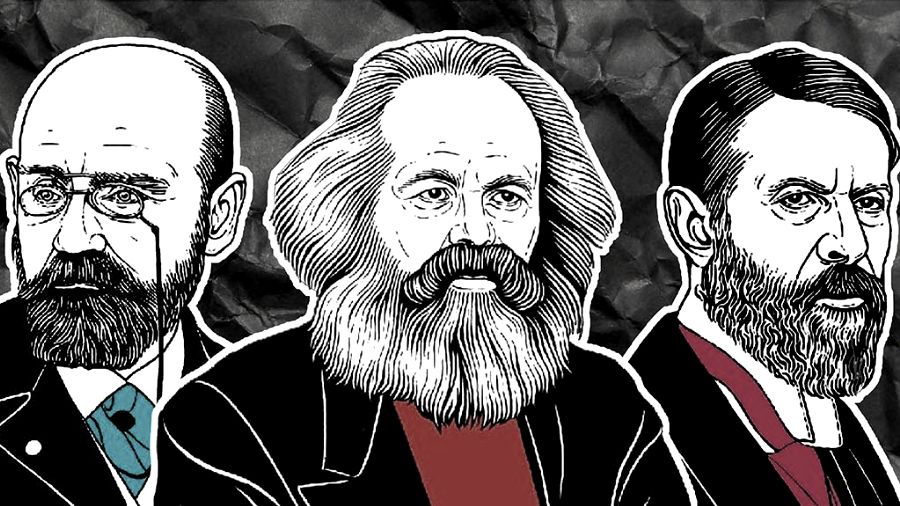
Three key thinkers established the foundations of sociological thought, each responding differently to the challenges of modernity:
Karl Marx (1818-1883) approached modernisation as a revolutionary socialist. He viewed the changes as an opportunity to create a more progressive society that would better serve ordinary people's interests. Marx focused on economic inequality and class conflict as driving forces of social change.
Émile Durkheim (1858-1917) held mixed views about social change. While he supported certain reforms, he worried that rapid social transformation might undermine society's stability. Durkheim emphasised the importance of social solidarity and shared values in maintaining social order.
Max Weber (1864-1920) took the most pessimistic stance towards modernity. He feared that industrial society was becoming increasingly bureaucratic and restrictive. Weber described the growth of bureaucratic structures as creating an "iron cage" that trapped individuals within rigid organisational systems.
Important
Each founding father's perspective reflects their different concerns about modernity: Marx saw revolutionary potential, Durkheim worried about social stability, and Weber feared bureaucratic control. These contrasting views continue to shape sociological debates today.
These three founders' different perspectives continue to influence modern sociological theories and approaches to understanding society.
Summary
Key Points to Remember:
- Sociology emerged in the 19th century as a response to the massive social changes brought by industrialisation and political revolutions
- Modernity involved three key transformations: economic (capitalism), political (nation states), and cultural (rationality over tradition)
- The three founding fathers - Marx, Durkheim, and Weber - each had different perspectives on these changes, from revolutionary optimism to bureaucratic pessimism