Quality Management (Edexcel A-Level Business): Revision Notes
📚Revision Notes
Quality management
Quality management is a critical aspect of business operations that can create competitive advantage and improve customer satisfaction. This topic explores different approaches to managing quality, from traditional quality control to modern continuous improvement methods.
What is quality?
Quality refers to the characteristics and features of a product or service that enable it to meet customer needs and expectations. When customers face similar products at comparable prices, quality becomes a key factor in their purchasing decisions.
Note
Factors customers consider when assessing quality:
- Physical appearance – does the product have the desired style and aesthetic?
- Reliability and durability – will the product function properly over its expected lifespan?
- Special features – does it include desired functionality or specifications?
- Suitability – does it meet the specific requirements of the customer?
- Parts availability – can spare parts be obtained easily?
- Repairs and maintenance – what service support is available?
- After-sales service – how responsive is delivery and customer support?
Customers also consider perceived quality factors such as brand image and reputation. The manufacturer's name recognition and what other consumers say about the business or product significantly influence purchasing decisions.
Why quality has become increasingly important:
- Consumer awareness has increased through publications like Which? magazine
- Customers have higher disposable income and greater expectations
- Legislation requires certain quality standards
- Increased competition forces businesses to differentiate through quality
Business perspective on quality:
Businesses must focus on quality in two key areas:
- Design quality – the ideas and plans for the product or service
- Production process quality – the methods used to manufacture goods or provide services
Important
Poor design creates problems with materials and product functionality, requiring costly redesigns and damaging client relationships. Poor production processes result in faulty products, machinery breakdowns, late deliveries, and reduced productivity, all harming the business's reputation.
Quality control
Quality control represents the traditional approach to ensuring quality, particularly in manufacturing. Production departments were historically responsible for maintaining quality standards.
Quality control objectives:
- Ensure products satisfy consumer needs
- Products work under expected conditions
- Products operate as intended
- Products can be produced cost-effectively
- Products can be repaired easily
- Products conform to safety standards set by legislation
Traditional quality control approach:
In the past, quality control involved dedicated quality controllers or inspectors checking other people's work after production had been completed. For example, at Kellogg's, samples were taken from production lines every half hour, tested twice daily by specialist staff, and graded against a 'perfect' sample. Samples scoring below acceptable thresholds would indicate quality problems.
Example
Worked Example: Kellogg's Quality Control Process
At Kellogg's manufacturing facilities:
- Step 1: Samples taken from production lines every half hour
- Step 2: Specialist staff test samples twice daily
- Step 3: Samples graded against a 'perfect' reference sample
- Step 4: Scores below acceptable thresholds trigger quality investigations
This traditional approach identifies problems after they occur rather than preventing them.
Important
Exam tip: Quality control is a reactive approach – it identifies problems after they occur rather than preventing them from happening.
Quality assurance
Quality assurance represents a shift from asking "Has the job been done properly?" to "Are we able to do the job properly?" This preventative approach conducts inspection during the production process rather than after completion.
Note
Key features of quality assurance:
- Problems and defects are prevented before final production
- Inspection occurs throughout the production process
- All employees contribute to and are responsible for quality
- Customer views are incorporated when planning production
- Market research may be conducted before manufacture
- Customers may participate in consultation groups during design and manufacturing stages
Quality assurance is a commitment by a business to maintain quality throughout the entire organisation. The aim is to stop problems before they occur rather than finding them after they occur.
Important
Exam tip: Quality assurance is a proactive approach that aims to prevent defects by focusing on the processes used to make the product, not just the finished product itself.
Quality circles
Quality circles (or quality control circles) are small groups of workers, typically 5-20 people, working in the same production area who meet regularly to study and solve production problems.
Purpose of quality circles:
- Identify and solve production problems
- Motivate and involve shopfloor workers
- Allow workforce to directly improve their work
- Enable worker participation in decision making
Origins: Quality circles originated in America as a motivational tool but gained popularity in Japan before being adopted by Western businesses. Japanese companies establishing UK operations in the 1990s, such as Honda's Swindon plant, used quality circles extensively with teams examining improvements in allocated areas.
Note
Conditions for successful quality circles:
- Management support and commitment
- Employee support and union backing
- Structure that facilitates worker participation
- Employees feel their views are valued
- Workers make genuine contributions to decisions
Total quality management (TQM)
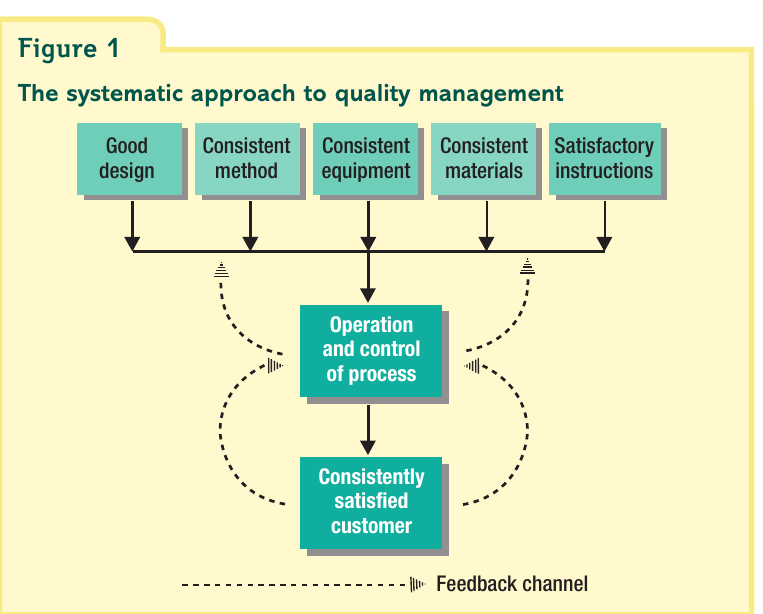
Total quality management (TQM) is a comprehensive approach designed to prevent errors before they happen. Research suggests approximately one-third of British business effort is wasted correcting errors, highlighting the value of getting things right first time.
TQM organises the business so that manufacturing processes are investigated at every stage. Every department, activity and individual is organised to consider quality at all times. The success of Japanese companies has been attributed to this superior organisational approach.
Quality chains
TQM emphasises quality chains where a series of suppliers and customers exists throughout the business. Each person is both a supplier to someone and a customer of someone else.
Example
Worked Example: Internal Customer-Supplier Relationships
A secretary is a supplier to a manager (the customer). The secretarial work must satisfy the manager's requirements. Quality chains also include external customers and suppliers.
The chain remains intact when suppliers satisfy customers. It breaks when a person or equipment fails to meet customer requirements, creating problems such as production delays.
Company policy, accountability and empowerment
TQM requires a company-wide quality policy starting from senior executives and spreading to every employee. This represents a form of job enrichment where individuals take pride in their work.
Important
Key requirements:
- Total commitment from all levels, especially top management
- Individual accountability for performance
- Employee empowerment to make decisions
- Recognition that lack of senior commitment undermines the entire system
Control
Customer needs can only be satisfied when businesses control the factors affecting product quality, including human, administrative and technical factors. The process is only under control when materials, equipment and tasks are used consistently.
Example
Worked Example: Consistency in Manufacturing
A biscuit manufacturer can only ensure consistent quality by maintaining identical cooking processes every time. This means:
- Same temperature settings
- Same cooking duration
- Same ingredient proportions
- Same equipment settings
Any variation in these factors will result in product inconsistency and quality problems.
Quality control systems:
- Methods are documented and used to assess operations
- Regular audits check quality standards
- Information feeds back from customer to producer
- Producer feeds information to suppliers
- Problems are traced and resolved through the supply chain
- Audits lead to suggestions for improvements
Monitoring the process
TQM relies on monitoring business processes to identify improvements. Statistical process control (SPC) collects data about process performance, presenting it in diagrams, charts and graphs that are shared with relevant personnel.
SPC reduces variability, the primary cause of quality problems. Variations occur in products, delivery times, methods, materials, attitudes and staff performance. Statistical data helps identify patterns and implement solutions.
Example
Worked Example: Using Data to Identify Patterns
Data showing productivity drops late Friday afternoons might lead to adjusting work schedules to resolve the problem.
Analysis:
- Problem identified: Productivity decline at specific time
- Data collected: Output measurements throughout the week
- Pattern recognized: Consistent Friday afternoon drops
- Solution implemented: Adjusted work schedules or break times
- Result: Improved productivity and quality
Teamwork
TQM strongly emphasises teamwork as the most effective problem-solving method.
Note
Advantages of teamwork:
- Greater range of skills, knowledge and experience applied to problems
- Improved employee morale
- Better handling of cross-departmental problems
- Ability to tackle more varied problems
- Team ideas more likely to be implemented than individual suggestions
Teamwork builds trust and morale, improves communication and cooperation, and develops interdependence. Many UK firms historically suffered from poor information sharing between departments, creating workforce divisions.

Consumer views
Businesses using TQM must be committed to customers, responding to changes in needs and expectations. This requires regular information gathering and clear communication channels for customer feedback.
Consumers often influence quality standards. Holiday companies, for example, issue questionnaires to returning customers, using feedback to identify operational strengths and weaknesses and upgrade quality standards.
Zero defects
Many quality systems aim for zero defects, ensuring every manufactured product is defect-free. Businesses guaranteeing zero defects in customer orders develop strong reputations, potentially attracting new clients and improving sales.
Quality circles within TQM
TQM stresses teamwork importance, with quality circles playing a key role. For successful implementation:
- A steering committee oversees the programme
- A senior manager chairs the committee
- At least one person is accountable for the programme
- Team leaders receive proper training
Benefits and problems of TQM
Benefits:
- Clear focus on customer needs and supplier-customer relationships
- Quality achievement in all business aspects, not just products
- Critical analysis of processes to remove waste and inefficiencies
- Development of performance measures and improvements
- Team approach to problem solving
- Effective communication and work acknowledgement procedures
- Continuous review for constant improvement strategy
Problems:
- Training and development costs for new systems
- Requires commitment from entire business to succeed
- Significant bureaucracy, documentation and regular audits (particularly challenging for small firms)
- Focus on process rather than product
Summary
Key Points About TQM:
Strengths:
- Comprehensive approach covering all business aspects
- Emphasis on prevention rather than detection
- Strong focus on customer satisfaction
- Promotes continuous improvement culture
Challenges:
- Requires total organizational commitment
- Significant time and resource investment
- Can be bureaucratic and documentation-heavy
- Success depends heavily on senior management support
Kaizen (continuous improvement)
Kaizen represents perhaps the most important concept in Japanese management, meaning continuous improvement. Every aspect of life – social, work and home – is constantly improved, with everyone in the business involved.
Kaizen is an 'umbrella concept' requiring various production techniques and working practices. The philosophy holds that no day should pass without some improvement being made somewhere in the business.
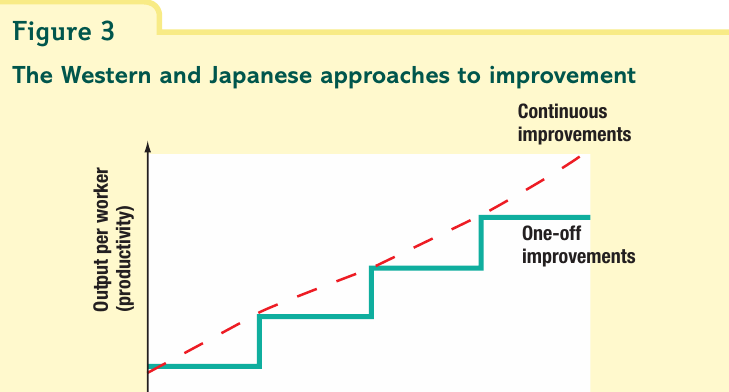
Continuous improvement approach
Kaizen differs fundamentally from traditional Western management approaches. The diagram above illustrates two approaches:
Note
Western approach (stepped line): Productivity remains stable for extended periods, then suddenly increases through new working practices or technology, followed by another stability period.
Japanese approach (dotted line): Improvements are continuous and gradual, resulting from production techniques introduced incrementally over time.
Eliminating waste (muda)
Waste elimination is central to Kaizen. Waste is any activity raising costs without adding value to products.
Important
Examples of waste:
- Waiting time – staff idle while waiting for materials or tasks
- Unnecessary movement – workers walking to central locations for tools
- Irregular machine use – equipment used infrequently (e.g., monthly for special orders)
- Excessive demands – staff working seven-day overtime causing fatigue and poor performance
Businesses adopting Kaizen train and reward workers to continuously identify waste and suggest elimination methods.
Implementing continuous improvement: the PDCA cycle
The PDCA cycle (Plan, Do, Check, Action) is a systematic series of activities leading to improvement:
Example
Worked Example: The PDCA Cycle in Action
Plan: Identify where improvement is needed. Gather and analyse data to develop an improvement plan.
Do: Implement the finalised plan, typically by production workers.
Check: Verify whether improvement has occurred, often through inspectors.
Action: If successful, introduce the plan throughout all business areas.
This cycle repeats continuously, creating ongoing improvements throughout the organization.
Competitive advantage from quality management
High-quality goods and services create significant positive business impact. The primary benefit is improved product quality, increasing sales. Business costs decrease when faults are identified before market release, as post-market failure costs are substantially higher than manufacturing-stage costs.
Quality as a unique selling point (USP):
Businesses using quality for product differentiation and persuading customers of superiority enjoy several benefits, particularly pricing flexibility. Premium pricing becomes possible when customers perceive superior quality.
Note
Competitive advantages:
- Win customers from rivals
- Increase market share
- Raise revenue
- Improve profitability
- Success in overseas markets
Examples: British firms successful internationally through quality include Rolls-Royce, Burberry, Jaguar Land Rover, British Airways and Jimmy Choo.
Costs of quality management
Despite benefits, quality improvement involves significant costs:
Design and setup costs:
- Time planning and designing quality control systems
- Staff training for new systems
Lost production:
- Disruption during system implementation
- Output losses while systems are 'bedded-in'
- Potential damage to customer relations from unmet orders
Quality improvement costs:
- Better materials
- Superior production methods
- New machinery
- Staff training in new practices
- System redesign if initial system fails
- Retraining requirements
Training costs:
Quality initiatives require proper staff training. TQM implementation, for example, requires training the entire workforce through specialist courses or outsourced expert training, proving very costly.
Important
Research suggests 10-20% of business revenue accounts for quality-related costs, with the vast majority relating to appraisal and failure, adding little product value. Eliminating such failures could save UK businesses billions of pounds.
Key terms
Quality – features of a product or service that allow it to satisfy customers' needs. May refer to a standard of excellence.
Quality control – making sure product quality meets specified quality performance criteria. A reactive approach identifying defects after production.
Quality assurance – a working method taking customer wants into account when standardising quality. A proactive approach preventing defects during production. Often involves guaranteeing quality standards are met.
Quality circles – groups of workers (5-20 people) meeting regularly to solve problems and discuss work issues in their production area.
Quality chains – when employees form a series of links between customers and suppliers within the business and externally.
Total quality management (TQM) – a managerial approach focusing on quality to improve business effectiveness, flexibility and competitiveness. Involves all employees and every department.
Statistical process control (SPC) – the collection of data about the performance of a particular business process, presented in charts and graphs.
Kaizen – Japanese term meaning continuous improvement. A philosophy where every aspect of business operations is constantly improved by all employees.
Zero defects – a policy aiming to ensure every manufactured product is free from defects.
PDCA cycle – Plan, Do, Check, Action – a systematic method for implementing continuous improvement.
Summary
Key Points to Remember:
- Quality control is reactive (finding defects after production) while quality assurance is proactive (preventing defects during production)
- Quality circles involve small groups (5-20 workers) meeting regularly to solve production problems and improve their work
- TQM requires total commitment from senior management down through all employees to succeed
- Kaizen means continuous improvement – making small improvements constantly rather than large one-off changes
- The PDCA cycle (Plan, Do, Check, Action) provides a systematic approach to implementing improvements
- Quality management creates competitive advantage through improved products, reduced costs, premium pricing and increased market share
- Quality costs include training, lost production during implementation, better materials, and new systems – but eliminating failures saves money long-term