Contestable Markets (Edexcel A-Level Economics A): Revision Notes
📚Revision Notes
Contestable Markets
What are contestable markets?
A contestable market is one where existing firms can only earn normal profits because they cannot raise prices without attracting new competitors. This occurs because there are no significant barriers preventing firms from entering or leaving the market, and there are no sunk costs involved in operating within that market.
The theory of contestable markets was developed by industrial economist William Baumol. This theory challenged the traditional monopoly model by suggesting that even in markets with few firms, competitive outcomes can occur if the threat of new entry is credible. The key insight is that there don't need to be actual competitors in the market – just the realistic possibility of competition is enough to constrain prices.
Note
Baumol's theory was revolutionary because it showed that market structure alone (the number of firms) doesn't determine market outcomes. What matters is the potential for competition, not just actual competition.
Key conditions for a market to be contestable
For a market to be truly contestable, several important conditions must be met:
No barriers to entry or exit
New firms must be able to enter the market freely, and existing firms must be able to leave without penalty. If artificial restrictions exist (such as licenses, regulations, or high capital requirements), these create barriers that reduce contestability.
No sunk costs
Sunk costs are expenses that a firm incurs when setting up a business that cannot be recovered if the firm later exits the market. For example, spending on advertising or specialised equipment that has no resale value represents sunk costs. When sunk costs are absent, firms can enter and exit markets without financial loss, making hit-and-run entry possible.
Important
The absence of sunk costs is perhaps the most critical condition for contestability. Even small amounts of unrecoverable expenditure can significantly reduce the threat of new entry and allow incumbent firms to charge prices above competitive levels.
No competitive disadvantage for new entrants
New firms entering the market must have access to the same technology, distribution channels, and production methods as incumbent firms. If established firms have significant advantages through experience, economies of scale, or proprietary technology, this reduces the contestability of the market.
Rapid entry and exit
Firms must be able to enter and exit the market quickly. If the process of establishing operations or closing down takes considerable time, incumbent firms may be able to adjust their pricing before new competitors become established, reducing the effectiveness of the threat of entry.
Hit-and-run entry
Hit-and-run entry refers to a situation where a firm can enter a market temporarily to earn short-run supernormal profits, then exit without incurring any costs. This is only possible when sunk costs are absent.
The threat of hit-and-run entry acts as a powerful constraint on incumbent firms. If an existing firm charges prices above average cost and earns supernormal profits, potential competitors can:
- Enter the market quickly
- Capture some of those supernormal profits
- Exit again before the incumbent firm responds
Under these conditions, incumbent firms are forced to charge prices equal to average cost, earning only normal profit. This prevents the exploitation of market power that might otherwise occur in concentrated markets.
Example
Worked Example: Hit-and-Run Entry in Action
Consider a monopoly airline charging $200 for a route where average cost is $150:
- Step 1: The monopolist earns supernormal profit of $50 per passenger
- Step 2: A potential entrant with mobile aircraft notices this profit opportunity
- Step 3: The entrant temporarily operates the route at $175 (below the monopolist's price but above average cost)
- Step 4: The entrant captures passengers and earns profit of $25 per passenger
- Step 5: Before the monopolist can respond, the entrant exits the market
To prevent this, the monopolist must price at $150 (equal to average cost) from the outset.
How contestability constrains monopoly pricing
Consider a monopoly firm operating in a contestable market. The diagram below illustrates the dilemma facing such a firm.
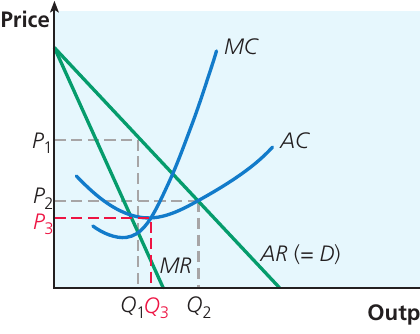
If the monopolist sets the profit-maximising price at (where marginal revenue equals marginal cost), it will earn supernormal profits shown by the shaded area. However, in a contestable market, these supernormal profits create an incentive for new firms to enter.
Note
The monopolist faces a crucial trade-off: charge high prices and risk entry, or charge lower prices and maintain market position. This is fundamentally different from a protected monopoly where high prices can be sustained indefinitely.
To prevent hit-and-run entry, the monopolist must set price equal to average cost at . At this price:
- The firm produces quantity
- No supernormal profits exist
- There is no incentive for new firms to enter
- The monopoly position is protected
However, if the firm attempted to minimise costs by producing at the lowest point on the AC curve (), it would not be operating on its demand curve. New entrants would enter to make normal profits, and the market would cease to be a monopoly. The theory doesn't fully explain how a long-run equilibrium with multiple firms at minimum average cost would be achieved.
Important
The best strategy for preventing entry is ensuring the long-run average cost curve is as low as possible through productive efficiency (X-efficiency), while setting price at a level that doesn't exceed the minimum point on the AC curve.
Contestability in practice
While the theoretical conditions for contestability are clear, in practice most markets don't fully meet these stringent requirements. Some important considerations include:
Sunk costs exist in most markets
Almost all businesses face some sunk costs. Advertising expenditure, for example, cannot be recovered if a firm exits the market. Even a firm with economies of scale will have incurred some fixed costs that cannot be fully recovered.
Example
Example: Airline Routes
An airline with surplus aircraft capacity might appear to face no sunk costs when entering a new route – the aircraft can simply be moved elsewhere if the route proves unprofitable. This makes airline markets appear highly contestable.
However, contestability in practice is limited by several factors:
- Passengers don't respond instantaneously to price differences, allowing incumbent airlines to react before new entrants capture significant market share
- Airlines typically face set-up costs (establishing ground operations and marketing) that cannot be recovered if they exit the market
- Building brand recognition and trust takes time and resources
Speed of entry matters
The effectiveness of the threat of entry depends on whether firms can actually enter quickly enough to capture profits before incumbents respond. If entry takes time, existing firms may have opportunities to engage in predatory pricing or adjust their strategies, reducing the practical impact of potential competition.
Finding markets without sunk costs is difficult
It's challenging to identify real-world markets with absolutely no sunk costs. Most businesses need to advertise to attract customers, and this expenditure represents an unrecoverable sunk cost.
Note
The rarity of truly contestable markets doesn't make the theory irrelevant. Instead, it provides a useful benchmark for understanding how different market characteristics affect competitive outcomes. Markets can be more or less contestable, with important implications for pricing and efficiency.
Contestability and efficiency
The relationship between contestability and economic efficiency is complex and doesn't guarantee optimal outcomes in all dimensions.
Productive efficiency
When a firm in a contestable market sets price equal to average cost, it may achieve productive efficiency by minimising costs. However, this isn't guaranteed – the firm needs to have strong incentives to keep costs competitive, which the threat of entry provides. If the firm is producing at in the diagram above, it's producing at minimum average cost, achieving productive efficiency.
Allocative efficiency
Allocative efficiency requires price to equal marginal cost. In a contestable market, price equals average cost, not marginal cost. Therefore, allocative efficiency is not achieved. Resources are not allocated in the most socially optimal way, and there remains some deadweight loss.
Important
Common Mistake to Avoid
Students often assume that contestable markets achieve all forms of efficiency. This is incorrect. While contestability improves efficiency compared to protected monopolies, it does not guarantee allocative efficiency because price still exceeds marginal cost.
X-inefficiency
X-inefficiency occurs when firms don't minimise their costs due to lack of competitive pressure. In highly contestable markets, X-inefficiency is unlikely to persist because incumbent firms must keep costs as competitive as possible. The constant threat of entry provides strong incentives for operational efficiency.
Dynamic efficiency
Dynamic efficiency relates to innovation and investment in new products or processes over time. Contestability may hinder dynamic efficiency because low profitability reduces the funds available for research and development. Firms earning only normal profit have limited resources to invest in innovation, potentially slowing technological progress and long-term improvements in productive efficiency.
The impact of the internet on contestability
The growth of the internet has significantly increased the contestability of many markets by reducing barriers to entry and improving information availability.
Improved consumer information
The internet provides consumers with easy access to price comparisons and product information. This improved transparency makes it harder for firms to exploit market power through information asymmetries. Consumers can quickly identify better deals from alternative suppliers, increasing competitive pressure on incumbent firms.
Easier market entry
Online sales platforms have dramatically reduced the costs of entering many markets. New firms can reach customers without needing extensive physical retail networks, reducing both fixed costs and sunk costs associated with entry.
Example
Case Study: The Travel Industry
The travel industry provides an excellent example of increased contestability through internet technology. In 2016, UK residents made over 70 million trips abroad, making this a significant sector.
Traditionally, overseas trips were arranged through high-street travel agents. Large chains of travel agents held significant market share and enjoyed advantages from their established networks. However, the internet has revolutionised this sector by:
- Enabling online booking by individual consumers
- Allowing new firms to compete effectively without physical retail presence
- Providing airlines with direct-to-consumer sales channels for combined flight and hotel packages
- Making price comparison much easier for consumers
This increased contestability has resulted in greater competition, putting pressure on traditional travel agents and benefiting consumers through better prices and wider choice. The COVID-19 pandemic initially slowed recovery in this sector, but the structural changes toward greater contestability remain.
Case study: Airline contestability
At the time of US airline deregulation in 1978, influential economists argued that the absence of actual competitors didn't indicate a lack of competition. They suggested airline markets were highly contestable, and therefore the threat of entry alone would keep prices competitive.

The argument for contestability
Aircraft are highly mobile capital assets ('capital with wings'). If an airline can easily move aircraft between different routes, then there are no sunk costs associated with operating in any particular market. This mobility should make airline markets contestable – new airlines can enter profitable routes and exit unprofitable ones without incurring unrecoverable costs.
Evidence against full contestability
However, research into US airline markets since deregulation has revealed that airline markets are not fully contestable, and potential entrants have limited impact on prices. Several factors explain this:
Note
Key Limitations of Airline Contestability:
-
Passengers don't respond instantaneously to price differentials, giving incumbent airlines time to react before entrants capture the market
-
Entry involves sunk costs that cannot be recovered if the firm exits – setting up ground operations, advertising, and establishing brand recognition all require expenditure that cannot be recouped
-
Hit-and-run entry is unprofitable in practice – by the time an entrant has established operations, incumbent airlines can respond through price cuts or other competitive strategies
-
Incumbents have deterrent strategies – established airlines use frequent flyer programmes and extensive networks to create relative advantages over small entrants, raising the effective cost of entry
While airline markets have some characteristics of contestability, these practical limitations mean they're not perfectly contestable in the way economic theory suggests.
Pricing strategies and entry deterrence
Firms may adopt various strategies to deter the entry of new competitors:
Limit pricing
Limit pricing occurs when a firm or group of firms deliberately sets prices below the profit-maximising level to prevent entry. The limit price is the highest price existing firms can charge without making entry attractive to potential competitors. By keeping prices low enough that new entrants couldn't earn sufficient returns, incumbent firms sacrifice some short-term profits to protect their market position in the long term.
Note
In some cases, the limit price enables incumbent firms to make only normal profit. When this occurs, the market is described as contestable – the threat of entry constrains prices to competitive levels even without actual competition.
Predatory pricing
Predatory pricing is an extreme and aggressive strategy involving setting prices so low that they force competitors to make losses. This approach is normally used to eliminate existing competitors rather than deter new entry.
Important
Predatory pricing is often illegal under competition law because it:
- Deliberately harms competitors rather than benefiting consumers
- Aims to reduce competition in the long term
- Can lead to monopoly power once rivals exit the market
Raising barriers through strategic behaviour
Firms can also deter entry by creating or increasing barriers through actions such as:
- Heavy advertising spending to build brand loyalty and create an effective sunk cost for potential entrants
- Investment in research and development to maintain technological advantages
- Establishing long-term contracts with suppliers or customers
- Building excess capacity to signal ability to increase output and cut prices if entry occurs
These strategies aim to make entry less attractive by increasing the required investment or reducing potential profitability for new firms.
Remember!
Summary
Key Points to Remember:
-
A contestable market is one where firms can only earn normal profits because the threat of new entry prevents them from raising prices above average cost, even if few firms currently operate in the market.
-
Four key conditions define contestability: no barriers to entry or exit, no sunk costs, no competitive disadvantage for new entrants, and rapid entry and exit. Perfect contestability is rare in practice.
-
Hit-and-run entry – the ability to enter a market, take profits, and exit without cost – forces incumbent firms to price at average cost to avoid attracting competitors. This threat constrains market power.
-
The internet has increased contestability in many markets by reducing barriers to entry and improving consumer information, as seen in the travel industry and online retail sectors.
-
Efficiency outcomes are mixed – contestable markets may achieve productive efficiency and limit X-inefficiency, but they don't guarantee allocative efficiency and may hinder dynamic efficiency due to low profitability limiting investment in innovation.