The coast, and wider littoral zone (Edexcel A-Level Geography): Revision Notes
📚Revision Notes
The coast, and wider littoral zone
The littoral zone
↳ A zone of dynamic equilibrium with many inputs, processes and outputs causing rapid change
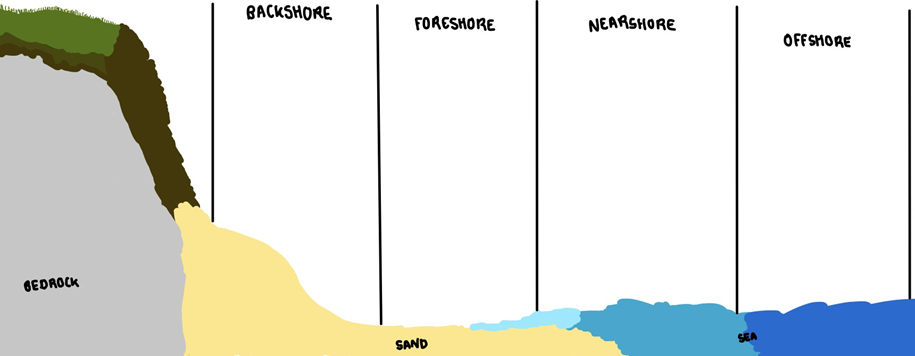
- Offshore → Beyond the influence of breaking waves
- Nearshore → Intertidal & within the breaker zone, often used for leisure, fishing etc
- Backshore → Above high tide & the influence of wave patterns
Classification of coasts
| Characteristic | Low energy | High energy |
|---|---|---|
| Waves | Less powerful, constructive waves, long fetches | More powerful, destructive waves, long fetches |
| Processes | Deposition & transport. Sediment from rivers, LSD and nearshore currents | Erosion & transport. Sediment from eroded land, mass movement & weathering |
| Landforms | Beaches, spits, bars, sand dunes, mudflats & salt marshes | Cliffs, wave-cut platforms, arches, sea caves, stacks |
| General location | Sheltered from large waves, lowland coasts, coastal plain landscapes | Exposed to largest waves, highland and lowland coasts, rocky landscape |
Rocky coasts
- Cliffs vary in height from a few metres to hundreds of metres
- Cliffs are formed from rock, but the hardness of these rocks is very variable
- Subject to erosion
- Tend to be steep or vertical in profile
- Also attacked by weathering and mass movement processes
- Often a high energy environment
Coastal plains
- Land gradually slopes towards the sea across an area of deposited sediment
- Deposited landscapes of sand, shingle and mud
- Dominated by processes of accretion ∴ the coastline advances seaward
- Often a low energy environment