Deriving the suvat Equations (Edexcel A-Level Mathematics): Revision Notes
📚Revision Notes
2.3.1 Deriving the SUVAT Equations
Derivation of SUVAT Equations
Note
The SUVAT equations are used in mechanics to describe the motion of an object under constant acceleration. They relate five key variables:
- : displacement
- : initial velocity
- : final velocity
- : acceleration
- : time
Note
The equations are:
Note
These equations apply only when acceleration is constant and are useful for solving problems involving linear motion, such as finding the distance travelled or the time taken to reach a certain velocity.
The SUVAT equations can be derived using a velocity-time graph.
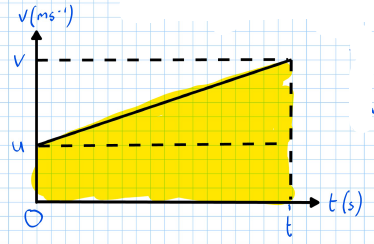
1. First Equation:
Note
Graph**:**
-
The vertical axis represents velocity v) in metres per second m/s).
-
The horizontal axis represents time t) in seconds.
-
The initial velocity is .
-
The final velocity is . Gradient**:**
-
The gradient of the graph represents acceleration .
Rearranging**:**
2. Second Equation:
Note
Area Under the Graph:
- The area under the graph represents the displacement s). Trapezium Area Formula:
- Where s is the area between the graph and the x-axis.
3. Third Equation:
Note
Derivation**:**
- Consider the area between the line and the x-axis to be the sum of a rectangle and a triangle. Equation**:**
Substituting (from the first equation):
4. Fourth Equation:
Note
Derivation**:**
- Consider the area to be a rectangle with a triangle subtracted. Equation**:**
Substituting :
5. Fifth SUVAT Equation:
Note
Starting from the equation:
Square both sides:
Recognize that:
where .
Thus, simplifying gives:
Note
The SUVAT equations are provided in the formula book, but the specification outlines that you should be able to 'understand, use and derive the formulae for constant acceleration for motion in a straight line'