Acceleration due to Gravity (Edexcel A-Level Mathematics): Revision Notes
📚Revision Notes
2.3.3 Acceleration due to Gravity
Definition
Note
- Acceleration due to gravity is the acceleration experienced by an object when it is in free fall, solely under the influence of gravity.
- On Earth, this acceleration is denoted by and has a standard value of approximately 9.81 m/s²
Key Concepts
Note
Uniform Acceleration: In a vacuum, where air resistance is negligible, all objects fall with the same acceleration due to gravity, regardless of their mass. Direction: The acceleration due to gravity always acts downward, towards the centre of the Earth.
Vertical Motion Under Gravity
Note
Example 1: A particle is projected vertically upwards with an initial speed of 3 ms⁻¹. How high will it get?
Given:
- (at the turning point)
- (acceleration due to gravity)
- is the positive direction (always state this)
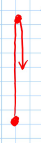
Using the equation:
Substituting the values:
Simplifying:
Note
Example 2: A particle is projected vertically upwards from, initially, 3 m above the ground. Its initial speed is 10 ms⁻¹. At what time after projection will it hit the ground?
Given:
- (because it is in the negative direction from where it was projected)
-
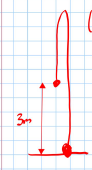
Using the equation:
Substituting the values:
Simplifying:
Solving the quadratic equation:
(Only the positive value is valid in this context)
Tips:
Note
-
Identify the direction of gravity: Gravity always acts downward. If you choose upward as the positive direction, the acceleration due to gravity will be negative . Make sure you consistently use the correct sign depending on your chosen direction.
-
Choose the right SUVAT equation:
Use the SUVAT equations when the motion involves constant acceleration. Select the appropriate equation based on the variables provided in the problem (such as time, initial velocity, or displacement). The equations are:
- Initial velocity:
- If an object is dropped from rest, the initial velocity is zero.
- If an object is thrown upwards, the initial velocity is positive, but it decreases as the object rises until it reaches its maximum height, where the velocity becomes zero.
- Maximum height:
At the highest point of an upward throw, the final velocity v = 0. However, the acceleration remains throughout the motion because gravity continues to act.
- Time of flight:
For vertically projected objects, the total time in the air (time of flight) is double the time it takes to reach the maximum height. This is due to the symmetry of the motion: the time going up is equal to the time coming down.
- Ignore air resistance:
Unless the question specifically mentions air resistance, assume that the only force acting on the object is gravity. Air resistance is generally ignored in basic A Level problems.