Further Tree Diagrams (Edexcel A-Level Mathematics): Revision Notes
📚Revision Notes
3.2.3 Further Tree Diagrams
Example Problems with Tree Diagrams
Note
Example Question
- A bag contains:
- 5 red discs
- 6 blue discs
- 7 green discs
- Two discs are selected from the bag without replacement. Questions:
- Draw a tree diagram to illustrate the probabilities of the various possible selections.
- Find the probability of: (a) Two red discs being chosen.
(b) At least one green disc being selected.
(c) Given that the first disc is blue, find the probability that the second disc is green.
(d) Given that the second disc was blue, find the probability that the first was red.
Worked Solutions
- Draw a tree diagram to illustrate the probabilities of the various possible selections.
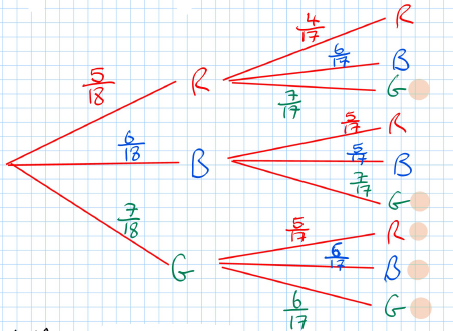
- The tree diagram starts with the first draw, showing three branches representing the possible outcomes: Red (), Blue (), and Green ().
- For each first draw outcome, the tree branches further into three outcomes () for the second draw, but with updated probabilities reflecting the fact that one disc has already been removed.
- Find the probability of: (a) Two red discs being chosen.
- The probability of drawing a red disc on the first draw is .
- After drawing one red disc, the probability of drawing another red disc on the second draw is .
- The combined probability of this sequence is calculated as:
- Find the probability of: (b) At least one green disc being selected.
- This requires considering all the outcomes where at least one of the discs drawn is green.
- The relevant branches are identified and their probabilities multiplied and summed to get the total probability:
- Find the probability of: (c) Given that the first disc is blue, find the probability that the second disc is green.
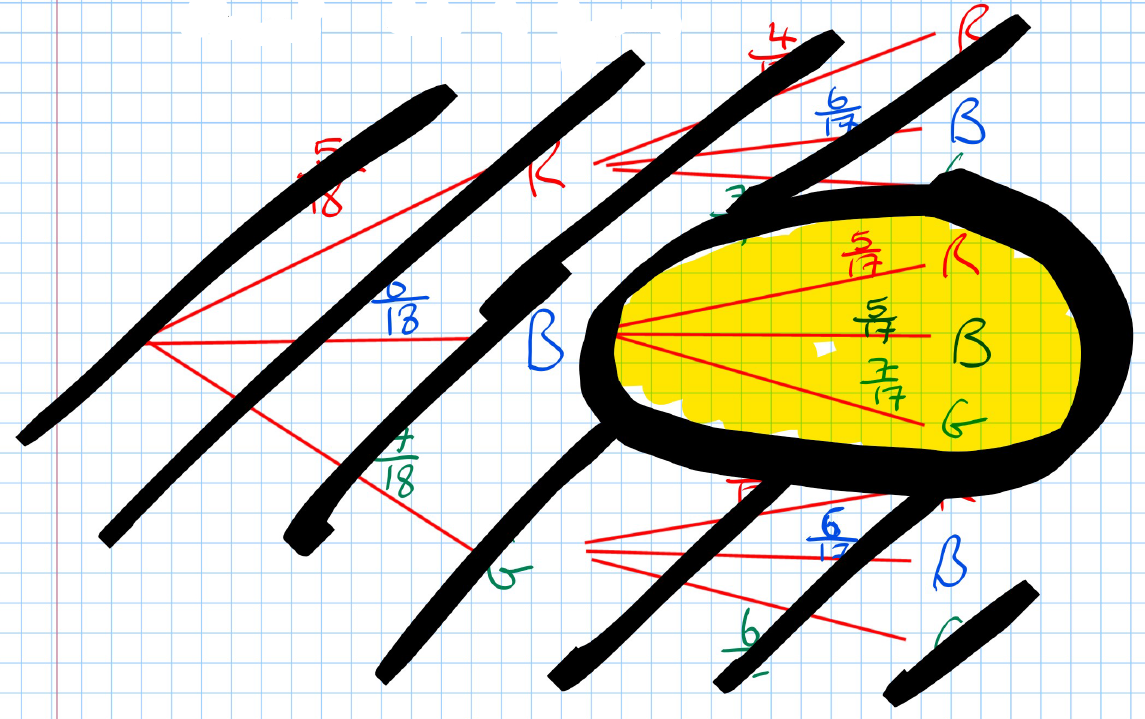
- The tree diagram shows the sequence of draws, starting with the first disc being blue (B).
- The subsequent branches depict the probability of drawing either a red (R), blue (B), or green (G) disc after the first disc has been selected.
- The branch of interest is the one where the first disc is blue, and the second disc is green.
- The probability of this sequence is calculated as:
- Find the probability of: (d) Given that the second disc was blue, find the probability that the first was red.
Method:
- Conditional Probability Formula:
- The probability of the first disc being red given that the second disc is blue is calculated using the conditional probability formula:
- Calculation:
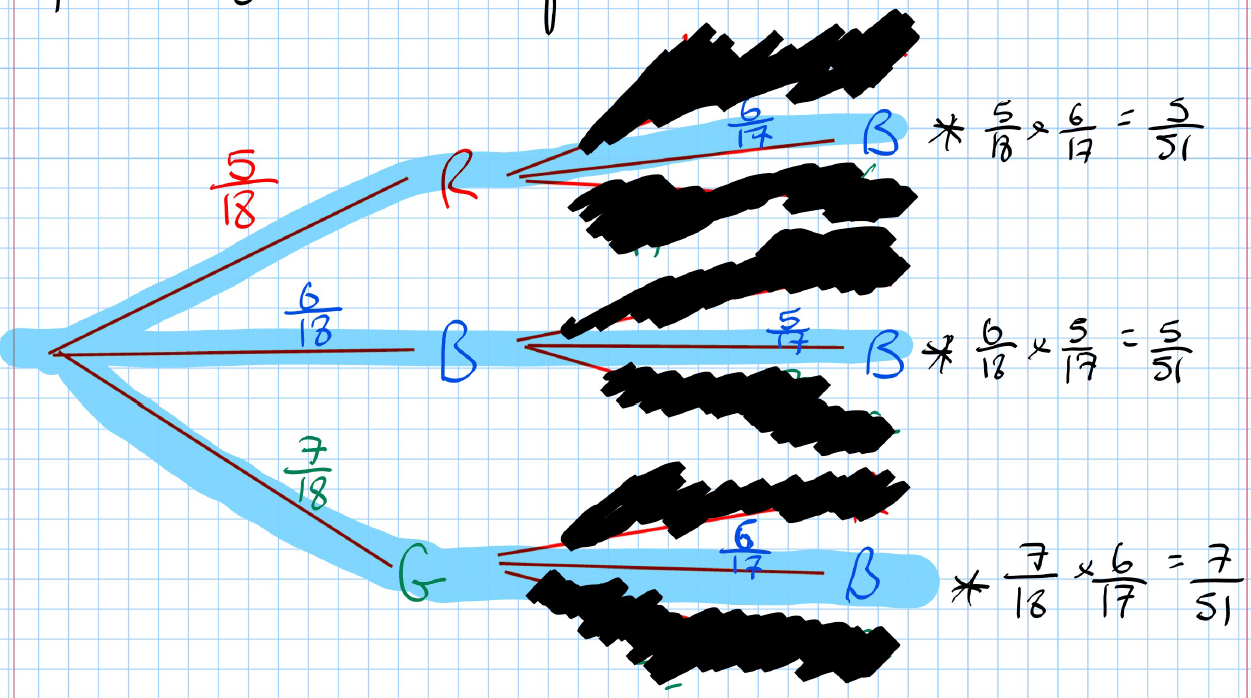
- The numerator, , is given as .
- The denominator, , is the sum of the probabilities of all outcomes where the second disc is blue:
- Thus, the conditional probability is:
Explanation:
The problem involves finding the probability that the first disc drawn was red, given that the second disc drawn was blue.