Key treaties and agreements. (Edexcel A-Level Politics): Revision Notes
📚Revision Notes
33.4.3 Key treaties and agreements.
Key Treaties to Deepen the EU
1957 - Treaty of Rome
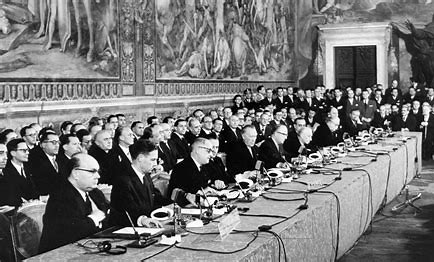
The Treaty of Rome was pivotal in establishing the European Economic Community (EEC) and committing to the creation of a common market by eliminating restrictions on the movement of goods, people, capital, and services. It also established a customs union with common external tariffs on imports, promoting deeper economic integration among member states. The Treaty founded key institutions like the European Parliament, the European Commission, and the European Court of Justice, which remain central to the EU's functioning today. Additionally, it contained a legal commitment to an "ever closer union," setting the tone for the continuous process of European integration. The Treaty also introduced the Common Agricultural Policy (CAP) and the Common Fisheries Policy (CFP), which have been crucial in managing the EU's economic and environmental resources.
1986 - Single European Act
The Single European Act (SEA) marked a significant step forwards in European integration by setting a deadline for completing the single market by 1993. At this time, EU membership had grown to 12 states, complicating decision-making processes. To address this, the SEA introduced Qualified Majority Voting (QMV) in the Council of Ministers, reducing the number of policies subject to veto and allowing decisions to be made even if some states opposed them. The Act also removed several non-tariff barriers within the European Community (EC), further facilitating free trade and economic integration. The powers of the European Parliament were strengthened, giving it a greater role in shaping new laws. Margaret Thatcher, the UK Prime Minister, supported the SEA, viewing it as a means to boost free trade across Europe.
1992 - Maastricht Treaty
The Maastricht Treaty marked a transformative moment in European history, creating the European Union (EU) and expanding its scope from a purely economic organisation to a more comprehensive political union. The Treaty introduced the EU's three pillars: Economic and Monetary Union (EMU), Common Foreign and Security Policy (CFSP), and Justice and Home Affairs (JHA), broadening the areas of cooperation among member states. It set the EU on a path towards adopting a single currency, with the UK opting out, and established the criteria for entry into the Eurozone through the Stability and Growth Pact (SGP), which required member states to maintain a budget deficit below 3% of GDP and national debt below 60% of GDP. The Maastricht Treaty also introduced the Social Chapter, which covered employment rights, although the UK initially opted out of this provision. Additionally, the Treaty expanded Qualified Majority Voting (QMV) to more policy areas and granted more powers to the European Parliament, further deepening EU integration.
1999 - Introduction of the Euro
The introduction of the Euro in 1999 was a major milestone in European integration, initially involving 11 member states, with Greece joining later. The process began with the use of the Euro for commercial transactions, followed by the introduction of coins and banknotes in 2002. The creation of the European Central Bank (ECB) was central to managing the new currency, and the EU began coordinating economic policymaking between member states, including setting limits on government debts and deficits under the Stability and Growth Pact (SGP). The Eurozone's fiscal policies became more coordinated, and the ECB took on the role of setting independent monetary policy, including interest rates, across the Eurozone.
2003 - Treaty of Nice
The Treaty of Nice, signed in 2001 and effective in 2003, facilitated the largest expansion of the EU to date, with 10 new states joining in 2004. To accommodate these new members, the Treaty made adjustments to the EU's institutional structure, including the creation of additional commissioner roles to ensure representation from each member state. The Treaty further extended Qualified Majority Voting (QMV) in the Council of Ministers and adjusted voting weights, giving larger states more influence in the decision-making process. The Treaty of Nice also deepened cooperation on defence policy, marking another step towards greater integration within the EU.
2009 - Treaty of Lisbon
The Treaty of Lisbon, which came into force in 2009, introduced significant new powers for the European Parliament, which now has legislative authority over approximately 75% of EU policy areas. The Treaty also granted more powers to national parliaments, allowing them to review and provide opinions on EU legislation, reinforcing the principle of "subsidiarity"—the idea that decisions should be made as closely as possible to the citizens affected by them. Additionally, the Treaty created the permanent role of President of the European Council, replacing the previous system of rotating presidencies every six months. It also established the position of High Representative for Foreign Affairs, giving the EU a more independent voice in international relations.