Transmission of Pathogens (OCR A-Level Biology A): Revision Notes
📚Revision Notes
Transmission of Pathogens
For any pathogen to survive and continue its existence, it must successfully move from one host organism to another. When a host dies, the pathogen faces extinction unless it has already transferred to a new individual. This movement between hosts is called disease transmission, and understanding how this process works is essential for controlling communicable diseases.
Note
Pathogens face a critical survival challenge: they must reach new hosts before their current host dies. This evolutionary pressure has shaped sophisticated transmission strategies across different pathogen types.
Principles of pathogen transmission
Pathogen transmission operates on two fundamental principles. First, the process requires a pathogen to move from an infected individual to an uninfected one. Second, transmission is inherently risky for the pathogen, so evolutionary pressure has led to strategies that maximise success. Pathogens typically produce very large numbers of infective stages to increase the probability that at least some will reach a new host. These infective stages tend to be extremely small, as producing numerous tiny particles requires less energy than creating fewer large ones, unless those larger forms have guaranteed access to new hosts.
Transmission can occur through two main routes: direct transmission (straight from one host to another) or indirect transmission (via an intermediate organism that remains unaffected by the pathogen).
Important
Critical Concept: Infective Stages
Not all pathogen life cycle stages can infect new hosts. Only specific infective stages are capable of establishing infection, regardless of how many pathogen particles are present. This is why understanding pathogen life cycles is crucial for disease control.
Plant pathogen transmission examples
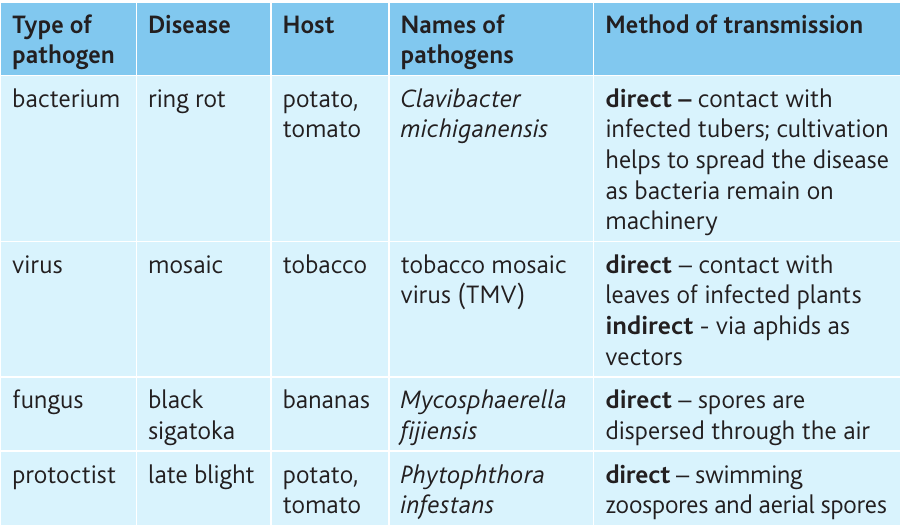
The table above shows different types of plant pathogens and their transmission methods. Ring rot in potatoes and tomatoes spreads through direct contact with infected tubers, with cultivation machinery acting as a vehicle for the bacteria. Tobacco mosaic virus (TMV) spreads both through direct leaf contact and indirectly via aphids acting as vectors. Black sigatoka affecting bananas disperses fungal spores through the air, while late blight uses both swimming zoospores and aerial spores for transmission.
Direct transmission
Direct transmission involves immediate transfer between hosts without any intermediate organism. This can happen in several ways depending on the pathogen and host species involved.
Contact transmission
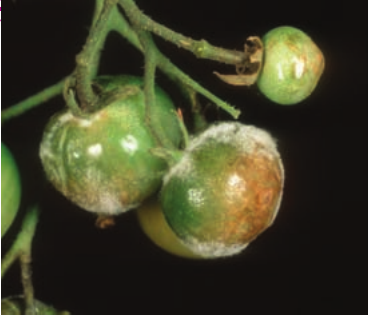
Physical contact between infected and uninfected individuals allows many pathogens to spread. In tobacco fields, leaves infected with TMV can brush against healthy leaves, transferring virus particles directly. When fungal spores from black sigatoka or late blight land on suitable host plants, they develop small penetrating tubes that enter the host through either the waxy cuticle or through stomata openings.
Droplet infection
Respiratory pathogens such as tuberculosis (TB) bacteria, influenza viruses, and meningitis-causing bacteria spread through tiny water droplets. Infected individuals expel these droplets when breathing, coughing, or sneezing, and uninfected people can inhale them. This method is particularly effective in enclosed spaces or crowded environments where people are in close proximity.
Important
Why Droplet Infection Spreads So Effectively
Droplet infection is highly efficient because:
- Droplets remain airborne for extended periods in enclosed spaces
- People constantly breathe, providing continuous pathogen release
- Close proximity makes inhalation of infectious droplets nearly unavoidable
- Many respiratory pathogens require very low doses to establish infection
Transmission via body fluids
HIV represents a pathogen with very specific transmission requirements. Unlike many viruses, HIV is not robust outside the body and can only spread through direct contact involving particular body fluids.
Example
Example: HIV Transmission Routes
HIV transmission occurs through specific pathways involving direct body fluid exchange:
Sexual transmission:
- Unprotected vaginal or anal intercourse between HIV-positive and uninfected individuals
Blood-borne transmission:
- Sharing needles or syringes among intravenous drug users
- Improper sterilisation of medical equipment
- Contaminated blood transfusions or blood products
Mother-to-child transmission:
- Blood mixing during childbirth
- Breastfeeding from HIV-positive mother
Following HIV transmission, a brief incubation period of several weeks occurs before mild flu-like symptoms appear, which are frequently misdiagnosed. The infection then enters a symptomless phase that can last for years. Eventually, the virus destroys lymphocytes, weakening the immune system and allowing opportunistic diseases to develop. These include thrush, tuberculosis, rare forms of pneumonia, and Kaposi's sarcoma (an unusual cancer). This collection of opportunistic infections is known as acquired immunodeficiency syndrome (AIDS), which presents with varying symptoms depending on which opportunistic diseases affect each individual.
Spore formation and dispersal
A more sophisticated form of direct transmission involves spores - small reproductive structures specifically designed for dispersal through air or water. Phytophthora infestans (late blight) provides an excellent example. The pathogen produces thread-like structures called hyphae that grow out through stomata on leaf surfaces. These hyphae swell at their tips to form pear-shaped structures called sporangia, measuring approximately in length. Wind carries these sporangia to uninfected leaves, where they produce specialised hyphae that penetrate the plant tissue and establish new infections.
Note
Spore Adaptations for Transmission
Spores are evolutionary marvels designed for efficient dispersal:
- Extremely small size allows wind or water transport over long distances
- Protective coating enables survival in harsh environmental conditions
- Remain dormant until reaching suitable host tissue
- Can be produced in enormous numbers with minimal energy investment
Indirect transmission
Indirect transmission requires an intermediate organism called a vector - a species that transfers pathogens between hosts without suffering harm itself. Many vectors are insects, which offer several advantages for pathogen transmission.
Mosquito vectors and malaria
Female Anopheles mosquitoes serve as vectors for malaria parasites (Plasmodium species). While these mosquitoes normally feed on plant sap, females require protein-rich blood meals when preparing to produce eggs. If a female mosquito feeds on someone infected with Plasmodium, she ingests reproductive forms of the parasite along with the blood. These parasites reproduce within the mosquito's gut, then migrate to her salivary glands. When the mosquito takes her next blood meal from an uninfected person, she injects saliva containing the parasites to prevent blood clotting, completing the transmission cycle.
Note
The Mosquito-Malaria Partnership
The malaria parasite has evolved to exploit mosquito biology perfectly:
- Parasites time their development to coincide with mosquito feeding cycles
- They survive in mosquito salivary glands without harming the vector
- Anti-coagulant saliva injection provides the perfect delivery mechanism
- The mosquito's need for multiple blood meals ensures continued transmission
Aphid vectors and plant viruses
Plant viruses often spread through aphid vectors in a similar manner. The peach potato aphid (Myzus persicae) is a particularly important vector for plant viruses. These aphids insert needle-like stylets into phloem sieve tubes to feed. Viruses such as TMV attach to these stylets, and when the aphid flies to an uninfected plant, the viruses transfer during feeding. Some viruses, like potato leaf roll virus, actually pass through the aphid's intestinal lining into its blood, then reach the salivary glands. This increases transmission probability during subsequent feeding episodes, and individual aphids can carry the virus for extended periods.
Why insects make effective vectors
Insects prove particularly effective as disease vectors because they reproduce rapidly in large numbers when conditions are favourable. Aphids reproduce when host plants are available, providing perfect timing for pathogen transmission. This high reproductive rate increases the probability that pathogens will successfully reach new hosts.
Factors influencing transmission
Multiple factors affect how successfully pathogens spread between hosts. These factors vary depending on the transmission method and the specific pathogen-host relationship.
General factors affecting all diseases
The most fundamental factor is the presence of infected individuals within a population. Without infected hosts carrying the pathogen, no transmission can occur regardless of other conditions. Endemic diseases are those constantly present within a population, even if case numbers remain low at any given time. Malaria is endemic in many tropical regions but absent elsewhere, while tuberculosis is endemic globally. In contrast, an epidemic occurs when disease cases increase significantly within a population - a distinct concept from endemic presence.
Note
Endemic vs. Epidemic: Understanding the Difference
- Endemic diseases: Always present in a population at baseline levels (e.g., malaria in tropical regions, tuberculosis worldwide)
- Epidemic diseases: Show sudden, significant increases in case numbers above normal levels within a population
Think of endemic as the "background level" and epidemic as a "spike" in cases.
Many pathogens have complex life cycles with multiple developmental stages, but only certain stages can actually infect new hosts. The malarial parasite Plasmodium exemplifies this - only the stage present in Anopheles mosquito salivary glands can infect humans. Without infective stages available, transmission cannot proceed regardless of other favourable conditions.
Important
Resistance vs. Immunity: Two Different Protection Mechanisms
Resistance:
- Inherited genetic traits present from birth
- Prevents infection or pathogen development within the body
- Example: Heterozygous sickle cell allele provides malaria resistance
- Cannot be acquired during a person's lifetime
Immunity:
- Develops after exposure to a pathogen
- First infection may cause symptoms, but subsequent exposures typically do not
- Acquired through infection or vaccination
- Can change over a person's lifetime
Both reduce transmission rates, but they work through completely different biological mechanisms.
Resistance and immunity play crucial roles in limiting transmission. Resistance refers to inherited genetic traits that prevent infection or pathogen spread within the body. For example, people heterozygous for the sickle cell allele show resistance to malaria - when exposed, the parasite cannot develop sufficiently to cause symptoms. Most humans are resistant to numerous diseases including leprosy and Creutzfeldt-Jakob disease (a prion disease), while some individuals even resist HIV infection.
Immunity differs from resistance. Animals develop immunity through exposure to pathogens, meaning they may experience symptoms during initial infection but rarely develop symptoms upon subsequent exposure to the same pathogen. The proportion of resistant or immune individuals in a population directly affects transmission rates - higher proportions mean lower transmission probability.
Factors affecting direct transmission
Diseases spreading through droplet infection depend heavily on host proximity. Influenza infects more people in high-density populations. Schools often show higher infection rates than the general population, with boarding schools experiencing higher rates than day schools due to extended close contact. Tuberculosis transmission increases when people live in close quarters - particularly those who sleep in proximity, such as families sharing single rooms in poor housing or people using homeless shelters.
Crop plants typically grow in monocultures at high densities to maximise land use and light absorption. Under these conditions, TMV-infected leaves easily contact healthy leaves on neighbouring plants, allowing rapid virus spread throughout entire crops and producing characteristic yellow blotches on foliage.
Note
Population Density and Disease Transmission
High-density populations create ideal conditions for direct transmission:
- Physical proximity increases contact frequency
- Shared air spaces facilitate droplet transmission
- Agricultural monocultures allow plant pathogens to spread rapidly
- Urban environments concentrate susceptible hosts
This explains why epidemics often begin in densely populated areas before spreading to rural regions.
Factors affecting indirect transmission
Vector populations heavily influence transmission rates for diseases spread by organisms like mosquitoes and aphids. Climate and weather conditions directly affect these vector populations.
Anopheles mosquitoes require small water bodies for breeding, so they reproduce more frequently during wet conditions than dry periods. Malaria transmission rates are consequently much higher during rainy seasons. Temperature also plays a critical role - malarial parasites cannot complete their development inside mosquitoes when temperatures drop below , effectively preventing transmission in cooler conditions.
Important
Critical Temperature Threshold for Malaria Transmission
The temperature threshold for Plasmodium development is crucial for understanding malaria geography:
- Below : Parasites cannot complete their life cycle in mosquitoes
- Above : Transmission becomes possible
- This explains why malaria is primarily a tropical and subtropical disease
- Climate change may expand malaria's geographic range as temperatures rise
Aphids have a compressed reproductive cycle where females give birth to live female offspring (not eggs) every few days. Optimal aphid reproduction occurs when abundant food is available and temperatures remain just above . These conditions dramatically increase aphid populations and consequently enhance plant pathogen transmission rates.
Factors affecting human disease transmission
Human migration has profoundly impacted disease transmission throughout history. Many diseases preferentially affect impoverished populations. Water-borne diseases such as cholera, typhoid, and polio spread when human faecal waste contaminates drinking water. This occurs in areas with inadequate housing, poor or absent sanitation, no sewage treatment, and no provision of chlorinated piped water. Poor housing conditions may also lack proper hygiene facilities, increasing transmission of other diseases, particularly when people cannot cook food thoroughly.
Note
Poverty and Disease: A Vicious Cycle
The relationship between poverty and disease transmission is multifaceted:
- Poor sanitation allows waterborne pathogen spread
- Crowded housing increases direct transmission
- Malnutrition weakens immune systems
- Limited access to healthcare prevents early treatment
- Economic constraints prevent infrastructure improvements
Breaking this cycle requires addressing both public health and socioeconomic factors simultaneously.
Diseases spread rapidly when introduced to populations lacking natural resistance or immunity. Spanish conquistadores brought European diseases like smallpox to the Americas, where indigenous populations had no immunity and suffered extremely high mortality rates. Conversely, sailors returning from the Americas introduced syphilis to Europe, causing a widespread epidemic during the sixteenth century.
Global travel has accelerated disease transmission in modern times. The 1918 H1N1 influenza A strain spread worldwide in approximately one year. By comparison, the 2009 pandemic spread from Mexico to Ghana in just three months. Similarly, severe acute respiratory syndrome (SARS) spread across three continents within weeks in 2003. Toronto became a SARS focal point when a person travelled there from Hong Kong after contracting the virus. Today, someone infected in one country can travel to major centres like London or New York within a day while still asymptomatic, potentially exposing thousands of people.
Important
Modern Travel and Disease Spread
Air travel has fundamentally changed disease transmission dynamics:
- Pathogens can cross continents in hours, faster than incubation periods
- Asymptomatic carriers unknowingly spread diseases globally
- Major transport hubs become disease amplification centres
- Traditional quarantine measures become less effective
Compare: 1918 flu took one year to spread globally; 2009 pandemic took three months. This acceleration will continue as global connectivity increases.
Human behaviour patterns also influence disease transmission. For sexually transmitted diseases like HIV, infection risk increases with the number of sexual partners. Understanding these behavioural factors helps public health officials develop effective prevention strategies.
Summary
Key Points to Remember:
-
Pathogen transmission - the movement of disease-causing organisms from infected to uninfected hosts - is essential for pathogen survival and occurs through direct or indirect routes
-
Direct transmission includes physical contact, respiratory droplets, sexual contact, blood transfer, and spore dispersal through air or water
-
Indirect transmission requires vectors (organisms like mosquitoes or aphids) that carry pathogens between hosts without being harmed themselves
-
Transmission success depends on multiple factors: presence of infected individuals, population density, proportion of resistant or immune individuals, and for vector-borne diseases, climate conditions affecting vector populations
-
Human factors including poverty, sanitation standards, global migration patterns, and individual behaviour significantly influence disease transmission rates, particularly for human pathogens
-
Temperature thresholds (e.g., for Plasmodium development) create geographic boundaries for vector-borne diseases