Gas Exchange in Other Animals (OCR A-Level Biology A): Revision Notes
📚Revision Notes
Gas Exchange in Other Animals
Common features of gas exchange systems
Gas exchange systems across different animal groups share several essential adaptations that enable efficient oxygen uptake and carbon dioxide removal. These universal features ensure effective gas exchange regardless of the organism's environment or body plan.
Note
All gas exchange surfaces possess a large surface area to maximise the amount of gas that can be exchanged simultaneously. The exchange surface is always moist, allowing gases to dissolve before diffusing across cell membranes. In aquatic animals like fish, this requirement is automatically met by their watery environment. Every gas exchange system maintains a short diffusion pathway to minimise the distance oxygen must travel to reach the blood or tissues. Finally, most systems include an ample blood supply to transport gases efficiently around the body.
Insects represent an important exception to the blood supply principle, as their gas exchange system delivers oxygen directly to tissues without relying on blood for transport.
Gas exchange in bony fish
Fish are classified into two main groups based on their skeletal composition. Teleosts are bony fish with skeletons made of bone, whilst elasmobranchs (such as sharks and rays) possess skeletons made of cartilage.
Gill structure and adaptations
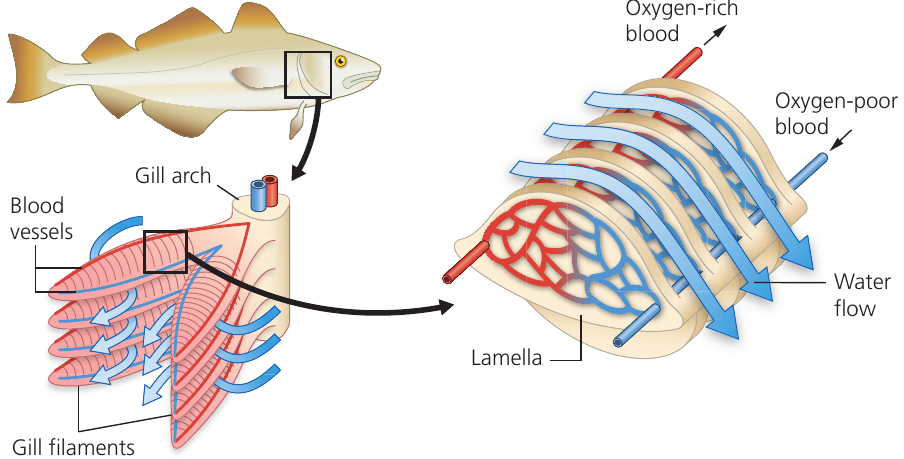
The gills serve as the gas exchange organs in bony fish. Their surface area is dramatically increased through a hierarchical branching system. Each gill is divided into numerous gill filaments, which project from a supporting gill arch. Each gill filament carries many gill lamellae (also called gill plates) on its surface, further multiplying the available surface area for gas exchange.
Note
The gill lamellae contain an extensive network of blood vessels positioned very close to their outer surface. This arrangement creates an extremely thin barrier between water and blood, typically just a few micrometres thick. Such a short diffusion pathway allows oxygen to move rapidly from water into the blood.
Living permanently in water means fish do not require any special modifications to keep their gill surfaces moist, unlike terrestrial animals which must actively maintain moisture on their respiratory surfaces.
Ventilation mechanism in fish
Bony fish employ a sophisticated pressure-based ventilation system to maintain constant water flow over their gills. This mechanism operates through coordinated movements of the buccal cavity (mouth cavity) and the operculum, a protective flap of tissue covering the gills.
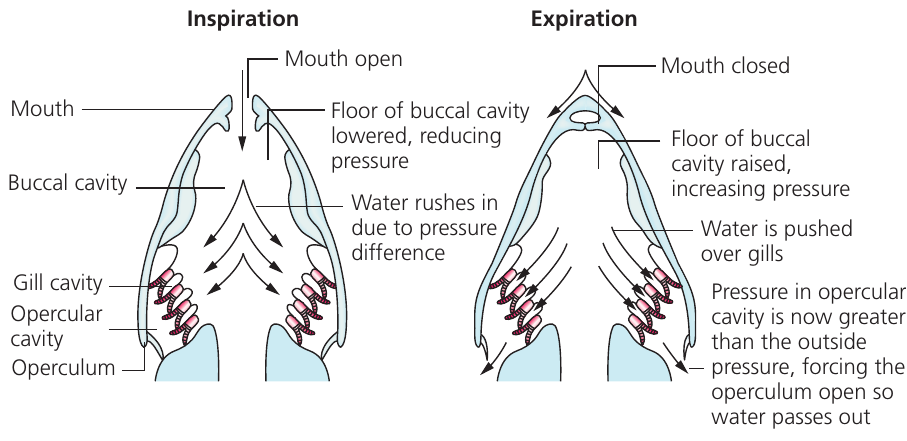
The ventilation cycle consists of two phases:
Inspiration:
- The fish opens its mouth
- The floor of the buccal cavity lowers, increasing the cavity's volume
- This volume increase reduces pressure inside the buccal cavity
- Water flows inward because external pressure exceeds buccal cavity pressure
- The lowered floor also creates suction that pulls the operculum closed
Expiration:
- The fish closes its mouth
- The floor of the buccal cavity raises, decreasing the cavity's volume
- Increased pressure forces water from the buccal cavity into the gill cavity (which has lower pressure)
- Pressure builds in the gill cavity
- This increased pressure forces the operculum open
- Water flows out over the gills and through the opercular opening
Important
This continuous pumping action ensures gills receive a constant supply of oxygen-rich water, maintaining the concentration gradient between water and blood that drives oxygen diffusion.
Counter-current exchange mechanism
The efficiency of fish gills reaches its maximum through counter-current flow, where blood flows through the gill lamellae in the opposite direction to water flowing over them. This arrangement creates a remarkably effective gas exchange system.
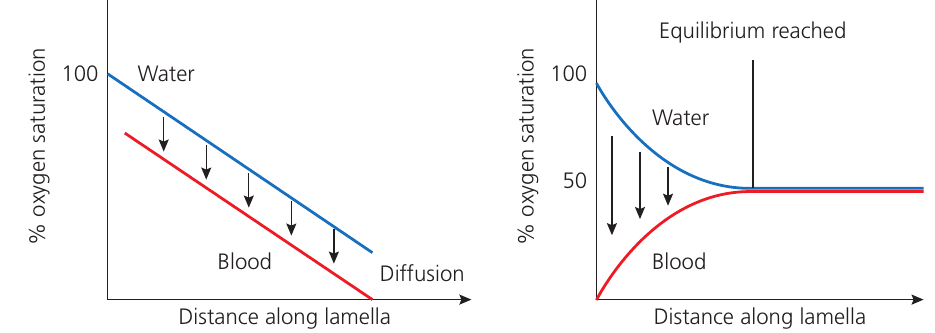
In counter-current flow, blood entering the gill lamella (with low oxygen concentration) first encounters water that has already released much of its oxygen. As blood moves through the lamella and gains oxygen, it progressively meets water with increasingly higher oxygen concentrations. This ensures that at every point along the lamella, blood encounters water containing more oxygen than itself, maintaining a diffusion gradient throughout the entire length of the exchange surface.
Important
Counter-current vs Concurrent Flow
In counter-current flow, blood and water move in opposite directions, maintaining a diffusion gradient across the entire gill lamella. This allows bony fish to extract up to – of oxygen from water.
By contrast, cartilaginous fish use concurrent flow, where blood and water move through the gills in the same direction. This arrangement proves far less efficient. As blood and water travel together, their oxygen concentrations gradually equalise until reaching equilibrium approximately halfway across the gill. Beyond this point, no concentration difference exists, so oxygen diffusion stops even though water still contains unused oxygen. Concurrent flow systems typically extract only or less of available oxygen.
Carbon dioxide exchange operates in reverse: carbon dioxide diffuses from blood into water and is expelled from the body as water leaves through the operculum.
Gas exchange in insects
Insects possess a fundamentally different respiratory system that operates without relying on blood for oxygen transport. Instead, air containing oxygen travels directly to all body tissues through an elaborate network of tubes.
Structure of the tracheal system
The insect respiratory system centres on a branching network of air-filled tubes. Spiracles are small openings located along each side of the insect's abdomen, with each body segment typically bearing a pair. These spiracles serve as entry points for atmospheric air.
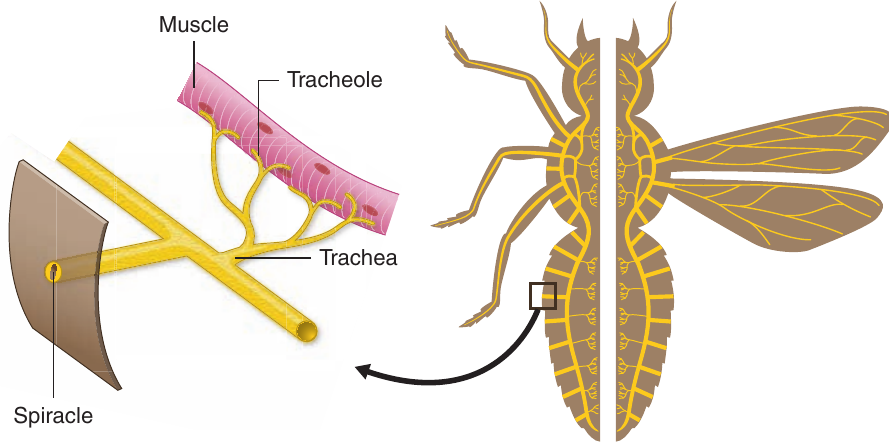
Air enters through spiracles and flows into tracheae (singular: trachea), the main air tubes running through the insect's body. The walls of larger tracheae are reinforced by rings of chitin, a tough polysaccharide material. These rings prevent the tubes from collapsing under pressure, functioning similarly to the cartilage rings that support the mammalian trachea.
Note
Tracheae branch repeatedly into progressively smaller tubes called tracheoles, which penetrate deep into tissues, reaching every respiring cell. At the terminal end of each tracheole sits a small quantity of tracheal fluid. This fluid plays a vital role in gas exchange by providing an aqueous medium in which oxygen can dissolve before diffusing into surrounding tissues.
Mechanism of gas exchange
Insects actively ventilate their tracheal system through rhythmic pumping movements of the thorax and abdomen. When the body expands, internal pressure drops below atmospheric pressure, drawing air inward through the spiracles. This air then flows through the branching tracheal network until reaching the finest tracheoles.
At the tracheole endings, oxygen dissolves in the tracheal fluid and diffuses directly into adjacent cells. The extremely short distance between tracheole and cell (often just a few micrometres) enables rapid oxygen delivery. Carbon dioxide follows the reverse pathway: it diffuses from respiring cells into the tracheal fluid, then passes into the air within tracheoles and tracheae before exiting through spiracles.
Important
This direct delivery system eliminates the need for blood to transport respiratory gases, representing a completely different evolutionary solution to the challenge of gas exchange.
Histology of gas exchange surfaces
Microscopic examination of gas exchange surfaces from different organisms reveals both similarities arising from common functional requirements and differences reflecting specific adaptations.
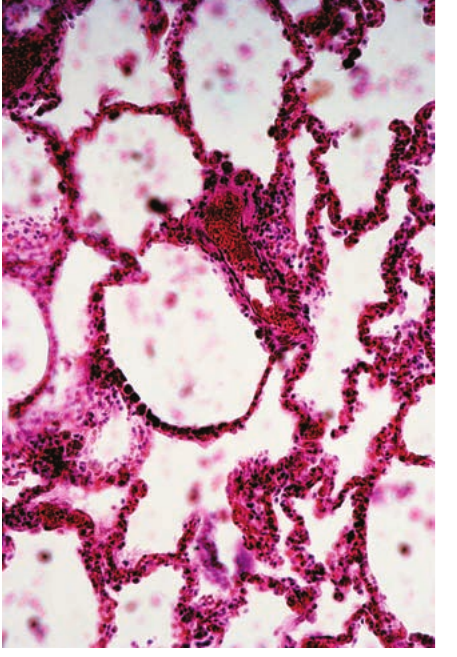
Mammalian lung tissue shows the characteristic alveolar structure with extremely thin epithelium. The alveolar walls measure typically – micrometres thick, creating minimal barrier to gas diffusion between air and blood capillaries.
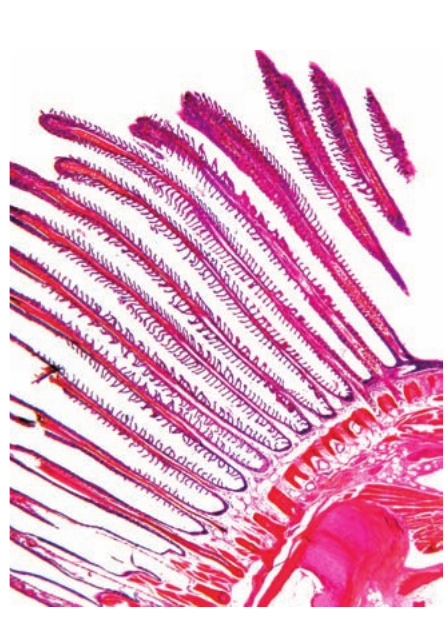
Fish gill lamellae display similar thinness, with the exchange surface reduced to a few cell layers separating water from blood vessels. This thinness is immediately apparent in stained sections, where the lamellae appear as delicate, translucent structures.
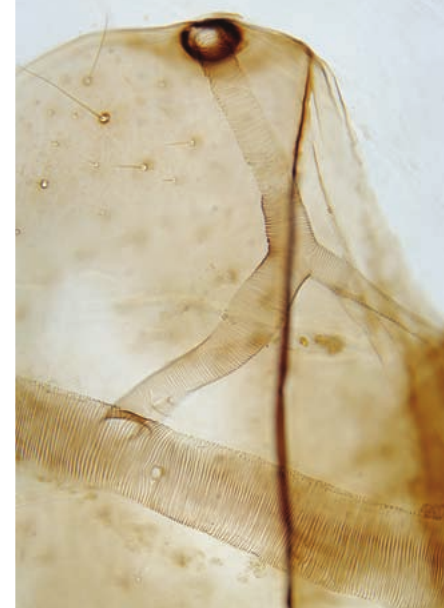
Insect tracheae show thin, transparent walls facilitating gas diffusion between air and tissues. The characteristic chitin rings appear clearly in microscopic sections as darker, more rigid structures supporting the larger tubes. The extensive branching of tracheoles ensures close proximity to all tissues.
Note
Despite their structural differences, all three systems share the fundamental requirement for minimal diffusion distance, achieved through thin exchange surfaces positioned close to either blood vessels (in mammals and fish) or respiring cells (in insects).
Remember!
Summary
Key Points to Remember:
- All gas exchange systems share four key features: large surface area, moist surface, short diffusion pathway, and (usually) good blood supply
- Fish gills achieve high efficiency through counter-current flow, where blood and water flow in opposite directions, maintaining the oxygen concentration gradient across the entire gill lamella
- The fish ventilation mechanism relies on pressure differences created by movements of the buccal cavity floor and operculum to drive continuous water flow over the gills
- Insects use a tracheal system that delivers oxygen directly to tissues via branching tubes (spiracles → tracheae → tracheoles), completely bypassing the need for blood transport
- All gas exchange surfaces are extremely thin to minimise diffusion distance, whether in mammalian alveoli, fish gill lamellae, or insect tracheoles