The Need for Specialised Gas Exchange Surfaces (OCR A-Level Biology A): Revision Notes
📚Revision Notes
The Need for Specialised Gas Exchange Surfaces
Introduction to gas exchange requirements
Most organisms obtain energy through aerobic respiration, which requires a continuous supply of oxygen and produces carbon dioxide as a waste product. The exchange of these gases between an organism and its environment must meet the metabolic demands of all cells.
During intense physical activity, metabolic rate increases substantially. Muscle cells require more oxygen to release energy aerobically. When oxygen supply cannot match demand, cells resort to anaerobic respiration temporarily, creating an oxygen deficit that must later be repaid.

Note
The principles governing gas exchange apply not only to respiratory surfaces but also to other exchange sites in organisms. For instance, plant root hair cells increase surface area for water absorption, whilst intestinal epithelial cells possess microvilli to enhance nutrient uptake.
Gas exchange in small organisms
Simple diffusion mechanisms
In unicellular organisms and very small multicellular organisms, gas exchange occurs directly across the body surface through simple diffusion. This process relies on concentration gradients:
- Oxygen is consumed during respiration, creating a lower concentration inside the cell compared to the surrounding environment
- Oxygen diffuses inward down its concentration gradient
- Carbon dioxide is produced during respiration, establishing a higher internal concentration
- Carbon dioxide diffuses outward down its concentration gradient
Requirements for effective gas exchange
For diffusion to function adequately, the organism's surface must meet specific criteria:
Important
Critical Requirements for Diffusion-Based Gas Exchange:
- Permeable to oxygen and carbon dioxide
- Moist – gases can only cross cell membranes when dissolved in solution, not in gaseous form
- Thin – to minimise diffusion distance
Aquatic organisms naturally maintain moist surfaces, avoiding the problem of desiccation. The short diffusion distances in small organisms (typically under ) mean that gases reach all cells quickly enough to sustain metabolic processes.
Problems arising in larger organisms
Increased diffusion distances
As organisms evolved greater size and complexity, several challenges emerged. The central problem concerns diffusion distance: oxygen would take excessively long to reach cells deep within a large organism through simple diffusion alone.
Example
Worked Example: Comparing Diffusion Times
Consider the time scales involved in different-sized organisms:
Small organism (Paramecium caudatum):
- Maximum diffusion distance:
- Time for oxygen to reach all cells: approximately seconds
- Result: Diffusion is fast enough to sustain life
Large organism:
- Maximum diffusion distance: (or )
- Time for oxygen to reach centre: approximately hours
- Result: Cells in the organism's core would die from oxygen starvation long before diffusion could supply their needs
Elevated metabolic demands
Larger, more complex organisms typically exhibit higher levels of activity and possess specialised organ systems. This increased metabolic activity generates a substantially greater demand for oxygen across all tissues. Simultaneously, carbon dioxide production rises proportionally, requiring efficient removal to prevent toxic accumulation.
Note
The combination of greater diffusion distances and higher metabolic demands creates a compounding problem: not only does oxygen take longer to reach cells, but those cells also require oxygen at a much faster rate than smaller organisms.
Waterproof body coverings
Organisms that colonised terrestrial environments faced an additional constraint. To prevent excessive water loss through evaporation, they evolved waterproof outer coverings. However, surfaces that are impermeable to water are also impermeable to oxygen and carbon dioxide, preventing gas exchange through the general body surface.
Surface area to volume ratio
The fundamental principle
The relationship between surface area and volume represents a key limiting factor for gas exchange. Gases diffuse across surfaces, so the surface area determines the quantity of gas that can be exchanged. However, the volume of an organism indicates the total number of cells requiring oxygen and producing carbon dioxide.
As organisms increase in size, volume grows proportionally faster than surface area. Mathematically, if linear dimensions double:
- Surface area increases by a factor of
- Volume increases by a factor of
This creates a declining surface area to volume ratio (SA:V).
Mathematical demonstration
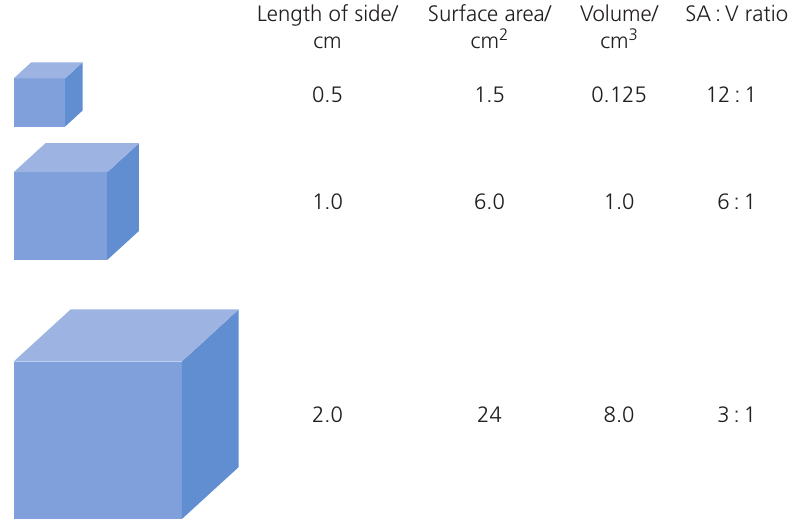
The principle can be illustrated using cubes of different sizes:
Example
Worked Example: Calculating Surface Area to Volume Ratios
For a cube with side length :
- Surface area
- Volume
- SA ratio
Applying this formula to cubes of different sizes:
| Side length () | Surface area () | Volume () | SA ratio |
|---|---|---|---|
Analysis:
- As the cube doubles in size from to , the SA:V ratio halves from to
- Doubling again to reduces the ratio to
- Each doubling of size results in halving the SA:V ratio
Although animals possess more complex shapes than cubes, they have relatively compact bodies, making the cube a valid model for understanding this principle.
Consequences for gas exchange
A declining SA:V ratio means:
- The available surface area becomes insufficient to meet oxygen demands
- Carbon dioxide production exceeds the capacity of the body surface to remove it
- Simple diffusion across the body surface cannot sustain the organism's metabolic requirements
Important
These constraints necessitate the evolution of specialised gas exchange surfaces with enhanced surface area and mechanisms to maintain steep concentration gradients. Without these adaptations, larger organisms simply could not exist.
Terminology clarification
Important
Common Terminology Mistakes to Avoid:
Ventilation describes the process of moving the respiratory medium (air or water) over the gas exchange surface. This term applies to all organisms with specialised exchange systems.
Breathing specifically refers to the mechanical process in mammals and some other animals of taking air into the body, exchanging gases in the lungs, and expelling air. It is incorrect to describe plants, fish, or many invertebrates as "breathing" – they ventilate their exchange surfaces but do not breathe.
Respiration is the biochemical process occurring in cells that releases energy from glucose, consuming oxygen and producing carbon dioxide. Respiration should never be confused with breathing or ventilation.
Remember!
Summary
Key Points to Remember:
- Small organisms rely on diffusion across their body surface for gas exchange, requiring moist and permeable surfaces
- As organisms increase in size, three main problems arise: greater diffusion distances, higher metabolic demands, and the need for waterproof coverings
- The surface area to volume ratio decreases as organisms become larger, calculated as SA:V for a cube of side length
- This declining ratio means the body surface area becomes inadequate for meeting oxygen requirements and removing carbon dioxide
- Specialised gas exchange surfaces evolved to overcome these limitations by increasing effective surface area and maintaining concentration gradients