Translocation (OCR A-Level Biology A): Revision Notes
📚Revision Notes
Translocation
What is translocation?
Translocation is the movement of dissolved photosynthetic assimilates (nutrients made during photosynthesis) through a plant. Unlike water transport in the xylem, translocation requires energy and therefore depends on living cells.
The primary substance transported during translocation is sucrose, though amino acids and several other organic compounds are also moved through the plant.
Note
Sucrose is the main transport sugar because it is:
- Soluble in water
- Chemically unreactive
- Does not interfere with the plant's water potential as much as glucose would
These properties make sucrose ideal for long-distance transport through the plant's vascular system.
This process is essential for distributing the products of photosynthesis from where they are made to where they are needed for growth, storage, or respiration. Without translocation, the plant's non-photosynthetic tissues would not receive the nutrients they require.
Sources and sinks
Translocation involves movement from sources to sinks, creating directional flow within the phloem tissue.
A source is any region of the plant with a high concentration of sucrose. The main sources are the leaves, where sucrose is produced as a result of photosynthesis. Mature, photosynthetically active leaves generate sucrose and export it to other parts of the plant.
A sink is any area that requires sugar or other nutrients. Sinks have low sucrose concentrations because they either use the sugar immediately or convert it to storage forms. Key examples of sinks include:
- Growing points (meristems) in roots, stems, and developing leaves
- Roots in general, which require energy for active uptake of minerals
- Storage organs such as potato tubers, developing fruits, and seeds
Note
Sources and sinks can change roles!
The designation of source or sink can change depending on the plant's developmental stage. For instance, a potato tuber acts as a sink when starch is being stored, but becomes a source when the tuber begins to sprout and the stored starch is converted back to sucrose for use by the growing shoot.
Because sources maintain high sucrose concentrations and sinks maintain low concentrations, assimilates naturally move down the concentration gradient from sources to sinks. This concentration difference is the basis for the transport mechanism.
Evidence for phloem transport
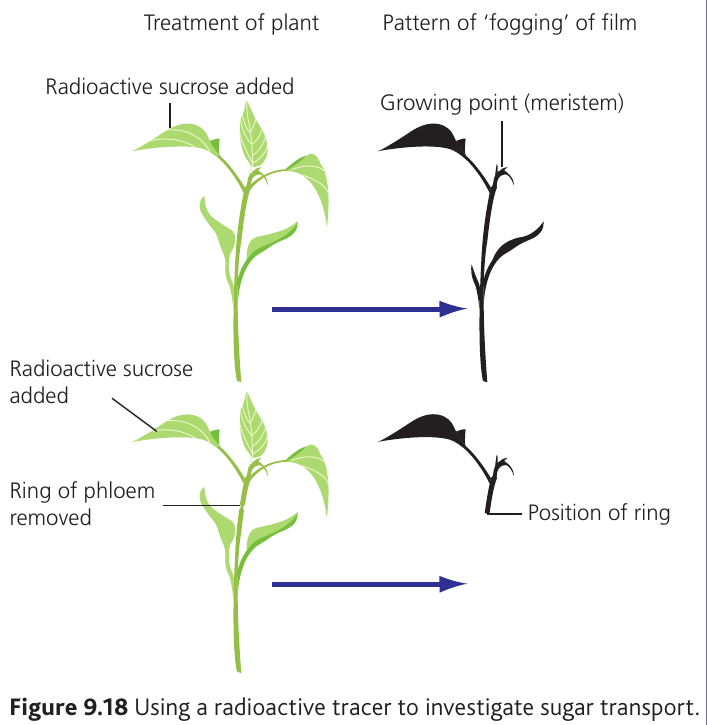
Several lines of evidence demonstrate that translocation occurs in the phloem tissue. One particularly convincing approach uses radioactive tracers to track the movement of sugars through the plant.
Example
Experimental Technique: Radioactive Tracer Method
Step 1: A plant leaf is supplied with sucrose solution containing a radioactive isotope of carbon (C).
Step 2: The radioactive sucrose is transported throughout the plant via the phloem.
Step 3: Researchers place the plant against photographic film to detect the radioactive tracer.
Step 4: Wherever radioactivity is present, the film becomes 'fogged' (exposed).
Result: When the film is developed, it creates a pattern showing where the radioactive sucrose travelled.
The results from intact (un-ringed) plants show that radioactive sucrose moves both upward and downward from the treated leaf. The tracer appears in growing points (meristems) and throughout the plant's tissues, demonstrating that translocation can occur in multiple directions depending on where the sinks are located.
Important
The Ringing Experiment
To confirm that this transport occurs specifically in the phloem, some experimental plants undergo ringing – a procedure where a ring of phloem tissue is removed from the stem.
In these ringed plants:
- Radioactive sucrose accumulates above the ring
- The tracer does not pass beyond the ring
- This proves that the phloem tissue is essential for translocation
The radioactivity still reaches the growing tip above the ring, but cannot move to lower parts of the plant.
This experimental approach provides strong evidence that sucrose is transported bidirectionally through the phloem tissue, and that removing the phloem prevents this transport.
Mechanism of translocation: the mass flow hypothesis
While the mechanism of phloem transport is not completely understood, the most widely accepted explanation is the mass flow hypothesis. This theory proposes that translocation occurs through pressure-driven bulk flow of solution through the sieve tube elements of the phloem.
Loading at the source
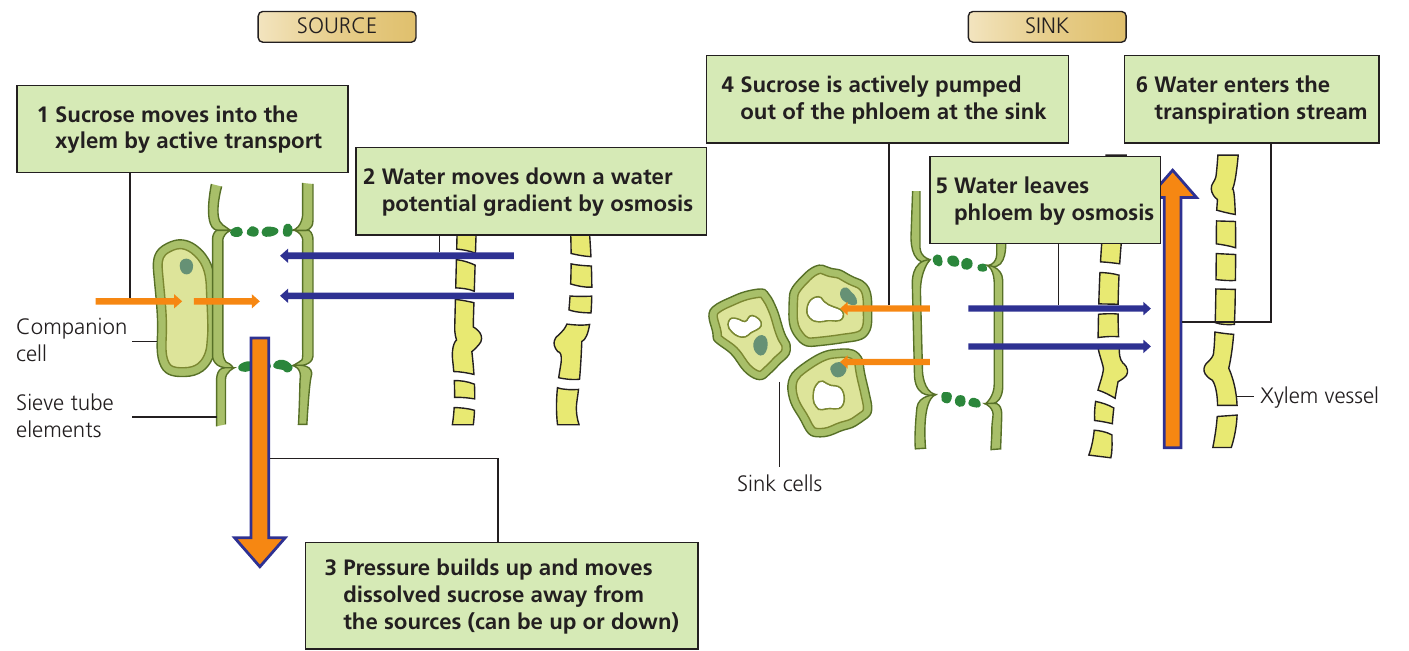
The process begins at the source (photosynthetic leaves) where sucrose must be loaded into the phloem tissue. This loading primarily involves active transport, though some sucrose may also move passively through the cytoplasm and plasmodesmata (cytoplasmic connections between cells).
Note
The Role of Companion Cells
Companion cells play a vital role in this process. These metabolically active cells are closely associated with sieve tube elements and provide the ATP required for active transport. Using this energy, sucrose is actively pumped into the sieve tube elements against its concentration gradient.
As sucrose accumulates in the sieve tubes, it lowers the water potential inside these cells. Water from the adjacent xylem vessels moves into the phloem by osmosis, following the water potential gradient. This influx of water creates hydrostatic pressure within the phloem at the source.
Mass flow from source to sink
The high hydrostatic pressure at the source forces the solution (containing dissolved sucrose) away from the source region. This pressure-driven movement is called mass flow, and it can occur both upward and downward through the plant, depending on where the sinks are located relative to the sources.
Important
The dissolved sucrose moves as part of the bulk solution – this is not diffusion of individual molecules, but rather a pressure-driven flow of the entire solution through the phloem sieve tubes.
Unloading at the sink
At the sink regions, sucrose must be removed from the phloem and transferred to the cells that need it. While the exact mechanism is still uncertain, this unloading is thought to involve active transport, with sucrose being pumped out of the sieve tube elements into the surrounding sink cells.
As sucrose leaves the phloem, the water potential inside the sieve tubes increases (becomes less negative). Water then moves out of the phloem by osmosis, following the water potential gradient. Much of this water re-enters the xylem vessels and becomes part of the transpiration stream.
The loss of water at the sink reduces the hydrostatic pressure in the phloem at this location.
Maintaining the pressure gradient
Because pressure is high at the source (due to water influx) and lower at the sink (due to water efflux), a pressure gradient is maintained throughout the phloem system. This pressure difference drives continuous mass flow from sources to sinks, as long as there is active loading at sources and active unloading at sinks.
Important
Why Living Cells Are Essential
The requirement for active transport at both ends explains why translocation depends on living cells with functioning mitochondria to provide ATP. If the phloem cells die or are poisoned, translocation stops because the active transport mechanisms fail.
Remember!
Summary
Key Points to Remember:
-
Translocation is the transport of photosynthetic products (mainly sucrose) through the phloem – it requires energy and living cells, unlike passive water transport in xylem.
-
Movement occurs from sources to sinks – sources have high sucrose concentration, sinks have low sucrose concentration. Leaves are typically sources, while growing regions and storage organs are sinks, though this can reverse.
-
Radioactive tracer experiments provide evidence that translocation occurs in the phloem – ringing experiments show that removing phloem prevents sugar transport.
-
The mass flow hypothesis explains translocation through pressure-driven bulk flow – active loading at sources creates high pressure, active unloading at sinks creates lower pressure, and the pressure gradient drives mass flow.
-
Active transport occurs at both the source and sink – companion cells provide ATP for loading sucrose into phloem at sources; active transport also removes sucrose at sinks. Water movement by osmosis follows the sucrose, creating and relieving pressure.