Interactions and Inhibitors (OCR A-Level Biology A): Revision Notes
📚Revision Notes
Interactions and Inhibitors
Enzymes do not work in isolation. Their activity can be influenced by various substances that interact with them in different ways. Understanding these interactions is essential for comprehending how cells regulate metabolic processes and how certain drugs and poisons affect biological systems.
Note
The substances that interact with enzymes fall into two main categories: helper molecules that enable enzyme function (cofactors, coenzymes, and prosthetic groups) and inhibitors that reduce or prevent enzyme activity. Both play crucial roles in cellular regulation.
Cofactors, coenzymes and prosthetic groups
Many enzymes require additional non-protein substances to function properly. Without these helper molecules, the enzyme remains inactive or works inefficiently.
Cofactors
A cofactor is a non-protein substance required by an enzyme to carry out its catalytic function. Cofactors can be either permanently attached to the enzyme molecule (prosthetic groups) or temporarily associated during the reaction.
Inorganic cofactors
Some enzymes require inorganic ions to function correctly. These metal ions help to stabilise the enzyme's tertiary structure or participate directly in the catalytic reaction at the active site.
Example
Cofactor Examples in Action
Amylase: Requires calcium ions () and chloride ions () to break down starch into maltose.
Carbonic anhydrase: Found in red blood cells, uses a zinc ion () as part of its active site to catalyse the conversion of carbon dioxide and water to carbonic acid.
Coenzymes
Larger organic molecules that act as cofactors are called coenzymes. These are small organic non-protein molecules that participate in enzyme-catalysed reactions by transferring chemical groups or hydrogen ions between different reactions.
Coenzymes can bind to enzymes in two ways:
- Some bind permanently to the enzyme, often in or near the active site
- Others bind temporarily during the reaction and then dissociate
Note
Coenzymes play a vital role in linking different enzyme-catalysed reactions within metabolic sequences such as respiration and photosynthesis. This makes them essential for coordinating complex metabolic pathways.
Many coenzymes are synthesised from B-group vitamins:
- Pantothenic acid (vitamin B₅) is a component of coenzyme A
- Nicotinic acid is used to synthesise the coenzymes NAD and NADP
- Riboflavin (vitamin B₂) forms the basis of the coenzyme FAD
These coenzymes serve specific functions in metabolism:
- NAD and FAD are alternately reduced and oxidised during respiration, transferring energy in the form of hydrogen ions
- NADP fulfils a similar role in chloroplasts during photosynthesis
- Coenzyme A transfers acetyl groups () from glucose and fatty acids during respiration
- ATP transfers phosphate groups between respiration and energy-consuming processes in cells
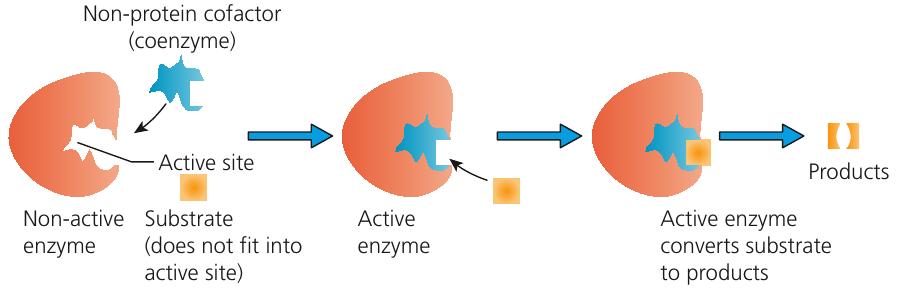
The diagram above shows how a cofactor (coenzyme) activates an enzyme. In the non-active state, the enzyme's active site cannot accept the substrate. When the coenzyme binds, the enzyme becomes active and can convert substrate molecules into products.
Prosthetic groups
Any cofactor that becomes a permanent part of an enzyme molecule is called a prosthetic group. These groups contribute to the three-dimensional shape of the enzyme and are therefore essential for its catalytic function.
Example
Prosthetic Group Examples
- The zinc ion in carbonic anhydrase forms an essential part of its active site
- FAD acts as the prosthetic group for the mitochondrial enzyme succinate dehydrogenase
Enzyme inhibitors
An inhibitor is any substance that reduces the rate of or completely stops an enzyme-catalysed reaction by interacting with the enzyme molecule. Inhibitors play crucial roles in regulating metabolic pathways, and some are used as medicinal drugs or act as poisons.
Non-reversible inhibitors
Non-reversible inhibitors (also called irreversible inhibitors) bind permanently to enzymes by forming strong covalent bonds. This binding completely inactivates the enzyme. Once inhibited, the cell must synthesise new enzyme molecules through gene transcription and translation to restore enzyme activity.
Important
Heavy metal ions such as lead () and mercury () are examples of non-reversible inhibitors. These ions form covalent bonds with sulfur-containing R groups in proteins, causing permanent damage. They are serious metabolic poisons that can have fatal consequences.
For instance, lead permanently inhibits the enzyme ferrochelatase, which is involved in synthesising haem for haemoglobin production.
Reversible inhibitors
Reversible inhibitors bind temporarily to enzymes. Their inhibitory effect can be overcome by changes in the enzyme's environment, such as alterations in substrate concentration or removal of the inhibitor. There are two main types of reversible inhibitors, classified according to where they bind on the enzyme.
Competitive inhibitors
Competitive inhibitors are molecules that possess a similar three-dimensional structure to the substrate molecule, or have at least one region with a complementary shape. These molecules compete directly with substrate molecules for access to the enzyme's active site.
When a competitive inhibitor collides with an enzyme and binds to the active site, it effectively blocks substrate molecules from entering. This forms an enzyme-inhibitor complex that cannot catalyse any reaction, reducing the overall reaction rate.
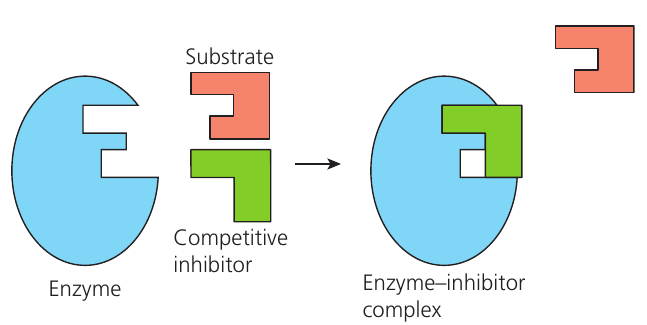
The effectiveness of competitive inhibition depends on the relative concentrations of inhibitor and substrate molecules:
- When inhibitor concentration is low compared to substrate concentration, the reaction rate is only slightly reduced
- When inhibitor concentration is high, more inhibitor molecules successfully occupy active sites, significantly reducing enzyme-substrate complex formation
Important
Competitive inhibition can be overcome by increasing the substrate concentration. With more substrate molecules present, they can outcompete the inhibitor for active sites, allowing the reaction rate to increase.
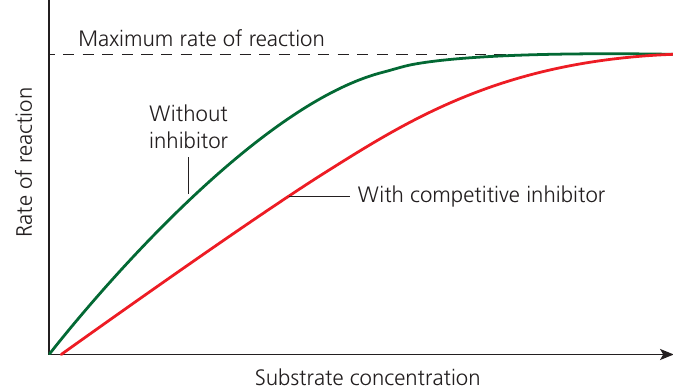
The graph above demonstrates the effect of a competitive inhibitor on reaction rate. Notice that:
- Both curves (with and without inhibitor) eventually reach the same maximum rate of reaction
- The curve with inhibitor requires a higher substrate concentration to reach the maximum rate
- This is because substrate molecules must outcompete the inhibitor molecules
Example
Product Inhibition by Galactose
The enzyme β-galactosidase catalyses the breakdown of lactose:
Galactose, one of the products, acts as a competitive inhibitor. This provides a natural regulatory mechanism - when sufficient product molecules accumulate, they slow down further enzyme activity.
Non-competitive inhibitors
Non-competitive inhibitors do not compete with substrate molecules for the active site. Instead, they bind to a different region of the enzyme called an allosteric site. This binding causes a conformational change in the enzyme's tertiary structure, which distorts the shape of the active site.
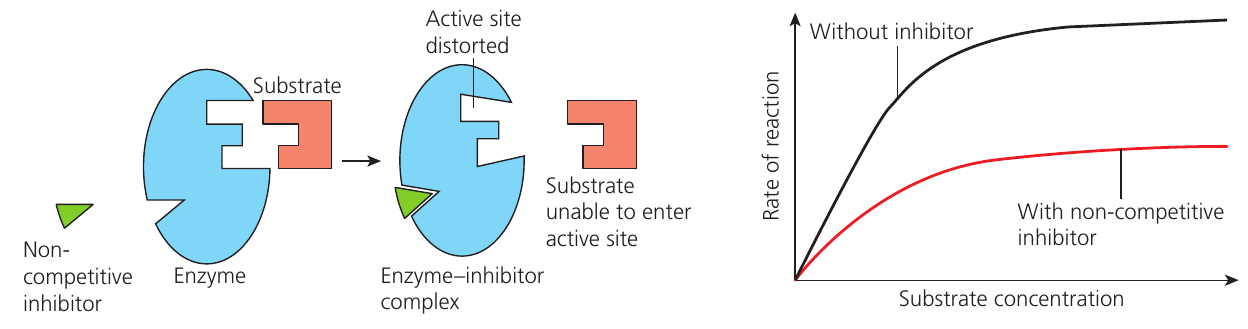
Once the active site shape has been altered, substrate molecules can no longer bind effectively, preventing enzyme-substrate complex formation and reducing the reaction rate.
Note
Because competitive and non-competitive inhibitors work through different mechanisms, their effects differ significantly:
- Increasing substrate concentration has no effect on non-competitive inhibition
- The maximum rate of reaction is reduced when a non-competitive inhibitor is present
- Once all allosteric sites are occupied by inhibitor molecules, the reaction stops completely, regardless of substrate concentration
The graph in the figure above shows how non-competitive inhibitors reduce the maximum rate of reaction, unlike competitive inhibitors which only delay reaching the maximum rate.
Applications of enzyme inhibitors
Controlling metabolic processes
Enzyme inhibitors provide essential control mechanisms for metabolic pathways. Most intracellular enzymes work as part of sequential pathways, where the product of one reaction becomes the substrate for the next.
Note
In many metabolic sequences, the final product molecules act as non-competitive inhibitors of the first enzyme in the pathway. This creates a feedback mechanism called product inhibition - when sufficient product has been synthesised, it automatically reduces its own production by inhibiting the initial enzyme. This prevents wasteful overproduction of metabolic products.
Since enzymes can accelerate reaction rates by factors of up to ten million, such regulatory mechanisms are vital for maintaining metabolic balance within cells.
Inhibitors as poisons
Some inhibitors are highly toxic metabolic poisons that prevent essential metabolic reactions from occurring. These substances can be fatal because they block critical biochemical pathways.
Important
Cyanide is a non-reversible inhibitor of cytochrome oxidase, the mitochondrial enzyme that catalyses the final step of aerobic respiration. Because this inhibition is permanent and cannot be reversed except by synthesising new enzymes (a time-consuming process), cyanide poisoning is often fatal.
Malonate is a competitive inhibitor of the mitochondrial enzyme succinate dehydrogenase. It is also a metabolic poison, though its effects can potentially be overcome by increasing substrate concentration.
Note
Researchers use metabolic poisons as experimental tools to understand enzyme function and metabolic pathways, particularly in processes like cellular respiration.
Inhibitors as medicinal drugs
Many enzyme inhibitors have beneficial medical applications because they selectively block enzymes that contribute to disease processes or unwanted physiological responses.
| Medicinal drug | Inhibitory action | Benefit of the inhibitor |
|---|---|---|
| Penicillin | Non-reversible inhibition of transpeptidase enzyme responsible for forming cross-links in bacterial cell walls | Bacteria are destroyed |
| Aspirin (acetylsalicylic acid) | Non-reversible inhibition of the COX enzyme involved in producing prostaglandins for stimulating inflammation and pain | Reduces inflammation and provides pain relief |
| Eflornithine | Non-reversible inhibitor of ornithine decarboxylase, an enzyme essential for cell growth | Used for treatment of African trypanosomiasis (sleeping sickness) |
| Statins | Competitive inhibition of HMG-CoA reductase, an enzyme involved in cholesterol synthesis | Reduces the concentration of cholesterol in the blood |
Note
These examples demonstrate how understanding enzyme inhibition mechanisms has led to the development of effective treatments for bacterial infections, pain management, parasitic diseases, and cardiovascular conditions.
Remember!
Summary
Key Points to Remember:
- Cofactors are non-protein substances (inorganic ions or organic coenzymes) that enzymes require to function properly
- Prosthetic groups are cofactors permanently attached to enzymes, contributing to their three-dimensional structure
- Competitive inhibitors compete with substrates for the active site and can be overcome by increasing substrate concentration
- Non-competitive inhibitors bind to allosteric sites, changing the active site shape, and cannot be overcome by adding more substrate
- Enzyme inhibitors serve important roles in regulating metabolism, act as poisons, and form the basis of many medicinal drugs