Isolating Mechanisms and Artificial Selection (OCR A-Level Biology A): Revision Notes
📚Revision Notes
Isolating Mechanisms and Artificial Selection
Isolating mechanisms in forming new species
When a large population divides into smaller groups, these sub-populations become separated and isolated from one another. The causes of this separation are known as isolating mechanisms. Once isolated, each group experiences different changes in allele frequencies depending on the genetic composition of the founding population and the selection pressures acting on each group over time.
Some alleles may disappear completely from certain populations, whilst others increase in frequency. Over extended periods, the sub-populations may diverge to such an extent that they can no longer interbreed successfully. At this point, they have become distinct species.
Note
The process of speciation through isolation follows a clear pattern: population division → reproductive isolation → differential selection pressures → changes in allele frequencies → accumulation of genetic differences → inability to interbreed → formation of new species. This process can take thousands to millions of years depending on the strength of selection pressures and the rate of genetic change.
Isolating mechanisms fall into two main categories, based on the nature of the barrier preventing gene flow between populations.
Allopatric speciation
Allopatric speciation (from the Greek allos, meaning 'other') occurs when a geographical mechanism physically separates a population into distinct sub-groups. These geographical barriers might include rivers, mountain ranges, or climatic changes that divide habitats.
Once separated, the populations experience different selection pressures, genetic drift, and mutations. This leads to genotypic and phenotypic divergence – the populations become increasingly different in their genetic makeup and physical characteristics.
Example
Example: Speciation in the Galápagos Islands
The Galápagos Islands provide classic examples of allopatric speciation:
Iguanas: The terrestrial and marine iguanas evolved from a common ancestor but became separated by geographical and climatic differences. Each adapted to their distinct environments – marine iguanas developed the ability to swim and feed on algae underwater, while terrestrial iguanas remained land-based herbivores.
Tortoises: Galápagos tortoises show such significant differences between islands that individuals can be identified based on which island they originated from. Shell shapes, neck lengths, and sizes vary dramatically depending on the vegetation and terrain of each island.
If these separated populations eventually come back into contact, they may have changed so extensively that they are reproductively isolated – they can no longer exchange genes through reproduction and are therefore different species.
Sympatric speciation
Sympatric speciation does not involve geographical separation. Instead, reproductive differences cause some individuals within a population to become isolated from the rest, even whilst living in the same location. Two or more species can form from a single ancestral species within the same geographical area.
An impressive example of sympatric speciation is found in the cichlid fish of East Africa's Rift Valley lakes (Lake Victoria, Lake Malawi, and Lake Tanganyika). Over different species have descended from the ancestral fish Oryzias latipes over millions of years. All are now reproductively isolated despite living in close proximity.
Example
Example: Hawthorn Flies and Ongoing Speciation
The hawthorn fly (Rhagoletis pomonella) provides a contemporary example of sympatric speciation in progress:
Original population: Fed exclusively on hawthorn fruit in North America
Population split: When apples (a non-native species) were introduced, one population began feeding on apples instead of hawthorn
Reproductive isolation: The two groups do not interbreed because:
- Hawthorn-feeding flies mature later in the season
- They develop more slowly than apple-feeding flies
- The timing difference prevents mating between groups
Genetic evidence: DNA analysis has revealed that six out of gene loci for enzymes differ between the two populations, demonstrating significant genetic divergence is already occurring.
Important
Other Reproductive Isolating Mechanisms
Reproductive isolation can occur through several mechanisms beyond geographical separation:
- Temporal isolation: Shifted breeding cycles in animal populations mean individuals are fertile at different times
- Behavioural isolation: Different courtship behaviours prevent mating (for example, swans and geese are related but have been isolated so long that any offspring are infertile)
- Mechanical isolation: Altered physical features where reproductive organs are no longer compatible
- Chromosomal isolation: When polyploidy occurs, creating incompatible chromosome numbers
Hybridisation and polyploidy in plants
Hybridisation sometimes occurs between different plant species. The resulting hybrids are often sterile and cannot breed with either parent species. However, if the chromosome number doubles due to a failure during meiosis, they can become fertile. This process, called polyploidy, allows speciation to occur and is common in plants but rare in animals.
Example
Example: Cord Grass (Spartina) Speciation Through Polyploidy
The evolution of English cord grass demonstrates how polyploidy can create new species:
Step 1 - Initial invasion:
- Foreign species Spartina alterniflora (from East and Gulf coasts of USA) invaded salt marshes in Southampton Water, UK
- Encountered native species S. maritima
Step 2 - Hybridisation:
- The two species interbred to produce hybrid S. townsendii
- This hybrid was sterile because chromosomes from the two parent species could not pair during meiosis
- Despite sterility, it reproduced asexually
Step 3 - Chromosome mutation:
- A chromosome mutation doubled the chromosome number in S. townsendii
- This created a fertile organism with compatible chromosome pairs
Step 4 - New species formation:
- The fertile organism became English cord grass (Spartina anglica)
- This is a distinct species because it does not interbreed with S. maritima, S. alterniflora, or S. townsendii
- It is reproductively isolated from all other species
Artificial selection
Artificial selection occurs when humans direct the breeding process by choosing which features of plants or animals are desirable and selecting which individuals are allowed to reproduce. Unlike natural selection, where environmental factors determine which organisms survive and reproduce, artificial selection is guided by human preferences and needs.
Humans have practiced artificial selection for thousands of years. Selective breeding of wild plants and animals is thought to have begun approximately years ago when human populations began settling in larger groups and developing agriculture.
Evolution of modern bread wheat
Modern bread wheat (Triticum aestivum) provides an excellent example of artificial selection in plants. It evolved from crosses between the genus Triticum (wild wheat) and the genus Aegilops (wild grass) around years ago.
The evolution of modern bread wheat involved several key processes:
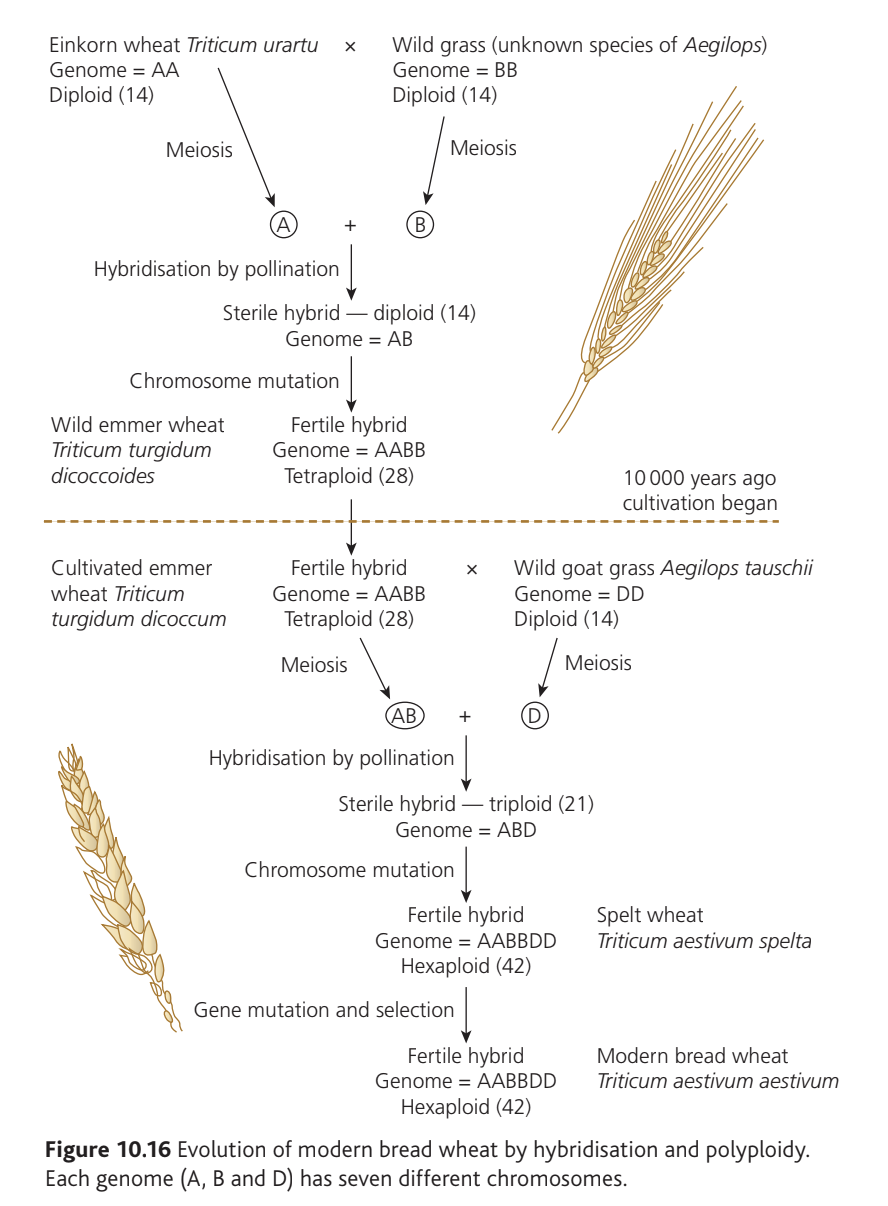
Example
Example: Step-by-Step Evolution of Modern Bread Wheat
The creation of modern bread wheat demonstrates how hybridisation and polyploidy work together in artificial selection:
Stage 1 - Introducing new genes:
- Einkorn wheat (Triticum urartu): diploid with chromosomes (genome AA)
- Wild grass (Aegilops): diploid with chromosomes (genome BB)
- Humans selected crosses between these species to combine desired traits
Stage 2 - First hybridisation:
- Crossing wild wheat and wild grass created sterile hybrids
- Both parents had diploid chromosome numbers of (seven pairs)
- Chromosomes were incompatible and could not pair during meiosis
- Result: reproduction was impossible
Stage 3 - First polyploidy event:
- Chance chromosome mutation doubled the chromosome number
- Created nuclei with more than diploid number after fertilisation
- Produced fertile tetraploid individuals with chromosomes
- These produced diploid gametes instead of haploid gametes
- Created emmer wheat that could not cross with either parent species
Stage 4 - Second hybridisation:
- Crosses between tetraploid emmer wheat ( chromosomes) and wild goat grass (Aegilops, genome DD, chromosomes)
- Produced sterile triploid hybrid with chromosomes
Stage 5 - Second polyploidy event:
- Further chromosome mutations doubled the number again
- Created fertile hexaploid with chromosomes
- Became spelt wheat (Triticum aestivum spelta)
Stage 6 - Continued selection:
- Further human selection over thousands of years
- Resulted in modern bread wheat (Triticum aestivum aestivum)
- Final chromosome count: hexaploid with chromosomes
Chromosome progression: Diploid () → Tetraploid () → Hexaploid ()
Artificial selection in animals
Modern domestic dogs illustrate artificial selection in animals particularly well. Intensive selective breeding has produced a vast variety of different breeds. Modern dogs almost certainly evolved from the ancestral grey wolf around the time humans began settling and farming, or slightly before.
Initially, wolves were selected for their ability to be tamed and used for tasks such as hunting. Those that could not be tamed were not selected for breeding. However, selection for tameness simultaneously caused physical changes that later proved ideal for specific tasks.
Note
Selection for Specific Traits in Dog Breeds
Tamed wolf-dogs were used to hunt prey and pursue them until humans could catch up and make the kill. Different breeds were then selected for specific purposes:
- Terriers: Selected for running into burrows after animals such as rabbits, so small size and speed were important traits
- Gun dogs: Selected for their ability to learn, point, and retrieve game, making size, speed, and intelligence important traits
Currently, all dog breeds remain the same species, but over time the accumulating differences may result in speciation between breeds.
Selective breeding in cattle
Selective breeding has been particularly important in cattle, where improving milk yield is economically valuable. However, this represents a challenging task because milk yield is determined by many genes, making it an example of continuous variation. Additionally, milk yield is significantly affected by environmental conditions including:
- Type of feed
- Temperature
- Type of grass and soil quality
- Living conditions
Recognising these environmental influences, some farmers employ additional techniques such as playing music and increasing human contact to improve milk yield.
The need to maintain genetic resources
To improve traits like milk yield in dairy cattle, it is essential to maintain a resource of genetic material including types close to the original wild populations. This prevents the gene pool from becoming too small, which can weaken the population by reducing variation.
Important
The Dangers of Reduced Genetic Diversity
Holstein cow example: Inbreeding in Holstein cows reduced the gene pool with a consequent drop in milk yield. This demonstrates how limiting genetic diversity can be counterproductive even when trying to improve desired traits.
Population vulnerability: In some cases, lack of variation can lead to loss of an entire population following disease outbreak or environmental change. Without genetic diversity, populations cannot adapt to new challenges.
Bottleneck effects: After a bottleneck event, genetic variation decreases substantially, reducing the population's ability to withstand environmental change or resist disease. Many instances exist where gene pools have been severely reduced through such events.
Ethical considerations
Unfortunately, some intensive selection processes have resulted in conditions and diseases that are extremely harmful for the animals involved, raising serious ethical concerns. These problems arise as unintended consequences of selecting for desired features whilst simultaneously selecting damaging genes.
Important
Health Problems Resulting from Selective Breeding
The following examples illustrate serious ethical concerns in artificial selection:
Respiratory issues:
- Bulldogs and Pekingese dogs commonly suffer breathing problems due to their extremely shortened snouts
- These breeds struggle with basic activities like exercise and sleeping
Skeletal problems:
- Giant breeds such as Saint Bernards and Great Danes show strong correlation between large size and frequency of hip dysplasia
- They tend to overheat because cooling a large body is difficult
- They are prone to malignant bone tumours in their legs, likely due to their excessive weight
Autoimmune diseases from inbreeding:
- Inbreeding to maintain pedigree lines often results in inheritance of two recessive alleles for genetic diseases
- Addison's disease (affecting adrenal glands) occurs frequently in Bearded Collies and Standard Poodles
- Diabetes mellitus (affecting pancreatic islets of Langerhans and blood glucose control) occurs more often in Samoyeds and Australian Terriers
Cancers:
- Many inherited cancers occur with increased frequency in specific breeds
- Malignant blood vessel tumours are common in Golden Retrievers
The ethical dilemma: All these inherited diseases raise ethical questions about the extreme selective processes employed to maintain these breeds. The limited number of alleles in the gene pool makes the survival of these breeds precarious.
Summary
Key Points to Remember:
-
Isolating mechanisms cause populations to split into sub-groups that become reproductively isolated, potentially forming new species through changes in allele frequencies
-
Allopatric speciation involves geographical separation (rivers, mountains, climate), whilst sympatric speciation occurs through reproductive isolation within the same location
-
Polyploidy allows fertile species to form from sterile plant hybrids when chromosome numbers double, as seen in cord grass (Spartina) evolution
-
Artificial selection differs from natural selection because humans, rather than environmental factors, choose which individuals reproduce based on desired traits
-
Maintaining genetic diversity is essential in selective breeding programmes to prevent gene pool reduction, inbreeding depression, and loss of variation needed to withstand environmental changes or disease
-
Retaining a resource of genetic material close to wild types helps address problems in selective breeding whilst supporting ongoing selection programmes