pH of Strong Bases (OCR A-Level Chemistry A): Revision Notes
📚Revision Notes
pH of Strong Bases
Introduction
When dealing with bases in aqueous solutions, calculating pH requires understanding the ionic product of water and how strong bases completely dissociate. This note covers the essential concepts and calculation methods for determining the pH of strong base solutions.
Note
Understanding the behaviour of water and its ionic product is fundamental to all pH calculations, whether dealing with acids or bases. This foundational knowledge will help you master more complex acid-base equilibria.
The ionisation of water
Water molecules undergo a very slight dissociation process, behaving as both an acid and a base simultaneously. This establishes an important equilibrium in all aqueous solutions.
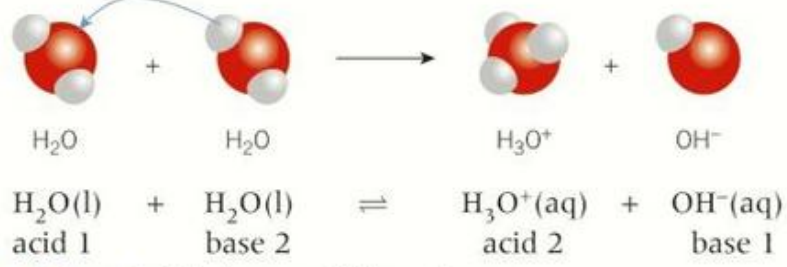
The equilibrium can be represented simply as:
Understanding the ionic product of water ()
Water acts as a weak acid in this equilibrium, so we can write an equilibrium expression. Since the concentration of water remains essentially constant (approximately 55.6 mol dm⁻³), we can incorporate this into the equilibrium constant:
This gives us the ionic product of water, :
The value of at 298 K (25°C) is:
Important
Key points about :
- It is an equilibrium constant, so it varies with temperature
- At 25°C, the value is exactly mol² dm⁻⁶
- This value controls the concentrations of H⁺(aq) and OH⁻(aq) ions in all aqueous solutions
- The product [H⁺(aq)][OH⁻(aq)] always equals in any aqueous solution
The pH of pure water at 25°C
When water dissociates, it produces equal amounts of H⁺(aq) and OH⁻(aq) ions, making it neutral:
Using the expression for :
Therefore:
Note
This explains why neutral solutions have a pH of 7 at 25°C. This value is temperature-dependent, so at different temperatures, the neutral pH will be slightly different.
The relationship between H⁺ and OH⁻ in solutions
In any aqueous solution, both H⁺(aq) and OH⁻(aq) ions will always be present, and their concentrations are linked by :
This relationship allows us to classify solutions:
- Acidic solution: - more H⁺ ions than OH⁻ ions
- Neutral solution: - equal concentrations
- Alkaline solution: - more OH⁻ ions than H⁺ ions
Important
Even an acidic solution still contains OH⁻(aq) ions, just in lower concentration than H⁺(aq) ions. Similarly, alkaline solutions still contain H⁺(aq) ions. The value at 25°C ensures the concentrations of both ions are always controlled - when one increases, the other must decrease.
Worked example: Calculating [H⁺(aq)] and [OH⁻(aq)] in aqueous solutions
Example
Worked Example: Finding Ion Concentrations from pH
Question: What are the concentrations of H⁺(aq) and OH⁻(aq) ions in a solution with a pH of 3.25 at 25°C?
Step 1: Use your calculator to find [H⁺(aq)]:
Step 2: Calculate [OH⁻(aq)] from and [H⁺(aq)]:
Notice how in this acidic solution, the OH⁻ concentration is very small but not zero.
Calculating the pH of strong bases
A strong base is an alkali (soluble base) that completely dissociates in aqueous solution to release OH⁻ ions. The most common example is sodium hydroxide, NaOH.
Complete dissociation of strong bases
When NaOH dissolves in water, it dissociates completely:
Since NaOH is a monobasic base, each mole of NaOH releases exactly one mole of OH⁻(aq) ions. This means:
Important
Important note about dibasic bases: Some bases like calcium hydroxide, Ca(OH)₂, are dibasic - each mole releases two moles of OH⁻ ions:
Therefore:
This is a common source of errors - always check whether your base is monobasic or dibasic!
Calculation method for pH of strong bases
To calculate the pH of a strong base solution:
- Convert the concentration of the base into [OH⁻(aq)]
- Use and [OH⁻(aq)] to find [H⁺(aq)]
- Use your calculator to find pH from [H⁺(aq)]
Note
This three-step method is systematic and reliable. Master this approach and you'll be able to tackle any strong base pH calculation confidently.
Worked example: Calculating the pH of a strong base solution
Example
Worked Example: pH of a Strong Base Solution
Question: A solution of NaOH has a concentration of 0.0750 mol dm⁻³. What is the pH at 25°C?
Step 1: Convert [NaOH(aq)] into [OH⁻(aq)]:
NaOH is a strong monobasic alkali and completely dissociates.
Step 2: Use and [OH⁻(aq)] to find [H⁺(aq)]:
Step 3: Use your calculator to find pH:
Note how the pH is well above 7, confirming this is an alkaline solution.
Another worked example with a different approach
Example
Worked Example: pH from Hydroxide Ion Concentration
Question: What is the pH of a solution with [OH⁻(aq)] = 2.00 × 10⁻² mol dm⁻³ at 25°C?
Step 1: Calculate [H⁺(aq)] from and [OH⁻(aq)]:
Step 2: Use your calculator to find pH:
The pOH scale - an alternative method
What is pOH?
Just as pH is a convenient way of expressing H⁺ concentration, pOH provides a similar scale for OH⁻ concentrations:
The pOH scale has a similar range to pH, but it is centred at the neutral point where [H⁺(aq)] and [OH⁻(aq)] are both equal to mol dm⁻³. At 25°C, the pH and pOH scales are related by:

Note
This relationship comes directly from the expression and provides an alternative method for calculating the pH of strong alkalis. Some students find this approach more intuitive when working directly with OH⁻ concentrations.
Using pOH for pH calculations
Example
Worked Example: Using pOH to Find pH
Question: What is the pH of a solution with [OH⁻(aq)] = 4.50 × 10⁻³ mol dm⁻³ at 25°C?
Step 1: Calculate pOH from [OH⁻(aq)]:
Step 2: Calculate pH using pH + pOH = 14:
This method is particularly useful when working directly with OH⁻ concentrations in strong base calculations.
Exam tips and common mistakes
Important
Exam tips:
- Always check whether a base is monobasic or dibasic
- For monobasic bases: [OH⁻] = [base concentration]
- For dibasic bases: [OH⁻] = 2 × [base concentration]
- is the key to working out [H⁺(aq)] and [OH⁻(aq)] in any aqueous solution
- Remember that varies with temperature - always use the correct value
- Check your pH answer is sensible (strong bases should give pH > 7)
- Use your calculator correctly with logarithms and powers of 10
Common mistakes to avoid:
- Forgetting to double [OH⁻] for dibasic bases
- Using the wrong value of at different temperatures
- Confusing pH and pOH values
- Rounding too early in calculations - keep full calculator precision until the final answer
- Forgetting that even alkaline solutions contain H⁺ ions (just in very low concentration)
Remember!
Summary
Key Points to Remember:
-
is the ionic product of water: mol² dm⁻⁶ at 25°C
-
Strong bases completely dissociate in solution, so [OH⁻] equals the base concentration (for monobasic bases)
-
To calculate pH of strong bases: Find [OH⁻], use to find [H⁺], then calculate pH = -log[H⁺]
-
pH + pOH = 14 at 25°C - this provides an alternative calculation route
-
In any aqueous solution, both H⁺ and OH⁻ ions are present, with their concentrations always controlled by