Buffer Solutions in the Body (OCR A-Level Chemistry A): Revision Notes
📚Revision Notes
Buffer solutions in the body
Introduction to pH control in the body
Living organisms contain buffer solutions throughout their biological systems to maintain essential pH levels. Human health depends critically on precise pH control, as different parts of the body require specific pH values to function effectively.
Note
Enzymes are particularly sensitive to pH changes, with each enzyme having an optimal pH at which it works best. Even small deviations from this optimal pH can significantly reduce enzyme activity, affecting vital biological processes.
This pH control is achieved through various buffer systems, particularly in the blood plasma.

Blood plasma pH range
Blood plasma must be maintained within a narrow pH range of 7.35 to 7.45 for proper bodily function. The normal, healthy blood pH is 7.40. This tight control is achieved primarily through a mixture of buffers, with the carbonic acid-hydrogencarbonate buffer system being the most significant.
Understanding pH sensitivity
Important
The pH Scale is Highly Sensitive
A difference of just 0.30 pH units represents a two-fold change in concentration. This means that although the range 7.10 to 7.70 (which is ) might not seem very different from the healthy blood pH of 7.40, the difference in acidity or alkalinity is actually very large in chemical terms.
Consequences of pH imbalance
When blood pH deviates from the normal range, serious medical conditions can develop:
Important
Acidosis occurs when pH falls below 7.35. This condition can cause:
- Extreme fatigue
- Shortness of breath
- In severe cases, shock or death
Alkalosis occurs when pH rises above 7.45. This condition can cause:
- Muscle spasms
- Light-headedness
- Nausea
The carbonic acid-hydrogencarbonate buffer system
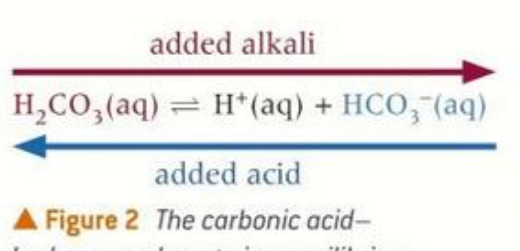
The primary buffer system controlling blood pH involves carbonic acid () and its conjugate base, the hydrogencarbonate ion (). This system operates according to the following equilibrium:
This buffer system functions similarly to other weak acid-conjugate base buffers, but plays a critical role in maintaining life.
Response to added acid
When acid is added to blood, increasing the concentration of ions, the buffer system responds in three steps:
- The concentration of increases
- The ions react with the conjugate base,
- The equilibrium position shifts to the left, removing most of the added ions
Response to added alkali
When alkali is added to blood in the form of ions, the buffer system responds differently:
- The concentration of increases
- The small existing concentration of ions reacts with the ions to form water:
- The carbonic acid dissociates to restore ions, shifting the equilibrium position to the right
Note
Understanding Le Chatelier's Principle in Action
This buffer system is a perfect example of Le Chatelier's principle at work:
- Adding acid → equilibrium shifts LEFT to remove excess H⁺
- Adding alkali → equilibrium shifts RIGHT to restore H⁺
Calculating the buffer concentration ratio in healthy blood
We can calculate the exact ratio of hydrogencarbonate ions to carbonic acid molecules in healthy blood using equilibrium principles and the Henderson-Hasselbalch equation.
Example
Worked Example: Concentration Ratio at pH 7.40
The for the carbonic acid-hydrogencarbonate equilibrium is 6.1 at body temperature. Let's determine the ratio of to in healthy blood at pH 7.40.
Step 1: Express the ratio in terms of and
Starting with the equilibrium equation:
The acid dissociation constant is:
Rearranging to find the ratio:
Step 2: Convert pH into and into
Step 3: Calculate the ratio
Result: In healthy blood, there are 20 hydrogencarbonate ions for every 1 carbonic acid molecule. This ratio is crucial for maintaining the correct blood pH.
How the body manages carbonic acid levels
The human body continuously produces more acidic materials than alkaline materials through normal metabolic processes. The hydrogencarbonate ions in the buffer system convert these acidic materials to carbonic acid. However, if carbonic acid were allowed to accumulate, it would eventually overwhelm the buffer system.
Note
The Body's Clever Solution
To prevent carbonic acid buildup, the body has a clever mechanism: carbonic acid is converted to carbon dioxide gas, which is then expelled from the body through the lungs during breathing. This process ensures that the buffer system can continue to function effectively.
The Henderson-Hasselbalch equation
An alternative method for calculating the pH of buffer solutions uses the Henderson-Hasselbalch equation. This equation provides a direct relationship between pH, , and the concentration ratio of conjugate base to weak acid:
Where:
- is the concentration of the conjugate base
- is the concentration of the weak acid
This equation makes it easy to see how the base/acid concentration ratio controls the pH.
When acid and base concentrations are equal
Note
When the concentrations of acid and conjugate base are the same:
Therefore: pH = pKₐ
This shows that when a buffer contains equal amounts of weak acid and conjugate base, its pH equals the of the weak acid.
Example calculation using Henderson-Hasselbalch equation
Example
Worked Example: Calculating Buffer pH
For a buffer solution containing 0.100 mol dm CHCOOH ( = 4.76) and 0.300 mol dm CHCOONa:
Although this equation may appear more complex initially, the calculation is often simpler than using the standard equilibrium expression method, especially when you need to find pH directly from concentrations.
Remember!
Summary
Key Points to Remember:
-
Blood plasma pH must be maintained between 7.35 and 7.45, with normal healthy blood at pH 7.40
-
The carbonic acid-hydrogencarbonate buffer system is the primary pH control mechanism in blood, involving the equilibrium:
-
Acidosis (pH < 7.35) and alkalosis (pH > 7.45) cause serious medical conditions with potentially fatal consequences
-
In healthy blood, the ratio of to is 20:1, calculated using at body temperature
-
The body prevents carbonic acid buildup by converting it to carbon dioxide gas, which is exhaled through the lungs
-
The Henderson-Hasselbalch equation provides an alternative calculation method:
Exam Focus Checklist:
-
Be able to write the equilibrium equation for the carbonic acid-hydrogencarbonate buffer system
-
Explain how this buffer responds to added acids and bases using Le Chatelier's principle
-
Calculate the concentration ratio of buffer components using either the standard expression or the Henderson-Hasselbalch equation
-
Know the normal blood pH range and the medical terms for pH imbalances
-
Understand why a small pH change represents a large change in hydrogen ion concentration
-
Explain how the body removes excess carbonic acid through conversion to carbon dioxide