Enthalpy and Entropy (OCR A-Level Chemistry A): Revision Notes
📚Revision Notes
Free energy
Understanding free energy and reaction feasibility
When studying chemical reactions, you may wonder why some reactions occur readily whilst others don't happen at all, even though they might seem energetically favourable. The concept of free energy helps us understand and predict whether a reaction is thermodynamically feasible - that is, whether it can happen from an energy perspective.
The free energy change (symbol: ) represents the overall energy change during a chemical reaction. This single value combines two important energy factors that determine whether a reaction can proceed. The term feasibility describes whether a reaction is energetically able to occur, and the word spontaneous is often used interchangeably to describe reactions that are thermodynamically feasible.
Note
Free energy is particularly useful because it considers both the energy exchange with surroundings and the energy dispersal within the system itself. Unlike simply looking at enthalpy changes alone, free energy gives us a complete thermodynamic picture of reaction feasibility.
The Gibbs equation
The relationship between free energy and its component parts is expressed through the Gibbs equation, named after scientist Josiah Willard Gibbs. This fundamental equation shows how free energy depends on two distinct types of energy change:
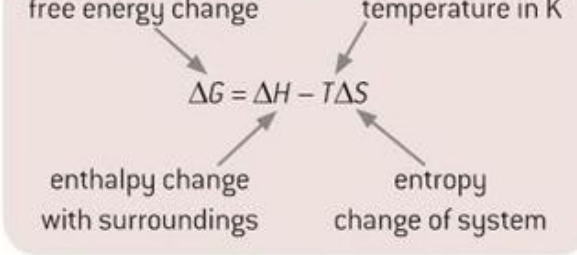
The Gibbs equation is:
Let's examine what each term represents:
- is the free energy change (measured in kJ mol⁻¹). This tells us whether a reaction is feasible
- is the enthalpy change (measured in kJ mol⁻¹). This represents heat transfer between the chemical system and its surroundings
- is the absolute temperature (measured in Kelvin, K). Temperature must always be in Kelvin for this equation
- is the entropy change of the system (measured in J K⁻¹ mol⁻¹). This represents the dispersal of energy within the system itself
Important
The Gibbs equation is crucial for A-Level chemistry and you should memorise it thoroughly. Notice how it subtracts the temperature-entropy term () from the enthalpy term, showing that these two factors compete to determine the overall free energy change.
The condition for reaction feasibility
The Gibbs equation allows us to predict whether a chemical reaction can occur by calculating the free energy change. The fundamental rule for thermodynamic feasibility is straightforward:
Important
For a reaction to be feasible, the free energy change must be negative:
When is negative, the products have lower overall energy than the reactants, and the reaction can proceed. Conversely, when is positive (), the reaction is not feasible under those conditions.
Important considerations about units
A crucial aspect of using the Gibbs equation is ensuring your units are consistent. Notice that values are typically given in kJ mol⁻¹, whilst values are usually given in J K⁻¹ mol⁻¹. These must be matched before calculation.
Note
To convert from J K⁻¹ mol⁻¹ to kJ K⁻¹ mol⁻¹, divide by 1000.
For example, if J K⁻¹ mol⁻¹, then:
Similarly, temperature must be in Kelvin, not Celsius. To convert:
For instance, 25°C = 298 K.
Important
Common exam mistake: Mixing units is one of the most frequent errors in free energy calculations. Always check that and have compatible units before substituting into the Gibbs equation. Your calculated will have units of kJ mol⁻¹.
Worked example: calculating free energy change
Example
Worked Example: Calculating Free Energy Change for Combustion
Let's consider the combustion of carbon to form carbon dioxide:
Given: kJ mol⁻¹ and J K⁻¹ mol⁻¹
At 25°C (298 K), we can calculate :
Step 1: Convert to kJ K⁻¹ mol⁻¹:
Step 2: Apply the Gibbs equation:
Since , this reaction is feasible at 25°C.
Notice that for many reactions at room temperature, has a much larger magnitude than , meaning the enthalpy term often dominates the calculation. However, as we'll see, this balance changes significantly with temperature.
How temperature affects feasibility
Temperature plays a crucial role in determining reaction feasibility because it directly multiplies the entropy term in the Gibbs equation. As temperature increases, the term becomes larger and more significant, potentially changing whether a reaction is feasible or not.
The balance between enthalpy and entropy
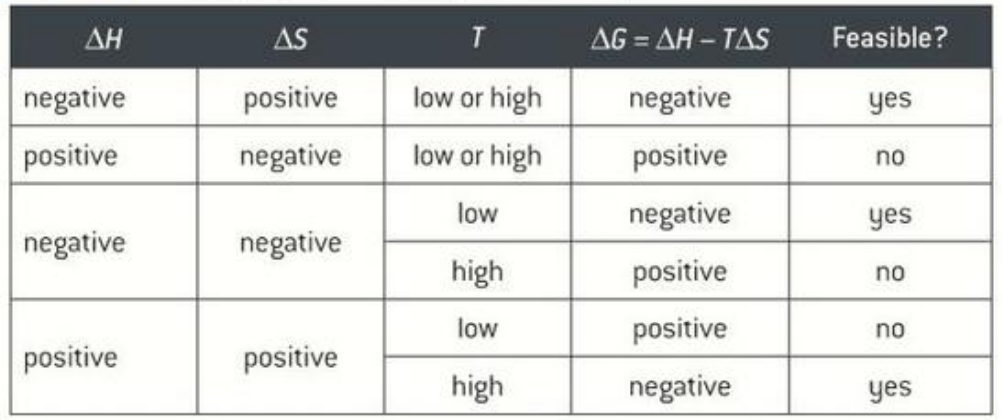
The feasibility of a reaction depends on the interplay between the enthalpy change () and the entropy change (). Different combinations of positive and negative values for these terms lead to different feasibility outcomes, and temperature determines which term dominates.
Note
Let's analyse each scenario:
1. Exothermic reactions with increasing entropy ( negative, positive)
When both terms favour feasibility, the reaction is feasible at all temperatures. The negative contributes a negative value, whilst the term (with positive ) becomes more negative as temperature increases. These are always feasible reactions.
2. Endothermic reactions with decreasing entropy ( positive, negative)
Both terms work against feasibility. The positive and the term (with negative becoming less negative) both contribute positive values to . These reactions are never thermodynamically feasible at any temperature.
3. Exothermic reactions with decreasing entropy ( negative, negative)
Here the terms compete. At low temperatures, the negative dominates and is negative (feasible). At high temperatures, the term becomes large and positive, making positive (not feasible). These reactions are only feasible at lower temperatures.
4. Endothermic reactions with increasing entropy ( positive, positive)
The terms compete in the opposite direction. At low temperatures, the positive dominates and is positive (not feasible). At high temperatures, the term becomes large and negative, making negative (feasible). These reactions require high temperatures to be feasible.
Important
Exam tip: The key insight is that temperature increases the significance of the entropy term because is multiplied by in the Gibbs equation. This is why many industrial processes operate at high temperatures - to make endothermic reactions with positive entropy changes feasible.
Worked example: calcium carbonate decomposition at different temperatures
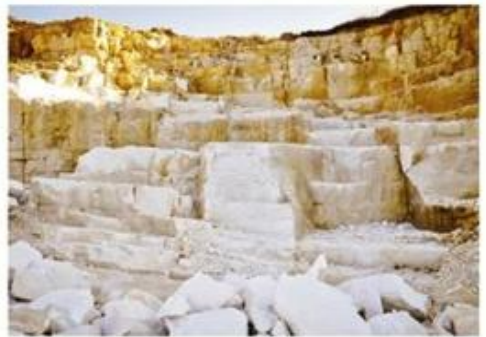
The thermal decomposition of limestone (calcium carbonate) demonstrates how temperature affects feasibility. This is an important industrial process for producing quicklime (calcium oxide) used in cement manufacture.
Example
Worked Example: Temperature Effect on Limestone Decomposition
The decomposition reaction is:
Given data: kJ mol⁻¹ and J K⁻¹ mol⁻¹
This is an endothermic reaction (positive ) with increasing entropy (positive ) because a solid decomposes to produce a gas, increasing disorder. Let's determine if it's feasible at 25°C and at 1000°C.
At 25°C (298 K):
First, make units consistent:
Apply the Gibbs equation:
Since , the reaction is not feasible at 25°C. Limestone doesn't decompose at room temperature.
At 1000°C (1273 K):
Convert temperature:
The entropy conversion remains the same: kJ K⁻¹ mol⁻¹
Calculate :
Since , the reaction is feasible at 1000°C.
Interpretation: At low temperatures, the positive enthalpy term dominates and the reaction cannot occur. However, at high temperatures (above approximately 883°C), the large term overcomes the enthalpy barrier, making the reaction feasible. This is why limestone must be heated in a furnace or lime kiln to produce calcium oxide industrially. The high temperature provides the energy needed and makes the process thermodynamically favourable.
Calculating minimum temperatures for feasibility

For reactions that are only feasible above a certain temperature (endothermic with positive entropy change), we can calculate the exact minimum temperature required for feasibility. This is the temperature at which the reaction switches from being non-feasible to feasible.
At the minimum temperature for feasibility, the free energy change equals zero:
Substituting into the Gibbs equation:
Rearranging to solve for temperature:
This formula allows you to find the threshold temperature. Above this temperature, becomes negative and the reaction is feasible. Below it, is positive and the reaction cannot occur thermodynamically.
Important
Remember to use consistent units (both in kJ) and keep temperature in Kelvin. You'll need to convert the final answer to °C by subtracting 273.
Worked example: minimum temperature for aluminium extraction
Example
Worked Example: Minimum Temperature for Aluminium Extraction by Carbon Reduction
Consider the reduction of aluminium oxide by carbon, which could theoretically be used to extract aluminium metal:

This reaction involves using carbon to remove oxygen from aluminium oxide. Let's determine if this is a realistic extraction method.
Step 1: Calculate for the reaction
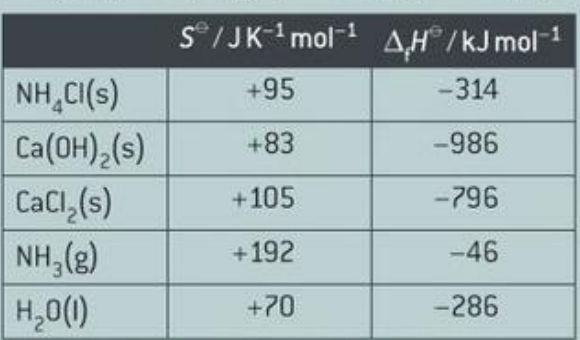
Using standard entropies:
Step 2: Calculate for the reaction
Using standard enthalpies of formation (elements in their standard states have ):
Step 3: Check feasibility at 25°C
Convert units: kJ K⁻¹ mol⁻¹ and K
The reaction is not feasible at room temperature (strongly positive ).
Step 4: Calculate minimum temperature
At the minimum temperature, :
Converting to Celsius:
Interpretation: The reduction of aluminium oxide by carbon requires a temperature above 2039°C to be thermodynamically feasible. This extremely high temperature makes carbon reduction impractical for aluminium extraction because:
- It would require enormous energy input
- Equipment to sustain such temperatures would be extremely expensive
- The process would be difficult to control safely
This explains why aluminium is extracted by electrolysis of molten aluminium oxide rather than by carbon reduction, even though electrolysis is energy-intensive. The thermodynamic constraints make carbon reduction simply not viable.
Endothermic reactions at room temperature

You might wonder how some endothermic processes can occur at room temperature if they require energy input. The answer lies in the entropy term of the Gibbs equation. When an endothermic process has a sufficiently large positive entropy change, it can still be feasible at 25°C because the term makes negative overall.
Example
Worked Example: Dissolution of Potassium Chloride
Consider the dissolving of potassium chloride in water:
Given: kJ mol⁻¹ (endothermic)
Standard entropies: J K⁻¹ mol⁻¹, J K⁻¹ mol⁻¹, J K⁻¹ mol⁻¹
Step 1: Calculate the entropy change at 25°C
Step 2: Calculate free energy change
Temperature: K
Convert entropy: kJ K⁻¹ mol⁻¹
Since , the process is feasible at 25°C.
Explanation: Even though dissolving potassium chloride absorbs heat from the surroundings (making the solution feel cold), the process still occurs spontaneously at room temperature. This is because the dissolution significantly increases entropy - the ordered ionic lattice breaks down into freely moving ions dispersed throughout the water. The large positive entropy change, when multiplied by temperature, produces a term that exceeds the endothermic enthalpy change. The result is a negative free energy change, making the process feasible.
Note
This illustrates an important principle: endothermic processes with large entropy increases can be spontaneous at room temperature because the system's drive towards greater disorder overcomes the energy requirement.
Limitations of free energy predictions
Whilst free energy calculations are extremely useful for predicting thermodynamic feasibility, they have important limitations that you must understand. The Gibbs equation tells us whether a reaction can occur from an energy standpoint, but it doesn't tell us whether the reaction will occur at an observable rate.
Kinetics versus thermodynamics
Free energy is a thermodynamic quantity - it deals with energy changes and equilibrium states. However, it provides no information about the rate of reaction or the mechanism by which it proceeds. This is the realm of chemical kinetics.
Important
Some reactions have negative values (thermodynamically feasible) but don't appear to occur because they have very high activation energies. The activation energy is the minimum energy required for reactant molecules to reach the transition state and form products. Even if products are energetically more stable than reactants (negative ), a large activation energy barrier can prevent the reaction from proceeding at any measurable rate.
Example: decomposition of hydrogen peroxide
Consider the decomposition of hydrogen peroxide:
At 25°C, this reaction has kJ mol⁻¹ (strongly negative), indicating it should be very feasible. However, a bottle of hydrogen peroxide can remain stable for months at room temperature without significant decomposition. Why?
Note
The answer is that the reaction has a very high activation energy, resulting in an extremely slow rate at room temperature. The activation energy creates a kinetic barrier that prevents the thermodynamically favourable reaction from occurring.
If hydrogen peroxide is left for long enough, it will gradually decompose. The reaction does eventually take place, but at such a slow rate that it's barely noticeable. However, if a catalyst such as manganese(IV) oxide (MnO₂) is added, the reaction occurs rapidly. The catalyst provides an alternative reaction pathway with a much lower activation energy, allowing the reaction to proceed quickly via a different mechanism. The thermodynamic feasibility () hasn't changed - only the kinetic route has been altered.
Important
Key distinction: The sign of indicates thermodynamic feasibility (whether a reaction can happen in principle), but it takes no account of kinetics or reaction rate. A negative is a necessary but not sufficient condition for a reaction to occur observably. You also need a reasonable activation energy for the reaction to proceed at a useful rate.
Example: diamond and graphite
An interesting case involves the allotropes of carbon. Diamond and graphite are both forms of pure carbon with different structures. The conversion of diamond to graphite has a negative free energy change:
According to thermodynamics, diamonds should spontaneously convert to graphite! However, diamonds remain stable for millions of years.
Note
The explanation is that the activation energy for breaking the strong covalent bonds in diamond's tetrahedral structure and rearranging them into graphite's layered structure is enormous. At room temperature, there is insufficient energy for this rearrangement to occur at any measurable rate. Diamonds are therefore described as kinetically stable but thermodynamically unstable relative to graphite.
This demonstrates that thermodynamic feasibility and observable reaction occurrence are different concepts. When answering exam questions, always consider whether the question asks about thermodynamic feasibility (based on ) or about whether a reaction actually occurs at a measurable rate (which also requires kinetic information).
Important
Exam tip: Common exam questions test your understanding of the difference between thermodynamics and kinetics. Be prepared to explain that:
- Negative means a reaction is thermodynamically feasible
- Feasibility doesn't guarantee the reaction will occur at a noticeable rate
- Activation energy and catalysts affect reaction rate but not
- Some feasible reactions don't occur because of high activation energy barriers
Remember!
Summary
Key Points to Remember:
-
Free energy change () determines whether a reaction is thermodynamically feasible: reactions are feasible when
-
The Gibbs equation links free energy to enthalpy and entropy: , where must be in Kelvin
-
Unit consistency is crucial: always convert from J K⁻¹ mol⁻¹ to kJ K⁻¹ mol⁻¹ by dividing by 1000 before calculations
-
Temperature affects feasibility significantly: at low temperatures, dominates; at high temperatures, the term becomes more important, potentially changing whether reactions are feasible
-
Minimum temperature for feasibility occurs when , giving (this applies to endothermic reactions with positive entropy changes)
-
Free energy predicts thermodynamic feasibility but not reaction rate: even when , reactions may not occur observably if they have high activation energies - this is the difference between thermodynamic feasibility and kinetic feasibility