Entropy (OCR A-Level Chemistry A): Revision Notes
📚Revision Notes
Entropy
What is entropy?
Entropy is a fundamental concept in thermodynamics that helps us understand why certain processes happen spontaneously in nature. The symbol for entropy is .
Entropy is a measure of how dispersed energy is within a chemical system, and it also represents the degree of disorder in that system. The key idea is that energy naturally tends to spread out rather than stay concentrated in one place.
Note
Natural Processes and Energy Dispersal
Examples of processes that involve increasing entropy include:
- A gas dispersing throughout a room
- Heat spreading from a fire through a room
- Ice melting in a warm environment
In all these situations, energy becomes more spread out and the particles become more randomly arranged. This natural tendency for energy to disperse is what drives many spontaneous changes.
The relationship between entropy and disorder:
- The greater the entropy value, the more dispersed the energy
- The greater the entropy value, the greater the disorder in the system
- Higher entropy means particles are arranged more randomly
Units of entropy: Entropy is measured in joules per kelvin per mole:
The higher the entropy value, the more energy is spread out per kelvin per mole of substance.
Entropy and states of matter
In general, there is a clear trend in entropy values across the three states of matter:
- Solids have the smallest entropies
- Liquids have greater entropies than solids
- Gases have the greatest entropies
This trend exists because:
- In solids, particles are held in fixed positions with limited movement - low disorder
- In liquids, particles can move past each other - moderate disorder
- In gases, particles are completely free to move randomly - high disorder
Important
Important Caveat About Entropy Trends
These are general rules only. Individual substances in different states can have very different entropy values depending on their structure and bonding. You cannot assume that every gas has a higher entropy than every liquid.
Predicting entropy changes
Understanding how entropy changes in chemical and physical processes is crucial for predicting whether reactions will occur spontaneously.
Entropy at absolute zero: At (absolute zero), there would be no thermal energy available and all substances would have an entropy value of zero. This is the only situation where entropy equals zero.
Above , energy becomes dispersed among the particles, and all substances have positive entropy values.
Systems and disorder: Systems that are more disordered have higher entropy values. When analyzing changes:
Note
Positive entropy change ():
- If a system becomes more random, energy can spread out more
- The entropy change will be positive
- The disorder increases
Negative entropy change ():
- If a system becomes less random, energy becomes more concentrated
- The entropy change will be negative
- The disorder decreases
Predicting entropy changes from equations: You can predict whether entropy increases or decreases in a physical or chemical change by comparing the physical states and the number of gas molecules on either side of an equation.
Changes of state
Entropy increases significantly during phase transitions that create more random arrangements of particles:
When any substance changes state from solid to liquid to gas, its entropy increases because:
- Melting and boiling increase the randomness of particles
- Energy becomes more spread out
- The entropy change is positive
Example
Worked Example: Water Phase Transitions
The table below shows the entropy values for water in its three states and the entropy changes during phase transitions:
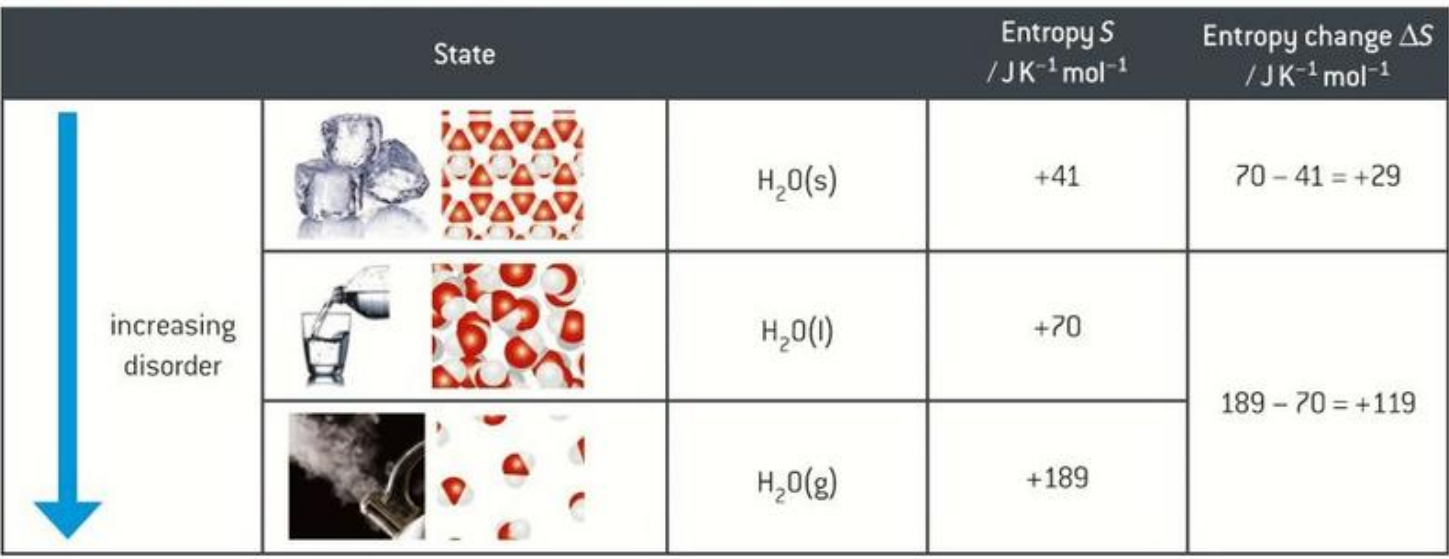
Key observations:
- Ice () has the lowest entropy:
- Liquid water () has intermediate entropy:
- Water vapor () has the highest entropy:
Calculating entropy changes:
The entropy change for melting is:
The entropy change for vaporization is much larger:
Conclusion: This shows that vaporization creates a much larger increase in disorder than melting.
Change in the number of gaseous molecules
Reactions that change the number of gas molecules present have significant effects on entropy because gases have very high entropy compared to solids and liquids.
Reactions producing gases: When reactions produce gas molecules, entropy increases. For example, calcium carbonate reacting with hydrochloric acid:
- Production of carbon dioxide gas increases the disorder of particles
- Energy spreads out more
- is positive
Reactions consuming gases: You can predict the sign of entropy change for reactions where reactants and products have different numbers of gas molecules.
Note
Example: Ammonia Synthesis
The reaction of nitrogen and hydrogen to produce ammonia results in a decrease in the number of gas molecules:
This can be viewed as:
Analysis:
- There is a decrease in the randomness of particles
- Energy becomes more concentrated
- is negative
Standard entropies
To perform calculations involving entropy changes, we use tabulated standard entropy values.
Definition: Every substance has a standard entropy , which is the entropy of one mole of a substance under standard conditions.
Standard conditions are:
- Pressure:
- Temperature: ()
Important
Properties of Standard Entropies
- Standard entropies have units of
- Standard entropies are always positive (unlike standard enthalpies of formation, which can be negative)
Standard entropy values can be found in data books and are essential for calculating entropy changes in reactions.
Example standard entropy values:
Some standard entropy values for common substances are shown in the tables below:
| Substance | / |
|---|---|
| Substance | / |
|---|---|
Note
Observations from the Data
Notice that:
- All values are positive
- Gaseous substances generally have higher values than liquids
- Liquid has a notably lower entropy () than gaseous substances ( range)
Calculating entropy changes
Standard entropies allow us to calculate the entropy change for a reaction, , using a formula similar to that used for enthalpy changes.
Formula:
where means "sum of"
This is analogous to Hess's law calculations - we sum all the standard entropies of products and subtract the sum of all standard entropies of reactants.
Example
Worked Example: Calculating an Entropy Change of Reaction
Question: Calculate the entropy change of reaction for the following:
Given data:
| Substance | / |
|---|---|
Step 1: Link the standard entropies with the equation
Write the formula and identify which values to use:
Note: We must multiply by the stoichiometric coefficients from the balanced equation.
Step 2: Calculate
Substitute the values:
Interpretation: The final entropy change is negative. This makes sense because 3 moles of gas molecules (2 NO + 1 O₂) are forming 2 moles of gas molecules (2 NO₂), representing a decrease in disorder.
Important
Common Mistakes to Avoid
- Forgetting to multiply standard entropy values by stoichiometric coefficients
- Getting products and reactants the wrong way round in the formula
- Using incorrect units (entropy is , not )
- Expecting negative standard entropy values - remember, values are always positive, but can be negative
Summary
Key Points to Remember:
Fundamental Concepts:
- Entropy () measures energy dispersal and disorder in a system, with units
- Greater entropy means greater energy dispersal and greater disorder
- General trend: gases have the highest entropy, then liquids, then solids (though exceptions exist)
Entropy Values:
- All substances have positive entropy above
- Standard entropies () are always positive
Predicting Entropy Changes:
- Positive : system becomes more disordered (favorable)
- Negative : system becomes more ordered
- Phase changes solid → liquid → gas always increase entropy
- Reactions producing more gas molecules have positive
- Reactions producing fewer gas molecules have negative
Calculations:
- Calculate entropy changes using:
- Standard conditions are and
Exam Focus Checklist:
- Be able to explain entropy in terms of energy dispersal and disorder
- Predict whether is positive or negative from physical states and gas molecule changes
- Recall that standard conditions are and
- Use standard entropy data tables correctly with stoichiometric coefficients
- Show all working in calculations with correct units throughout